17.3 Le serment d’allégeance (Bay’ah)
17.3 The Pledge (bay’ah)
Le serment d’allégeance (Bay’ah) est une obligation pour tous les musulmans, et c'est un droit pour chaque musulman, homme ou femme. La preuve de son caractère obligatoire se trouve dans de nombreux hadiths du Prophète ﷺ, dans lesquels il a dit :
Bay’ah is an obligation upon all Muslims, and it is a right for every Muslim, man or woman. The evidence for it being an obligation is in many ahadith of the Prophet (saw), in which he said:
« Quiconque meurt sans avoir un serment d’allégeance (Bay’ah) sur le cou meurt d'une mort d'ignorance préislamique (Jahiliyyah). »
“Whosoever dies without having a bay’ah upon his neck dies a death of jahiliyyah.”
Quant au fait que ce soit un droit pour les musulmans, la Bay’ah elle-même l'indique, car la Bay’ah est offerte par les musulmans au calife, et non par le calife aux musulmans. La Bay’ah des musulmans envers le Prophète ﷺ a été confirmée dans les hadiths. Al-Bukhari a rapporté qu'‘Ubadah bin as-Samit (qu'Allah l'agrée) a dit :
As for being a right for Muslims, the bay’ah itself indicates that, because the bay’ah is offered by the Muslims to the Khalifah, and not by the Khalifah to the Muslims. The bay’ah of the Muslims to the Prophet (saw) was confirmed in the ahadith. Al-Bukhari reported that ‘Ubadah bin as-Samit (ra) said:
« Nous avons prêté serment d’allégeance (Bay’ah) au Prophète ﷺ d'entendre et d'obéir, que ce qui nous plaise ou nous déplaise, et que nous ne contesterions pas l'ordre de ceux qui sont investis de l'autorité, que nous dirions la vérité où que nous soyons, et que nous ne craindrions le blâme de personne lorsque nous agissons ou parlons pour l'amour d'Allah. »
“We made a bay’ah to the Prophet (saw) to hear and to obey in whatever pleases and displeases us, and that we would not dispute the order of those in charge, that we would speak the truth wherever we are, and that we would not fear the blame of anyone when acting or speaking for the sake of Allah.”
Al-Bukhari a rapporté d'Ayyub, d'après Hafsa, d'après Umm ‘Atiyyah qui a dit :
Al-Bukhari reported from Ayyub from Hafsa from Umm ‘Atiyyah who said:
« Nous avons prêté serment d’allégeance (Bay’ah) au Prophète ﷺ et il m'a récité le verset : {Ils n'associeront rien à l'adoration d'Allah} (TMQ 60.12). Et il nous a également interdit de gémir et de déplorer la mort des défunts. Une femme parmi nous a tendu la main et a dit : "Une telle femme a pleuré sur un mort appartenant à ma famille et je veux la dédommager pour ces pleurs". Le Prophète ﷺ n'a rien dit en réponse, puis elle est partie et est revenue. »
“We gave a bay’ah to the Prophet (saw) and he recited to me the verse That they will not associate anything in worship with Allah (TMQ 60.12). And he also prevented us from wailing and lamenting over the dead. A woman from us held her hand out and said, "Such-and-such a woman cried over a dead person belonging to my family and I want to compensate her for that crying" The Prophet did not say anything in reply and she left and returned.”
Et dans Al-Bukhari, d'après Abu Hurairah (ra) qui a dit : Le Prophète ﷺ a dit :
And in Al-Bukhari from Abu Hurairah (ra) who said: The Prophet (saw) said:
« (Il y aura) trois personnes à qui Allah ne parlera pas au Jour de la Résurrection, et qu'Il ne purifiera pas, et pour elles il y aura un châtiment sévère : une personne qui possède un excédent d'eau sur la route et en empêche le voyageur ; une personne qui prête serment d’allégeance (Bay’ah) à un imam uniquement pour ses affaires mondaines, de sorte que si l'imam lui donne ce qu'il veut, il lui a tenu son serment d’allégeance (Bay’ah), sinon il ne le lui aurait pas tenu ; et une personne qui vend une marchandise à autrui après l'asr (la fin d'après-midi) et qui jure par Allah qu'on lui a proposé tel prix pour elle, alors que ce n'était pas le cas, et que la personne le croit et l'achète. »
“(There are) three persons to whom Allah will not talk on the Resurrection Day, nor purify them, and for them is a severe punishment: A person who has an excess of water on the road and prevents the wayfarer from it; a person who gives bay’ah to an Imam for his worldly affairs only, so if the Imam gave him that which he wants he fulfilled (the bay’ah) to him, otherwise he would not; and a person trading a commodity to another after asr (late afternoon) and he swore by Allah that he was offered so and so for it, although he was not, and the person believed him and bought it.”
Al-Bukhari a rapporté d'après ‘Abdullah bin ‘Umar (ra) qui a dit :
Al-Bukhari narrated from ‘Abdullah bin ‘Umar (ra) who said:
« Lorsque nous avons prêté serment d’allégeance (Bay’ah) au Prophète ﷺ pour entendre et obéir, il nous disait : "Dans la mesure de vos capacités" »
“When we gave a bay’ah to the Prophet (saw) to hear and obey, he would say to us: As much as you are capable of”
« Lorsque nous avons prêté le serment d’allégeance (Bay’ah) au Prophète ﷺ pour entendre et obéir, il nous disait : "Dans la mesure de vos capacités" »
“When we gave a bay’ah to the Prophet (saw) to hear and obey, he would say to us: As much as you are capable of”
« J'ai prêté serment d'allégeance (Bay’ah) au Prophète ﷺ pour entendre et obéir, et il m'a ordonné : autant que tu en es capable, et de donner de bons conseils à chaque musulman. »
“I gave bay’ah to the Prophet (saw) to hear and obey and he instructed me: As much as you are able, and to give good advice to every Muslim.”
Al-Bukhari a rapporté d'après Junada bin Abu Umayyah qui a dit :
Al-Bukhari narrated from Junada bin Abu Umayyah who said:
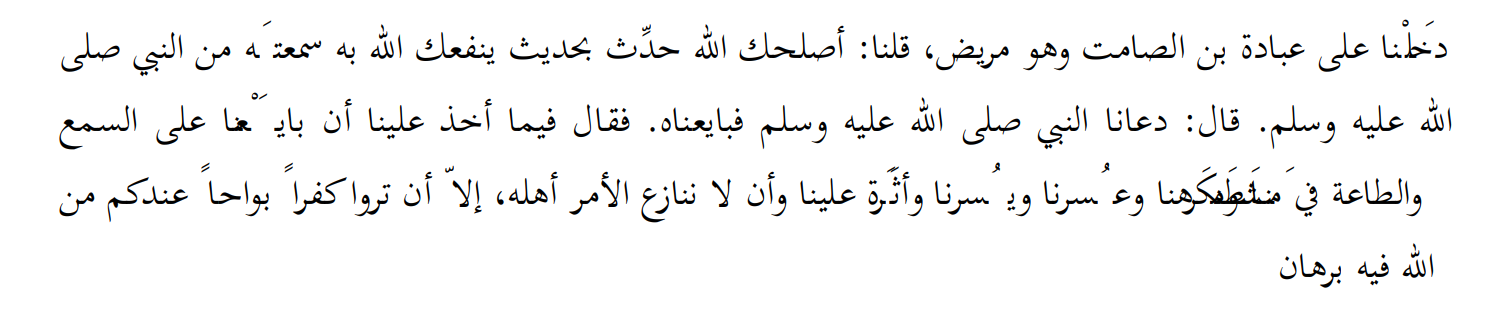
« Nous sommes entrés dans la maison de ‘Ubadah bin as-Samit alors qu'il était malade et nous avons dit : Qu'Allah vous accorde la santé, informez-nous d'un hadith que vous avez entendu du Prophète ﷺ par lequel Allah (SWT) pourrait vous faire bénéficier. Il dit : Le Prophète ﷺ nous a invités et nous lui avons donné notre serment d’allégeance (Bay’ah). Et parmi les conditions par lesquelles il a pris le serment d'allégeance auprès de nous, il y avait que nous devions écouter et obéir (aux ordres) tant lorsque nous étions actifs que lorsque nous étions fatigués, et dans les temps de facilité et de difficulté, et lorsque nous voyons une préférence (pour les autres sur nous], et de ne pas contester l'autorité de ceux à qui elle est confiée en disant : À moins que vous ne voyiez une mécréance (Kufr) flagrante sur laquelle vous avez une preuve claire d'Allah. »
“We entered the house of ‘Ubadah bin as-Samit while he was ill and we said: May Allah make you healthy, inform us of a hadith you heard from the Prophet (saw) by which Allah (swt) may benefit you. He said: The Prophet (saw) invited us and we gave him our bay’ah (pledge of Allegiance). And among the conditions on which he took the pledge from us, was that we were to listen and obey (the orders) both at the time when we were active and when we were tired , and in the times of ease and hardship and when we see preference (for others over us), and not to dispute the authority of those who are entrusted with it saying: Unless you see open disbelief (kufr bawah) upon which you have a clear proof from Allah.”
Le serment d’allégeance (Bay’ah) pour le calife est entre les mains des musulmans, et c'est leur droit ; ce sont eux qui donnent le serment d’allégeance (Bay’ah), et c'est leur serment d’allégeance (Bay’ah) qui rend le califat contractuel pour un calife. Le serment d’allégeance (Bay’ah) peut se faire par une poignée de main ou par écrit. ‘Abdullah bin Dinar a rapporté avoir dit :
The bay’ah for the Khalifah is in the hands of the Muslims, and it is their right; it is they who give the bay’ah, and it is their bay’ah which makes the Khilafah contracted for a Khalifah. The bay’ah can be by shaking hand or by writing. ‘Abdullah bin Dinar narrated saying:
« J'ai été témoin de bin ‘Umar alors que les gens se rassemblaient autour de ‘Abdulmalik bin Marwan. Il a écrit : J'accepte d'écouter et d'obéir au serviteur d'Allah, ‘Abdulmalik l'émir al-Mu’mineen, selon la sunna d'Allah et la sunna de Son Prophète ﷺ autant que je le peux. »
“I witnessed bin ‘Umar where the people gathered around ‘Abdulmalik bin Marwan. He wrote: I agree to listen and obey to the slave of Allah, ‘Abdulmalik the Amir al-Mu’mineen, according to the Sunnah of Allah and the Sunnah of His Prophet as much as I am able.”
De plus, le serment d’allégeance (Bay’ah) est correct par n'importe quel moyen (waseelah). Cependant, le serment d’allégeance (Bay’ah) doit être donné par une personne mature, il est donc inapproprié qu'il soit donné par un jeune. Abu Aqeel Zahra bin Ma‘bed a rapporté de son grand-père ‘Abdullah bin Hisham — qui a vu le Prophète ﷺ — que sa mère Zaynab, la fille de Hameed, l'a emmené auprès du Prophète ﷺ et a dit : Ô Prophète d'Allah, prends un serment d'allégeance (Bay’ah) de sa part. Le Prophète ﷺ a dit :
Moreover, the bay’ah is correct by any means (waseelah). However, the bay’ah has to be given by the mature person, so it is improper to be given by the young. Abu Aqeel Zahra bin Ma‘bed reported from his grandfather ‘Abdullah bin Hisham--who witnessed the Prophet (saw)--that his mother Zaynab, the daughter of Hameed, took him to the Prophet (saw) and said: O Prophet of Allah, take a pledge from him. The Prophet (saw) said:
« Il était un enfant, il lui a passé la main sur la tête et a fait une invocation (Du’a) pour lui. »
“He is a child, wiped his head and made a du‘a for him.”
Quant aux paroles du serment d’allégeance (Bay’ah), elles ne sont pas limitées à des termes spécifiques. Cependant, elles doivent inclure l'action conformément au Livre d'Allah (SWT) et à la sunna de Son Prophète ﷺ par le calife, ainsi que l'obéissance dans l'adversité et la facilité, et l'obéissance, ainsi que ce qui plaît et ce qui déplaît de la part de la personne qui prête le serment d’allégeance (Bay’ah) (au calife). Dès que celui qui s'engage a donné son serment d’allégeance (Bay’ah) au calife ou que le califat est conclu avec le calife par le serment d’allégeance (Bay’ah) d'autres musulmans, alors le serment d’allégeance (Bay’ah) devient un dépôt sur le cou de celui qui le donne et il ne lui est pas permis de le rétracter. C'est un droit pour le contrat du califat jusqu'à ce qu'il l'ait donné, et une fois qu'il l'a donné, il doit s'y conformer. Il ne lui est pas permis de s'en rétracter. Al-Bukhari a rapporté de Jabir bin ‘Abdullah (qu'Allah l'agrée) qu'un Bédouin a prêté serment d'allégeance au Prophète ﷺ sur l'Islam, puis une maladie l'a frappé et il dit au Prophète ﷺ : « Laisse-moi retirer mon serment d’allégeance (Bay’ah) », mais le Prophète ﷺ refusa, et l'homme partit. Le Prophète ﷺ dit alors :
As for the words of the bay’ah they are not restricted to specific terms. However they must include acting according to the Book of Allah (swt) and the Sunnah of His Prophet (saw) by the Khalifah, and obedience in hardship and ease and obedience, and whatever pleases and displeases on the part of the person who gives the bay’ah (to the Khalifah). Whenever the one who pledges has given his bay’ah to the Khalifah or the Khilafah is contracted to the Khalifah by the bay’ah of other Muslims, then the bay’ah has become a trust on the neck of the one who gives the bay’ah and he is not allowed to retract it. It is a right for the contract of the Khilafah until he has given it, and once he has given it he must abide by it. He is not allowed to retract from it. Al-Bukhari narrated from Jabir bin ‘Abdullah (ra) that a Bedouin gave the Prophet (saw) his pledge on Islam, and an illness struck him so he said to the Prophet (saw): “Let me withdraw my bay’ah but the Prophet (saw) refused, and the man left. The Prophet (saw) then said:
« Médine est comme un four, elle expulse les impuretés, sélectionne les bons et les rend parfaits. »
“Medina is like a furnace, it expels out the impurities and selects the good ones and makes them perfect.”
Et il est rapporté de Nafi‘a qui a dit : Ibn ‘Umar (qu'Allah l'agrée) m'a dit qu'il avait entendu le Prophète ﷺ dire :
And it is narrated from Nafi‘a who said: Ibn ‘Umar (ra) said to me that he heard the Prophet (saw) saying:
« Quiconque retirera sa main de l'obéissance (à l'émir) ne trouvera aucun argument (en sa défense) lorsqu'il se tiendra devant Allah au Jour de la Résurrection. »
“Whoever withdraws his hand from obedience (to the Amir) will find no argument (in his defense) when he stands before Allah on the Day of Resurrection.”
Rompre le serment d’allégeance (Bay’ah) du calife revient à retirer sa main de l'obéissance à Allah (SWT). Cela est le cas si son serment d’allégeance (Bay’ah) au calife est un serment d’allégeance (Bay’ah) de contrat ou s'il s'agit d'un serment d’allégeance (Bay’ah) d'obéissance à un calife que les musulmans ont accepté et à qui ils ont prêté leur serment d’allégeance (Bay’ah). Cependant, s'il a donné son serment d’allégeance (Bay’ah) au début à un calife et que celui-ci n'a pas été achevé parce que les musulmans dans leur ensemble ne l'ont pas accepté comme calife, alors il a le droit de se retirer de ce serment d’allégeance (Bay’ah). L'interdiction mentionnée dans le hadith se concentre sur le retrait d'un serment d’allégeance (Bay’ah) envers un calife, et non envers un homme pour qui le califat n'a pas été accompli.
To break the bay’ah of the Khalifah is withdrawing of one’s hand from the obedience of Allah (swt). This is the case if his bay’ah to the Khalifah is a bay’ah of contract or it is a bay’ah of obedience to a Khalifah whom the Muslims accepted and gave their bay’ah to. However, if he gave his bay’ah in the beginning to a Khalifah and it was not completed because the Muslims as a whole did not accept him as Khalifah, then he has the right to withdraw from that bay’ah. The prohibition mentioned in the hadith is focused on the withdrawal of a bay’ah to a Khalifah, not to a man for whom the Khilafah was not accomplished