17.8 La méthode pour nommer le calife
17.8 The Method To Appoint The Khalifah
Lorsque la charia (Shari’ah) a rendu obligatoire pour la communauté (Ummah) la nomination d'un calife (Khalifah), elle a également défini la méthode par laquelle le calife (Khalifah) est nommé. Cette méthode est prouvée par le Coran, la sunna et le consensus (Ijma’) des compagnons (Sahabah) (ra), et cette méthode est le serment d’allégeance (Bay’ah). Ainsi, la nomination du calife (Khalifah) est effectuée par le serment d’allégeance (Bay’ah) envers lui. La preuve que cette méthode est le serment d’allégeance (Bay’ah) est confirmée par le serment d’allégeance (Bay’ah) des musulmans envers le Prophète ﷺ et par l'ordre du Prophète ﷺ de prêter serment d’allégeance (Bay’ah) à l'imam. Le serment d’allégeance (Bay’ah) des musulmans envers le Prophète ﷺ ne portait pas sur sa prophétie ; il portait plutôt sur le commandement, car c'était un serment d’allégeance (Bay’ah) sur l'action et non un serment d’allégeance (Bay’ah) sur la croyance. Ainsi, le Prophète ﷺ a reçu le serment d’allégeance (Bay’ah) en sa qualité de dirigeant et non en tant que Prophète et Messager. Parce que la reconnaissance de la prophétie et du message est une question de croyance et non un serment d’allégeance (Bay’ah), le serment d’allégeance (Bay’ah) ne pouvait donc être que pour lui en sa qualité de chef de l'État. Le serment d’allégeance (Bay’ah) est mentionné dans le Coran et les hadiths. Allah (SWT) a dit :
When the Shari’ah made it obligatory upon the Ummah to appoint a Khalifah, it also defined the method by which the Khalifah is appointed. This method is proven by the Qur’an, the Sunnah and the Ijma’a of the Sahabah (ra), and this method is the bay’ah. So the appointment of the Khalifah is carried out by the bay’ah to him. The Proof that this method is the bay’ah is confirmed from the bay’ah of the Muslims to the Prophet (saw) and from the order of the Prophet (saw) for us to give bay’ah to the Imam. The bay’ah of the Muslims to the Prophet (saw) was not on his Prophethood; rather it was on ruling, since it was a bay’ah over action and not a bay’ah on belief. So the Prophet (saw) was given the bay’ah in his capacity as a ruler and not as a Prophet and a Messenger. Because the acknowledgement of the Prophethood and the Message is a matter of belief and not a bay’ah, so the bay’ah could only have been for him in his capacity as the head of the State. The bay’ah was mentioned in the Qur’an and the ahadith. Allah (swt) said:
« Ô Prophète ﷺ, si les femmes croyantes viennent pour te prêter un serment d’allégeance (Bay’ah) selon lequel elles n'associeront rien à Allah, ne voleront pas, ne commettront pas d'adultère, ne tueront pas leurs enfants, ne diront aucun mensonge qu'elles auront fabriqué de leurs propres mains et de leurs propres pieds, et ne te désobéiront pas dans ce qui est juste, alors accepte leur serment d’allégeance (Bay’ah). » [TMQ 60:12]
"O Prophet, if the believing women come to give you a bay’ah that they will not associate anything as partners to Allah, not to steal, not to commit adultery, not to kill their children, not to produce any lie that they have devised between their hands and feet, nor disobey you in what is right then give them the bay’ah" [TMQ 60:12]
Allah (SWT) a également dit :
Allah (swt) also said:
{Certes, ceux qui vous prêtent serment d’allégeance (Bay’ah), c'est à Allah qu'ils prêtent serment d'allégeance. La main d'Allah est au-dessus de leurs mains.}
"Lo! Those who give bay’ah to you (Muhammad) they give bay’ah only to Allah. The hand of Allah is above their hands"
Al-Bukhari a rapporté : Ismail nous a rapporté que Malik m'a rapporté de Yahya bin Said qui a dit : « 'Ubadah bin Waleed m'a informé que mon père m'a informé de 'Ubadah bin as-Samit (ra) qui a dit :
Al-Bukhari reported: Ismail related to us that Malik related to me from Yahya bin Said who said: “Ubadah bin Waleed informed me that my father informed me from ‘Ubadah bin as-Samit (ra) who said:
« que nous l'écouterions et lui obéirions, tant dans nos moments d'activité que dans nos moments de fatigue, et que nous ne combattrierions pas le gouverneur et ne lui désobéirions pas, et que nous resterions fermes sur la vérité ou dirions la vérité où que nous soyons, et que dans la Voie d'Allah, nous ne craindrions pas le blâme des blâmeurs. »
“that we would listen to and obey him both at the time when we were active and at the time when we were tired and that we would not fight against the ruler or disobey him, and would stand firm for the truth or say the truth wherever we might be, and in the Way of Allah we would not be afraid of the blame of the blamers.
Al-Bukhari a rapporté : Ali bin Abdullah nous a rapporté que Abdullah bin Yazeed nous a rapporté que Saeed (qui est ibn al-Musayyib) a dit : Abu ‘Aqeel Zahrah bin Ma’bad m'a narré de la part de son grand-père ‘Abdullah bin Hisham, qui a été témoin que le Prophète ﷺ, sa mère Zaynab, fille de Hameed, l'a emmené auprès du Messager d'Allah ﷺ et a dit : « Ô Messager d'Allah, recevez son engagement. » Le Prophète ﷺ a dit :
Al-Bukhari reported: Ali bin Abdullah related to us that Abdullah bin Yazeed related to us that Saeed (who is ibn al-Musayyib) who said: Abu ‘Aqeel Zahrah bin Ma’bad narrated to me from his grandfather ‘Abdullah bin Hisham who witnessed the Prophet (saw) that his mother Zaynab, daughter of Hameed, took him to the Messenger of Allah (saw) and said: “O Messenger of Allah, take his pledge. The Prophet (saw) said:
« Il est un enfant, alors il lui a frotté la tête et a fait une invocation (Du’a) pour lui. »
“He is a child, and rubbed (wiped) his head and said du‘a for him.”
Al-Bukhari a dit : ‘Abdan bin Abu Hamza nous a rapporté, d'après Al-‘Amash, d'après Abu Salih, d'après Abu Hurairah (qu'Allah l'agrée) qui a dit : Le Messager d'Allah ﷺ a dit :
Al-Bukhari said: ‘Abdan bin Abu Hamza related to us from Al-‘Amash from Abu Salih from Abu Hurairah (ra) who said: The Messenger of Allah (saw) said:

« (Il y aura trois types de personnes à qui Allah ne parlera pas au Jour de la Résurrection et qu'Il ne purifiera pas de leurs péchés, et elles auront un châtiment douloureux : ce sont (1) un homme qui possède une eau excédentaire (plus que ce dont il a besoin) sur un chemin et qu'il retient pour les voyageurs. (2) un homme qui prête allégeance à un imam (dirigeant) et ne le fait que pour des intérêts mondains ; si l'imam lui donne ce qu'il veut, il respecte son allégeance, sinon il ne respecte pas son allégeance ; (3) et un homme qui vend quelque chose à un autre homme après la prière de l'`Asr et jure par Allah (un faux serment) qu'on lui a proposé un tel prix, de sorte que l'acheteur le croit et l'achète alors qu'en réalité, le vendeur ne s'est pas vu proposer un tel prix... »
“(There will be three types of people whom Allah will neither speak to them on the Day of Resurrection nor will purify them from sins, and they will have a painful punishment: They are, (1) a man possessed superfluous water (more than he needs) on a way and he withholds it from the travelers. (2) a man who gives a pledge of allegiance to an Imam (ruler) and gives it only for worldly benefits, if the Imam gives him what he wants, he abides by his pledge, otherwise he does not fulfill his pledge; (3) and a man who sells something to another man after the `Asr prayer and swears by Allah (a false oath) that he has been offered so much for it whereupon the buyer believes him and buys it although in fact, the seller has not been offered such a price..”
À partir de ces trois hadiths, il est explicite que la serment d’allégeance (Bay’ah) est la méthode de nomination du calife. Le hadith d’‘Ubadah stipule qu'il a prêté serment d’allégeance (Bay’ah) au Prophète ﷺ pour écouter et obéir, et il s'agit là d'une serment d’allégeance (Bay’ah) à un dirigeant. Le hadith d’‘Abdullah bin Hisham stipule que le Prophète ﷺ a rejeté sa serment d’allégeance (Bay’ah) parce qu'il n'était pas mature, ce qui indique qu'il s'agit d'une serment d’allégeance (Bay’ah) au pouvoir. D'après le hadith rapporté par Abu Hurairah (ra), il est évident qu'il s'agit d'une serment d’allégeance (Bay’ah) à l'imam. Le mot « imam » dans le hadith n'est pas défini, c'est-à-dire n'importe quel imam. Il existe d'autres hadiths qui font référence au fait de prêter serment d’allégeance (Bay’ah) à l'imam. Il est rapporté dans Muslim via Abdullah bin ‘Amru que le Prophète ﷺ a dit :
From these three ahadith it is explicit that the bay’ah is the method of appointing the Khalifah. The hadith of ‘Ubadah states that he gave bay’ah to the Prophet (saw) to listen and obey and this is a bay’ah to a ruler. The hadith of ‘Abdullah bin Hisham states that the Prophet (saw) rejected his bay’ah because he was not mature which indicates that it is a bay’ah on ruling. From the hadith reported by Abu Hurairah (ra) it is evident that it is a bay’ah to the Imam. The word ‘Imam’ in the hadith is undefined i.e. any Imam. There are other ahadith which refer to giving bay’ah to the Imam. It is reported in Muslim via Abdullah bin ‘Amru that the Prophet (saw) said:
« Quiconque a prêté serment d’allégeance (Bay’ah) à un imam en lui serrant la main et en lui offrant le fruit de son cœur doit lui obéir autant qu'il le peut. Si une autre personne vient à contester son autorité, frappez le cou de cette dernière. »
“Whoever gave bay’ah to an Imam giving him his handshake and the fruit of his heart should obey him as much as he can. If another person comes to dispute with him, strike the neck of the latter”.
De même, Muslim rapporte d'après Abu Said al-Khudri qui a dit : Le Prophète ﷺ a dit :
Also Muslim narrates from Abu Said al-Khudri who said: The Prophet (saw) said:
« Si un serment d’allégeance (Bay’ah) est donné à deux Califes, tuez le second d'entre eux. »
“If a bay’ah is given to two Khalifahs kill the latter of them.”
Et Muslim a rapporté d'après Abu Hazim qui a dit : « J'ai accompagné Abu Hurairah (qu'Allah l'agrée) pendant cinq ans et je l'ai entendu rapporter du Prophète ﷺ qui a dit :
And Muslim narrated that Abu Hazim who said: “I accompanied Abu Hurairah (ra) for five years and heard him narrate from the Prophet (saw) who said:
« Les Prophètes régnaient sur les enfants d'Israël. Chaque fois qu'un Prophète mourait, un autre Prophète lui succédait, mais il n'y aura pas de Prophète après moi. Il y aura des califes et ils seront nombreux. Ils demandèrent : Que nous ordonnes-tu alors ? Il dit : Accomplissez le serment d’allégeance (Bay’ah) envers eux les uns après les autres et donnez-leur leur dû. Certes, Allah les interrogera sur ce qu'Il leur a confié. »
“The Prophets ruled over the children of Israel. Whenever a Prophet died another Prophet succeeded him, but there will be no Prophet after me. There will be Khulafaa and they will number many. They asked: What then do you order us? He said: Fulfill the bay’ah to them one after the other and give them their due. Surely Allah will ask them about what He entrusted them with.”
Ainsi, les textes du Coran et de la sunna sont clairs sur le fait que la méthode de nomination du calife est le serment d’allégeance (Bay’ah). Tous les compagnons (Sahabah) ont compris cela et l'ont suivi. Ainsi, Abu Bakr (ra) a reçu un serment d’allégeance (Bay’ah) spécial dans la cour de Banu Sa‘ida, et un serment d’allégeance (Bay’ah) public dans la mosquée ; ceux qui ne lui ont pas donné le serment d’allégeance (Bay’ah) dans la mosquée et dont le serment d’allégeance (Bay’ah) est considéré, l'ont donné plus tard, comme ‘Ali bin Abu Talib (ra). ‘Umar (ra) a reçu le serment d’allégeance (Bay’ah) des musulmans, ‘Uthman (ra) a également reçu le serment d’allégeance (Bay’ah) des musulmans et ‘Ali (ra) a également reçu le serment d’allégeance (Bay’ah) des musulmans. Ainsi, le serment d’allégeance (Bay’ah) est la seule méthode pour nommer un calife pour les musulmans.
So the texts from the Qura'n and the Sunnah are clear that the method of appointing the Khalifah is the bay’ah. All the Sahabah understood this and followed it. So Abu Bakr (ra) was given a special bay’ah in the courtyard of Banu Sa‘ida, and a public bay’ah in the mosque, those who did not give him the bay’ah in the mosque and whose bay’ah is considered gave it later on like ‘Ali bin Abu Talib (ra). ‘Umar (ra) was given the bay’ah from the Muslims, ‘Uthman (ra) also was given the bay’ah by the Muslims and ‘Ali (ra) was given the bay’ah by the Muslims as well. So the bay’ah is the only method to appoint a Khalifah for the Muslims.
Quant aux détails pratiques pour mener le serment d’allégeance (Bay’ah), ils sont évidents dans la nomination des quatre califes qui ont succédé directement à la mort du Prophète ﷺ, à savoir Abu Bakr (qu'Allah l'agrée), ‘Umar (qu'Allah l'agrée), ‘Uthman (qu'Allah l'agrée) et ‘Ali (qu'Allah l'agrée). Et tous les compagnons (Sahabah) (qu'Allah les agrée) ont accepté cela et l'ont confirmé. Si cela avait été contraire à la charia, ils l'auraient certainement nié car cela concerne la chose la plus importante sur laquelle dépendent le bien-être des musulmans et la pérennité de la gouvernance islamique. Quiconque suit ce qui s'est passé lors de la nomination de ces califes constatera que certains musulmans avaient débattu dans la cour de Banu Sa‘ida ; les nommés étaient Sa‘d (qu'Allah l'agrée), Abu ‘Ubaydah (qu'Allah l'agrée), ‘Umar (qu'Allah l'agrée) et Abu Bakr (qu'Allah l'agrée) uniquement, et à la suite du débat, le serment d’allégeance (Bay’ah) fut donné à Abu Bakr (qu'Allah l'agrée). Le lendemain, les musulmans furent appelés à la mosquée et lui donnèrent leur serment d’allégeance (Bay’ah). À la suite de ce serment d’allégeance (Bay’ah), Abu Bakr (qu'Allah l'agrée) devint un calife pour les musulmans. Lorsque Abu Bakr (qu'Allah l'agrée) sentit que sa maladie entraînait la mort, il appela les musulmans pour les consulter sur celui qui pourrait devenir le prochain calife. L'opinion lors de ces consultations se concentra uniquement sur ‘Ali (qu'Allah l'agrée) et ‘Umar (qu'Allah l'agrée). Il poursuivit ces consultations pendant trois mois. Lorsqu'il les eut achevées et connut l'opinion de la majorité des musulmans, il leur annonça que ‘Umar (qu'Allah l'agrée) serait le calife après lui. Immédiatement après sa mort, les musulmans se rendirent à la mosquée et donnèrent le serment d’allégeance (Bay’ah) du califat à ‘Umar (qu'Allah l'agrée), de sorte qu'il devint le calife par ce serment d’allégeance (Bay’ah) des musulmans et non par les consultations ou par l'annonce d'Abu Bakr (qu'Allah l'agrée). Lorsque ‘Umar (qu'Allah l'agrée) fut poignardé, les musulmans lui demandèrent de nommer un successeur pour lui-même, mais il refusa. Ils insistèrent, alors il laissa la chose entre les mains de six des compagnons (Sahabah) (qu'Allah les agrée). Puis, après sa mort, les nommés désignèrent l'un d'entre eux, ‘Abdurrahman bin ‘Auf (qu'Allah l'agrée), comme représentant. Il se référa à l'opinion des musulmans et les consulta. Ensuite, il déclara le serment d’allégeance (Bay’ah) à ‘Uthman (qu'Allah l'agrée). Les Musulmans se levèrent et prêtèrent leur serment d’allégeance (Bay’ah) à ‘Uthman (ra), et par conséquent, il devint le calife par le serment des Musulmans et non par l'annonce d'‘Abdurrahman (ra). Plus tard, ‘Uthman (ra) fut tué et la majorité des Musulmans à Madinah et Kufa prêtèrent leur serment d’allégeance (Bay’ah) à ‘Ali bin Abu Talib (ra), de sorte qu'il devint lui aussi le calife par la serment d’allégeance (Bay’ah) des Musulmans.
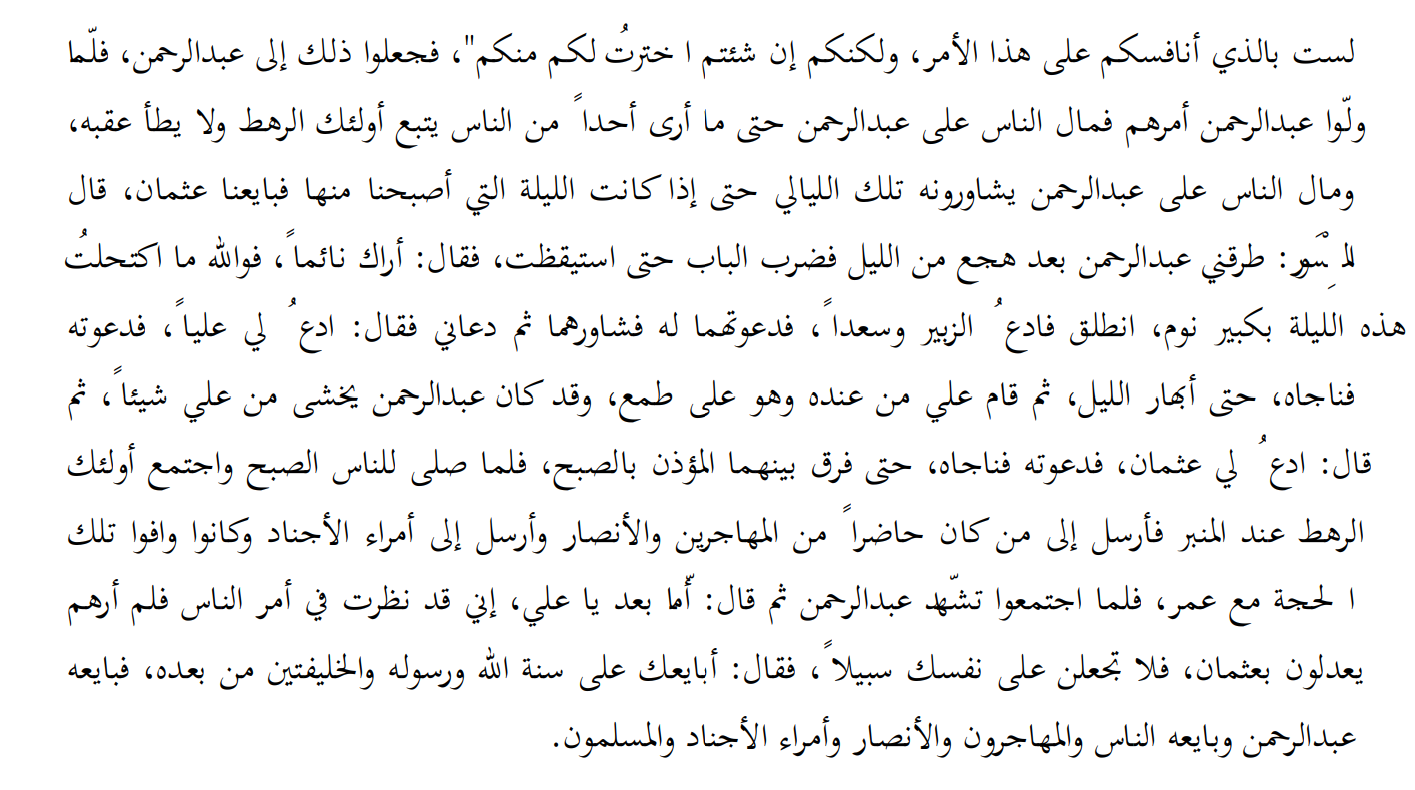
« Je ne suis pas de ceux qui entrent en compétition avec vous pour cette affaire, mais si vous le souhaitez, je pourrais en choisir un parmi vous. » Ils confièrent donc cela à ‘Abdurrahman. Lorsqu'ils chargèrent ‘Abdurrahman de cette affaire, les gens se tournèrent vers lui à un point tel que je ne vis personne suivre ce groupe ou marcher derrière eux. Les gens se tournèrent vers ‘Abdurrahman pour le consulter durant ces nuits, jusqu'à la nuit dont nous nous sommes réveillés le matin pour prêter notre serment d’allégeance (Bay’ah) à ‘Uthman. Al-Miswar a dit : « ‘Abdurrahman a frappé à ma porte, après qu'une partie de la nuit fut passée, jusqu'à ce que je me réveille. Il a dit : Je te vois dormir. Par Allah, mes yeux n'ont pas trouvé beaucoup de sommeil cette nuit. Lève-toi et appelle Az-Zubair et Sa‘d. » Je les ai invités auprès de lui. Il les a consultés. Puis il m'a appelé et a dit : « Appelle ‘Ali pour moi », alors je l'ai appelé. Il a poursuivi une conversation à voix basse avec lui jusqu'à ce que la nuit s'efface. Ensuite, ‘Ali l'a quitté avec certaines attentes, et ‘Abdurrahman craignait quelque chose de la part de ‘Ali. Puis il a dit : « Appelle ‘Uthman pour moi », alors je l'ai appelé. Il a poursuivi une conversation à voix basse avec lui jusqu'à ce qu'ils partent au moment où le muezzin appelait pour la prière du fajr. Après qu'il eut dirigé les gens pour la prière du fajr, et que le groupe des six personnes se fut réuni près du minbar (chaire), il fit appeler tous les Muhajirs et auxiliaires (Ansar) qui étaient présents (à Madinah) et fit appeler les chefs de l'armée qui avaient accompli le pèlerinage cette année-là avec ‘Umar. Lorsqu'ils se rencontrèrent, ‘Abdurrahman récita les deux témoignages de foi (shahadahs) et dit : Ô ‘Ali ! J'ai examiné l'affaire du peuple et je ne les ai pas vus accorder d'égalité à quiconque avec ‘Uthman, alors ne laisse rien te troubler. » Et il dit (à ‘Uthman) : « Je te donne le serment d’allégeance (Bay’ah) selon la voie d'Allah, de Son Messager ﷺ et des deux califes qui lui ont succédé. » Ainsi, ‘Abdurrahman, les Muhajirs, les auxiliaires (Ansar), les chefs de l'armée et le reste des musulmans lui donnèrent le serment d’allégeance (Bay’ah). »
“I am not one who competes with you for this matter but if you wish I could choose for you one from among you. So they assigned this to ‘Abdurrahman . When they charged ‘Abdurrahman with this matter, people turned to him to the extent that I did not see any one who followed this group or stepped behind them. The people turned to ‘Abdurrahman consulting him in those nights until the night of which we woke up in the morning and gave our pledge to ‘Uthman. Al-Miswar said: ‘Abdurrahman knocked at my door, after a part of the night had passed, until I woke up. He said: I see you sleeping. By Allah, my eyes did not find much sleep tonight. Set forth and call Az-Zubair and Sa‘d. I invited them to him. He consulted with them. Then he called me and said: Call ‘Ali for me, so I called him. He carried on a whispered conversation with him until the night faded away. Then ‘Ali left him with some expectations, and ‘Abdurrahman was afraid about something from ‘Ali. Then he said call ‘Uthman for me, so I called him. He carried on whispered conversation with him until they departed as the muezzin called for fajr prayer. After he led the people in the fajr prayer, and the group of six persons met near the minbar (pulpit), he sent for all the Muhajirs and Ansar who were present (in Madinah) and sent for the leaders of the army who delivered the pilgrimage that year with ‘Umar. When they met, ‘Abdurrahman recited the two testimonies of faith (shahadahs) and said: O ‘Ali! I viewed the matter of the people and did not see them equalling anyone to ‘Uthman, so do not let anything disturb yourself. And he said (to ‘Uthman): I give you the bay’ah upon the way of Allah, His Messenger and the two Khulafaa who came after him. So ‘Abdurrahman, the Muhajirs, the Ansar, the leaders of the army and rest of the Muslims gave him the bay’ah.”
Ainsi, les candidats au califat (Khilafah) furent limités au groupe désigné par ‘Umar (ra) après que les musulmans l'eurent prié de le faire. ‘Abdurrahman bin ‘Auf (ra), après s'être retiré de la nomination au califat (Khilafah), prit l'avis des musulmans sur l'identité du calife. Il annonça ensuite le nom de la personne que les musulmans souhaitaient après les avoir consultés. Après qu'il eut annoncé le nom de la personne que le peuple voulait, le serment d’allégeance (Bay’ah) lui fut donné et il devint le calife par ce serment d’allégeance (Bay’ah). Par conséquent, le statut légal (Hukm) de la charia concernant la nomination du calife est de limiter les candidats au califat (Khilafah) à ceux qui représentent l'opinion de la majorité des musulmans. Ensuite, leurs noms sont présentés aux musulmans et il leur est demandé de choisir l'un des candidats pour être le calife de tous. Il est alors déterminé qui la majorité des musulmans a choisi, et le serment d’allégeance (Bay’ah) de tous les musulmans est pris pour lui, que chaque personne l'ait spécifiquement choisi ou non. Cette méthode est due au consensus (Ijma’) des compagnons (Sahabah) concernant le fait que ‘Umar (ra) limite les candidats au califat (Khilafah) à six personnes spécifiques, et au consensus des compagnons (Sahabah) selon lequel ‘Abdurrahman (ra) prend l'avis de tous les musulmans sur l'identité de celui qui sera leur calife, et le consensus de donner le serment d’allégeance (Bay’ah) à celui qu'‘Abdurrahman (ra) a annoncé comme étant la personne élue par les musulmans en tant que calife est clair lorsqu'il a dit :
So the nominees for the Khilafah were limited to the group named by ‘Umar (ra) after the Muslims had asked him to do so. ‘Abdurrahman bin ‘Auf (ra), after he withdrew himself from the nomination to the Khilafah, took the opinion of the Muslims about who would be the Khalifah. He then announced the name of the person who the Muslims wanted after consulting with them. After he announced the name of the person who the people wanted, the bay’ah was given to him and he became the Khalifah by this bay’ah. Therefore the hukm shari’ concerning the appointment of the Khalifah is to limit the nominees for the Khilafah by those who represent the opinion of the majority of Muslims. Then their names are displayed to the Muslims and they are asked to select one of the nominees to be Khalifah for all. Then it is determined whom the majority of the Muslims have chosen, and the bay’ah from all the Muslims is taken for him, whether each person had specifically chosen him or not. This is the method because of the Ijma’a of the Sahabah about ‘Umar (ra) limiting the nominees for the Khilafah to six specific persons, and the consensus of the Sahabah that ‘Abdurrahman (ra) takes the opinion of all the Muslims about who will be the Khalifah for them, and the consensus to give the bay’ah to the one who ‘Abdurrahman (ra) announced as the person elected by Muslims as a Khalifah is clear when he said:
« J'ai observé les tendances des gens et j'ai remarqué qu'ils ne considèrent personne comme l'égal de `Uthman. »
“I have looked at the people's tendencies and noticed that they do not consider anybody equal to `Uthman.”
Tous ces points clarifient le statut légal (Hukm) de la charia concernant la nomination du calife.
All of these points clarify the hukm shari’ concerning the appointment of the Khalifah.
Deux questions restent à examiner. L'une d'elles est de savoir qui sont les musulmans qui nomment le calife ? S'agit-il des personnes influentes ou d'un nombre spécifique de musulmans ? Ou bien est-ce l'ensemble des musulmans qui nomment le calife ? La seconde question concerne les pratiques survenant en ce siècle lors des élections, telles que le vote secret, les urnes et le dépouillement des voix. Ces questions sont-elles conformes à l'Islam et l'Islam les autorise-t-il ou non ?
Two issues remain to be examined. One of them is who are the Muslims who appoint the Khalifah? Are they the influential people or a certain specific number of Muslims? Or do all of the Muslims appoint the Khalifah? The second issue concerns the actions occurring in this century in elections such as secret ballots, polling boxes and counting votes. Are these matters consistent with Islam and does Islam allows them or not?
Quant au premier point, Allah (SWT) a donné l'autorité à la communauté (Ummah) et Il a fait de la nomination du calife un droit et un devoir pour tous les musulmans ; Il n'en a pas fait un droit pour un groupe particulier excluant un autre, ni pour une jama‘ah laissant une autre jama‘ah de côté, puisque le serment d’allégeance (Bay’ah) est un devoir pour tous les musulmans. Le Prophète ﷺ a dit :
As for the first issue, Allah (swt), has given the authority to the Ummah and he (swt) made the appointment of the Khalifah a right and duty for all Muslims; and He did not make it a right for one particular group excluding another, nor for a jama‘ah leaving another jama‘ah aside, since the bay’ah is a duty upon all the Muslims. The Prophet (saw) said:
« Quiconque meurt sans avoir un engagement sur son cou meurt de la mort de l'ignorance préislamique (Jahiliyyah) »,
“Whoever dies without having a pledge upon his neck would die the death of jahiliyyah”,
Et cela est général pour chaque musulman. Par conséquent, les personnes influentes ne possèdent pas le droit exclusif de nommer le calife et ne peuvent ignorer le reste des musulmans. De même, des personnes spécifiques n'ont pas le droit exclusif. Au contraire, ce droit appartient à tous les musulmans sans exception, il inclut même les fajirs (gens pervers) et les munafiqeen (hypocrites), à condition qu'ils soient des musulmans matures, car le texte de la charia est venu sous une forme générale dans ce cas précis et rien n'est venu pour le limiter (le rendre spécifique à certaines personnes) si ce n'est le refus de l'allégeance de la part des jeunes qui n'ont pas encore atteint l'âge de la puberté. Ainsi, le texte doit être pris de manière générale.
And this is general for every Muslim. Therefore, the influential people do not possess the exclusive right to appoint the Khalifah and cannot ignore the rest of the Muslims. Nor do specific persons have the exclusive right. Rather, this right is for all the Muslims with no exception, it even includes the fajirs (wicked people) and munafiqeen (hypocrites), provided they are mature Muslims because the Shari’ah text came in a general form in this instance and nothing came to limit it (make it specific to certain people) except the refusal of the pledge from the young who have not yet reached the age of puberty. So the text has to be taken generally.
Cependant, il n'est pas conditionné que tous les musulmans exercent ce droit. Bien qu'il s'agisse d'un devoir, parce que la serment d’allégeance (Bay’ah) est obligatoire (Fard), il s'agit d'une obligation de suffisance (fard kifayah) et non d'une obligation individuelle (fard ain). Ainsi, si certains musulmans l'accomplissent, le devoir est levé pour le reste des musulmans. Mais tous les musulmans doivent être en mesure d'exercer leur droit d'élire le calife, qu'ils utilisent leur droit ou non. En d'autres termes, chaque musulman doit être capable de participer à la sélection du calife. La question est donc de permettre aux musulmans d'accomplir le devoir d'établir le calife qu'Allah (SWT) leur a prescrit, de telle sorte que ce devoir soit levé (de leurs épaules). La question n'est pas la participation effective de tous les musulmans à l'accomplissement de ce devoir. Cela est dû au fait que le devoir qu'Allah (SWT) a prescrit est d'établir le calife pour les musulmans par leur consentement, et il n'est pas exigé que tous les musulmans l'accomplissent. Deux conséquences en découlent : l'une est que le consentement de tous les musulmans dans l'établissement du calife est atteint. Deuxièmement, le consentement de tous les musulmans concernant la nomination n'est pas atteint. Les musulmans sont toutefois en mesure (de participer à la nomination) dans les deux cas.
However, it is not a condition that all Muslims practise this right. While it is a duty, because the bay’ah is fard, it is fard kifayah (obligation of sufficiency) and not fard ain (individual obligation). Thus, if some of the Muslims fulfill it, the duty drops from the rest of the Muslims. But all Muslims must be enabled to practice their right in electing the Khalifah, regardless of whether they use their right or not. In other words, every Muslim must be able to participate in selecting the Khalifah. So the issue is to enable the Muslims to carry out the duty of establishing the Khalifah which Allah (swt) prescribed upon them, in such a way that this duty falls (from their shoulders). The issue is not the actual participation of all the Muslims in conducting this duty. This is because the duty which Allah (swt) has prescribed is to establish the Khalifah for the Muslims by their consent, and it is not a requirement for all Muslims to perform it. Two matters result from this: One of them is that the consent of all the Muslims in the establishment of the Khalifah is achieved. Secondly, the consent of all the Muslims about the appointment is not achieved. The Muslims are however enabled (to participate in the appointment) in both cases.
« En principe, les choses sont autorisées à moins qu'il n'existe une preuve d'interdiction. »
“In Principle things are permitted unless there exists an evidence of prohibition.”
La différence entre la méthode (*tareeqah*) et le style est que la méthode est une action qui est considérée en soi comme une origine, ou une branche d'une action qui ne possède pas de preuve générale pour son origine ; sa preuve est plutôt spécifique à elle-même. Le style est une action qui est une branche d'une action — c'est-à-dire l'origine — sur laquelle il n'y a pas de preuve générale. Par conséquent, la méthode doit dépendre d'une preuve de la charia car elle est une règle de la charia, elle doit donc être respectée et les musulmans n'ont pas le choix à son sujet, à moins que sa règle ne soit l'*ibaha* (de permission). Cela diffère du style qui ne dépend pas d'une preuve de la charia ; il est plutôt inclus dans la règle de son origine. Par conséquent, il n'est pas obligatoire de suivre un style particulier même si le Messager ﷺ
The difference between method (tareeqah) and style is that the method is an action which is considered by itself as an origin, or a branch to an action that does not have a general evidence for its origin; rather its evidence is specific to it. The style is an action which is a branch to an action—i.e. the origin—upon which there is no general evidence. Therefore, the method must depend upon a Shari’ah evidence because it is a Shari’ah rule, thus it must be adhered to and Muslims have no choice concerning it unless its rule is ibaha (of permissibility). This is different from the style which does not depend on a Shari’ah evidence; rather it is included in the rule of its origin. Therefore, it is not obligatory to follow a particular style even if the Messenger (saw)
Il en est ainsi. Au contraire, un musulman est autorisé à utiliser n'importe quel style tant qu'il mène à l'accomplissement de l'action, et ainsi, il devient une branche de l'action. Ainsi, il est dit que le style est défini par le type d'action.
did so. Rather a Muslim is allowed to use any style as long as it leads to the performance of the action, and thus it becomes a branch to the action. Thus it is said that the style is defined by the type of action.