20. jihad
20. Jihad
Le jihad consiste à déployer (ses) efforts pour combattre dans le sentier d'Allah (SWT), que ce soit directement ou en apportant assistance par les biens, l'opinion, l'augmentation des effectifs ou autre. Le combat pour élever la parole d'Allah est le jihad. Quant au jihad par la parole dans le sentier d'Allah (SWT), il s'agit d'un jihad si la parole est directement liée au combat dans le sentier d'Allah. Si elle n'y est pas directement liée, ce n'est pas un jihad islamique (Shar’i), même si cela implique de la difficulté et même si les résultats contribuent à élever la parole d'Allah (SWT). Cela est dû au fait que le jihad dans la charia est spécifique au combat, de sorte que tout ce qui est directement lié au combat y est inclus. De la même manière que l'opinion, l'écriture et la parole sont des formes de jihad si elles sont directement liées au combat dans le sentier d'Allah (SWT), comme le discours adressé à l'armée pour l'encourager à combattre directement ou les paroles incitant à combattre les ennemis. Sinon, ce n'est pas un (jihad). Ni la lutte politique ni la réprimande des gouvernants ne sont qualifiées de jihad, bien que leur récompense soit élevée et leur bénéfice pour les musulmans grand. La question n'est ni la difficulté ni le bénéfice, mais plutôt le sens islamique (Shar’i) avec lequel ce mot est apparu. Le sens de la charia est le combat et tout ce qui s'y rapporte, qu'il s'agisse de l'opinion, de la parole, de l'écriture, de la stratégie et d'autres choses.
Jihad is expending (one’s) effort in fighting in the way of Allah (swt) directly or assisting by wealth or opinion or increasing numbers or other than that. The fighting to raise the word of Allah is jihad. As for jihad by speaking in the path of Allah (swt), this is jihad if the speech relates directly to fighting in the way of Allah. If it does not relate directly to it, it is not Shar’i jihad even if it involves difficulty and even if the results benefit in raising the word of Allah (swt). This is because jihad in Shar’a is specific to fighting, so there enters within it everything related directly to fighting. Similar to the opinion is writing and speaking; they are jihad if they are related directly to fighting in the way of Allah (swt) like the speech to the army to encourage it to fight directly or words inciting fighting the enemies. If not, this is not (jihad). Neither political struggle nor rebuking the rulers is termed jihad though their reward is high and their benefit to the Muslims great. The issue is neither difficulty nor the benefit, but rather it is the Shar’i meaning with which it came for this word. The Shari’ah meaning is fighting and all that it relates to from opinion, speech, writing, strategy and other things.
La cause du jihad n'est pas la capitation (Jizyah), même si nous cessons de (combattre) ceux qui acceptent la capitation (Jizyah). En revanche, la cause du jihad est que ceux que nous combattons sont des mécréants (kuffar) qui ont rejeté l'appel à l'islam (Da’wah). Allah (SWT) a dit :
The cause of jihad is not jizyah even though we stop (fighting) them when they accept the jizyah. Rather, the cause of jihad is that those whom we fight are disbelievers (kuffar) who rejected the da’wah. Allah (swt) said:
« Combattez ceux qui ne croient ni en Allah, ni au Jour Dernier, qui ne défendent pas ce qu'Allah et Son Messager ﷺ ont interdit, et qui ne suivent pas la religion (Deen) de la vérité parmi les Gens du Livre, jusqu'à ce qu'ils versent la capitation (Jizyah) de leurs propres mains, tout en étant humiliés » [TMQ 9:29].
Fight those who do not believe in Allah nor the Last Day, nor forbid what Allah and His Messenger have forbidden, nor follow the deen of truth among the People of the Book until they pay the jizyah from their hands while they are humiliated” [TMQ 9:29].
L'ordre de les combattre est (dû à) leur attribut de mécréance, c'est-à-dire combattez-les parce qu'ils ne croient pas en Allah et au Jour Dernier, etc. Ainsi, cette description est une restriction et, à ce stade, elle devient une cause. La cause du combat est donc la mécréance. Cela est apparu dans un autre verset (Ayah) :
The command to fight them is (due to) their attribute of disbelief i.e. fight them because they do not believe in Allah and the Last Day etc. So this description is a restriction and at this point it becomes a cause. So the cause of fighting is disbelief. It came in another ayah:
« Ô vous qui croyez, combattez ceux qui vous entourent parmi les mécréants et faites qu'ils ressentent votre fermeté » [TMQ 9:123]
“O you who believe, fight those who encircle you (close to you geographically) of the disbelievers and let them find harshness in you” [TMQ 9:123]
Ainsi, l'ordre de les combattre est dû à l'attribut de la mécréance. Il existe de nombreux versets (Ayah) similaires tels que :
So the command to fight them is due to the attribute of disbelief. There are many similar ayat such as:
« Combattez les alliés de Satan » [TMQ 4:76]
“Fight the allies of Satan” [TMQ 4:76]
Et
And
« Combattez les chefs de la mécréance » [TMQ 9:12]
“Fight the leaders of disbelief” [TMQ 9:12]
Et
And
« Combattez les polythéistes dans leur ensemble » [TMQ 9:36]
“Fight the polytheists altogether” [TMQ 9:36]
Tous ces versets (Ayah) ordonnent le combat en raison d'un attribut spécifique qui est la cause du combat, à savoir la mécréance. Quant au paiement de la capitation (Jizyah), le Coran l'a associé à l'humiliation comme cause de l'arrêt du combat et non comme cause du combat. De là, il est entendu que la cause du jihad est la mécréance. Si ceux contre qui nous combattons acceptent l'appel à l'islam (Da’wah), ils deviennent musulmans ; s'ils refusent d'accepter l'islam (mais) acceptent de payer la capitation (Jizyah) et d'être régis par l'islam, cela est accepté d'eux et ils ne sont pas combattus car il n'est pas permis de les contraindre à accepter l'islam. Tant qu'ils acceptent d'être régis par lui et de payer la capitation (Jizyah), ils se sont soumis à l'appel à l'islam (Da’wah) même s'ils n'ont pas accepté l'islam. En conséquence, il n'est pas permis de les combattre après qu'ils ont accepté d'être régis par lui et de payer la capitation (Jizyah). Cependant, s'ils acceptent de payer la capitation (Jizyah) mais refusent d'être régis par l'islam, il n'est pas permis d'accepter cela de leur part car la cause du combat, qui est qu'ils sont des mécréants ayant refusé d'accepter l'appel à l'islam (Da’wah), demeure, de sorte que les combattre reste obligatoire, une obligation qui ne s'est pas déchargée du cou des musulmans. Quant aux traités d'urgence dans lesquels le calife accepte de leur part la capitation (Jizyah) tout en les laissant se gouverner eux-mêmes par le système de la mécréance, en raison de l'absence de conformité des circonstances externes et internes pour cela, la Charia a accordé une concession à cette situation d'urgence dans les situations de nécessité, de sorte qu'aucune analogie n'est faite sur celle-ci. Par conséquent, la cause du jihad est que ceux contre qui nous combattons sont des mécréants qui ont refusé d'accepter l'appel à l'islam (Da’wah) et il n'y a pas d'autre cause pour le jihad. Quant à la capitation (Jizyah) accompagnée de l'humiliation étant une cause pour arrêter le combat, cela n'est que pour les Arabes non polythéistes. Quant aux Arabes polythéistes, rien n'est accepté d'eux si ce n'est l'islam ou le combat, en raison de la parole d'Allah :
All these ayat command the fighting due to a specific attribute which is the cause of fighting i.e. disbelief. As for the payment of jizyah, the Qur’an combined it with humiliation as the cause of stopping the fighting not the cause of fighting. From here it is understood that the cause of jihad is disbelief. If those whom we fight accept the da’wah they become Muslims; if they refuse to accept Islam (but) accept to pay the jizyah and be ruled by Islam, it is accepted from them and they are not fought as it is not permitted to force them to accept Islam. As long as they accept to be ruled by it and pay the jizyah, they have submitted to the da’wah even if they have not accepted Islam. Accordingly, it is not allowed to fight them after they accept to be ruled by it and pay the jizyah. However, if they accept to pay the jizyah but refuse to be ruled by Islam, it is not allowed to accept this from them because the cause of fighting which is that they are disbelievers who have refused to accept the da’wah remains standing so fighting them remains obligatory, an obligation which has not fallen from the Muslims’ necks. As for the emergency treaties in which the Khalifah accepts from them the jizyah while leaving them to rule themselves by the system of disbelief, due to the absence of compliance of the external and internal circumstances for it, the Shar’a gave concession to this emergency situation in the situations of necessity so no analogy is done upon it. Therefore the cause of jihad is that those whom we fight are disbelievers who refused to accept the da’wah and there is no other cause for jihad. As for jizyah together with humiliation being a cause to stop fighting, this is only with non polytheist Arabs. As for polytheist Arabs, it is not accepted from them except Islam or fighting due to Allah’s statement:
« Vous les combattrez ou ils deviendront musulmans » [TMQ 48:16].
“You will fight them or they will become Muslims” [TMQ 48:16].
Le jihad est obligatoire par le texte explicite du Coran et du hadith. Allah (SWT) a dit :
Jihad is obligatory by the explicit text of the Qur’an and Hadith. Allah (swt) said:
« Combattez-les afin qu'il ne reste plus d'épreuve (Fitnah) et que la religion (Deen) ne soit plus que pour Allah » [TMQ 8:39]
“Fight them so that there remains no (fitnah) and the deen becomes only for Allah” [TMQ 8:39]
Et Il (SWT) a dit :
And He (swt) said:
« Combattez ceux qui ne croient ni en Allah, ni au Jour Dernier, qui ne défendent pas ce qu'Allah et Son Messager ﷺ ont interdit, et qui ne suivent pas la religion (Deen) de la vérité parmi les Gens du Livre, jusqu'à ce qu'ils versent la capitation (Jizyah) de leurs propres mains, tout en étant humiliés. » [TMQ 9: 29 ]
“Fight those who don’t believe in Allah nor the Last Day, nor forbid what Allah and His Messenger have forbidden, nor follow the deen of truth among the People of the Book until they pay the jizyah from their hands while they are humiliated” [TMQ 9: 29 ]
Et Allah (SWT) a dit :
And Allah (swt) said:
« Si vous ne sortez pas (pour le jihad), Il vous châtiera d'un châtiment douloureux » [TMQ 9: 39]
“If you do not go out (for jihad), He will punish you with a painful punishment” [TMQ 9: 39]
Et Il (SWT) a dit :
And He (swt) said:
« Ô vous qui croyez ! Combattez ceux qui vous entourent parmi les mécréants et que vous trouviez en vous de la fermeté » [TMQ 9: 123].
“O you who believe, fight those who encircle you of the disbelievers and let them find harshness in you” [TMQ 9: 123].
Il est rapporté d'Anas (ra) qui a dit : « Le Messager d'Allah ﷺ a dit :
It is narrated from Anas (ra) who said: “The Messenger of Allah (saw) said:
« Combattez les polythéistes par vos biens, vos mains et vos langues » (rapporté par An-Nisai).
“Fight the polytheists with your wealth, your hands and your tongues” (narrated by An-Nisai).
De même, d'après Anas, le Prophète ﷺ a dit :
Also from Anas that the Prophet (saw) said:
« Certes ! Partir tôt le matin ou le soir afin de combattre dans le sentier d'Allah est meilleur que le monde et tout ce qu'il contient. » (rapporté par Al-Bukhari).
“Verily! Setting out in the early morning or in the evening in order to fight in Allah's way is better than the world and what it contains.” (narrated by Al-Bukhari).
Il a également rapporté que le Prophète ﷺ a dit :
He also narrated that he (saw) said:
« J'ai été commandé de combattre les gens jusqu'à ce qu'ils disent : "Il n'y a de divinité digne d'adoration qu'Allah" »
“I was commanded to fight the people until they say ‘There is no god but Allah”
L'imam Ahmad et Abu Dawud ont rapporté d'après Anas qui a dit : Le Messager d'Allah ﷺ a dit :
Imam Ahmad and Abu Dawud narrated from Anas who said: The Messenger of Allah (saw) said:
« ...le jihad sera pratiqué continuellement depuis le jour où Allah m'a envoyé en tant que prophète jusqu'au jour où le dernier membre de ma communauté combattra le Dajjal (l'Antéchrist). La tyrannie de n'importe quel tyran et la justice de n'importe quel dirigeant juste ne l'annuleront pas. »
“…jihad will be performed continuously since the day Allah sent me as a prophet until the day the last member of my community will fight with the Dajjal (Antichrist). The tyranny of any tyrant and the justice of any just (ruler) will not invalidate it.”
Il a été rapporté de Zayd bin Khalid qui a dit : Le Messager d'Allah ﷺ a dit :
It has been narrated from Zayd bin Khalid who said: The Messenger of Allah (saw) said:
« Celui qui prépare un combattant dans le sentier d'Allah a (également) combattu, et celui qui prend soin de sa famille avec bien (khayr) après lui a (également) combattu » (rapporté par Ahmad).
“Whoever prepares a warrior in the way of Allah has (also) fought, and whoever takes care of his family in goodness (khayr) after him has (also) fought” (narrated by Ahmad).
« Il fut dit : Ô Messager d'Allah ﷺ, lequel des gens est le meilleur ? Le Messager d'Allah ﷺ a dit : "Un croyant qui fait le jihad dans le sentier d'Allah par son corps et par ses biens" » (rapporté par Al-Bukhari).
“It was said: O Messenger of Allah, which of the people is better? The Messenger of Allah (saw) said: ‘A believer who does jihad in the way of Allah by his body and wealth” (narrated by Al-Bukhari).
Et il ﷺ a dit :
And he (saw) said:
« Quiconque meurt sans avoir combattu ou sans que son âme ait eu l'intention de combattre est mort sur une branche d'hypocrisie. »
“Whoever dies without fighting or his soul thinking of fighting has died upon a branch of hypocrisy.”
Il a été rapporté d'Abi Awfa (ra) que le Messager d'Allah ﷺ a dit :
It has been narrated from Abi Awfa (ra) that the Messenger of Allah (saw) said:
« Sachez que le Paradis se trouve sous l'ombre des épées » (rapporté par Al-Bukhari).
“Know that paradise is beneath the shade of swords” (narrated by Al-Bukhari).
Il est rapporté d'Abu Hurayra (ra) qui a dit :
It is narrated from Abu Hurayra (ra) who said:

« L'un des compagnons (Sahabah) du Messager d'Allah ﷺ passa près d'un ravin contenant des rivières d'eau douce et fut stupéfait par sa beauté, alors il dit : "Et si je me séparais des gens pour rester dans ce ravin ? Mais je ne le ferai jamais avant d'avoir demandé la permission au Messager d'Allah ﷺ". Il mentionna cela au Messager d'Allah ﷺ qui dit : "Ne fais pas cela, car le fait que l'un de vous se tienne debout dans le sentier d'Allah est meilleur que le fait qu'il prie dans sa maison pendant soixante-dix ans" » (rapporté par At-Tirmidhi).
“One of the Sahabah of the Messenger of Allah (saw) passed by a ravine with rivers of sweet water in it and was astounded by its beauty, so he said: What if I separated from the people and stayed in this ravine? But I will never do it until I seek permission from the Messenger of Allah (saw) so he mentioned that to the Messenger of Allah who said: Do not do (so) for the standing of one of you in the way of Allah is better than his praying in his house for seventy years” (narrated by At-Tirmidhi).
Le jihad est une obligation communautaire (fard kifayah) en mode offensif, et une obligation individuelle (fard ‘ayn) contre l'ennemi qui les attaque, tout en restant une obligation communautaire pour le reste. L'obligation ne tombe pas tant que l'ennemi n'est pas expulsé et que la terre islamique n'est pas libérée de leur souillure. Le fait que le jihad soit une obligation communautaire en mode offensif signifie que nous commençons à combattre l'ennemi même s'il ne nous attaque pas. Si aucun musulman n'exécute le combat en mode offensif à n'importe quelle période, alors ils seront pécheurs pour l'avoir délaissé. Si le peuple de l'Égypte exécute le jihad offensif, alors (son obligation) ne pèse plus sur le peuple de l'Indonésie, car il existe un combat effectif des musulmans contre des mécréants belliqueux, par conséquent l'obligation du jihad a été remplie. Cependant, si un combat éclate entre des musulmans et des mécréants mais que la suffisance (kifayah) n'a pas été assurée par le peuple de l'Égypte combattant les mécréants seul, alors l'obligation ne tombe pas sur le peuple de l'Inde et de l'Indonésie par l'action du peuple de l'Égypte et de l'Irak. Au contraire, elle est obligatoire sur le plus proche (musulman), puis le plus proche de l'ennemi jusqu'à ce que la suffisance soit atteinte ; si la suffisance ne peut être atteinte qu'avec tous les musulmans, alors le jihad devient obligatoire pour tous les musulmans jusqu'à ce que l'ennemi soit soumis. Le jihad est une obligation communautaire (fard kifayah) si le calife ne lui a pas ordonné d'avancer ; quant à celui à qui le calife a ordonné de participer, alors le jihad est devenu obligatoire pour lui en raison de la parole d'Allah :
Jihad is an obligation of sufficiency (fard kifayah) offensively, and an individual obligation (fard ‘ayn) against the enemy who attacks them while being a obligation of sufficiency upon the rest. The obligation does not fall until the enemy is expelled and the Islamic land liberated from their filth. The meaning of jihad being an obligation of sufficiency offensively is that we start fighting the enemy even if they do not start (fighting) us. If no Muslim performs the fighting offensively at any period then they will be sinful for leaving it. If the people of Egypt perform the offensive jihad then (its obligation) falls from the people of Indonesia, as there exists practical fighting by Muslims against belligerent disbelievers therefore the obligation of jihad has occurred. However if fighting broke out between Muslims and disbelievers but the sufficiency (kifayah) has not occurred by the people of Egypt fighting the disbelievers alone, then its obligation does not fall from the people of India and Indonesia by the performance of the people of Egypt and Iraq. Rather it is obligatory upon the nearest (Muslim) then the nearest to the enemy until sufficiency occurs; if sufficiency does not occur except with all the Muslims, then jihad becomes obligatory upon all the Muslims until the enemy is subdued. Jihad is an obligation of sufficiency (fard kifayah) if the Khalifah has not told him to advance; as for the one whom the Khalifah has told him to take part, then jihad has become obligatory upon him due to Allah’s statement:
« Ô vous qui croyez, qu'avez-vous pour vous attacher à la terre quand il est dit : "Partez dans le sentier d'Allah" ? »
“O you who believe, what is wrong with you that when it is said: ‘Go forth in the way of Allah’ you hold firm to the earth”
Et sa parole ﷺ :
And his (saw) statement:
« Et si l'on vous demande d'avancer, alors avancez. » (Narré par Bukhari & Muslim)
“And if you are asked to advance, then advance.” (Narrated by Bukhari & Muslim)
Le sens de la suffisance dans le jihad au sein de l'État islamique est qu'il surgisse pour le jihad un peuple dont le combat est suffisant ; qu'il s'agisse d'une armée pour laquelle il existe des registres (dawawin) à cet effet, comme c'était le cas à l'époque d'Umar (ra), ou qu'ils se soient préparés pour le jihad librement, comme c'était le cas à l'époque d'Abu Bakr (ra). Cela est identique qu'il s'agisse des premiers, des seconds, ou des deux ensemble, de sorte que si l'ennemi les cible, ils soient capables de se défendre, ce qui en fait une obligation de suffisance pour eux. S'ils sont incapables de se défendre, alors le calife prépare d'autres personnes pour le jihad, et ainsi de suite. Le jihad offensif ne signifie pas que nous engagions directement le combat contre l'ennemi ; nous devons plutôt d'abord les appeler à l'Islam.
The meaning of the sufficiency in jihad in the Islamic State is that there arise for jihad a people whose fighting is sufficient; whether they are an army for whom there are books of accounts (dawawin) for this as was the case in the time of Umar (ra), or they had prepared themselves for jihad freely as was the case in the time of Abu Bakr (ra). It is the same whether the first ones or the latter ones or both of them together such that if the enemy targets them they are able to defend so it is a obligation of sufficiency upon them. If they are unable to defend, then the Khalifah prepares others for jihad and so on. Offensive jihad does not mean that we initiate fighting the enemy directly; rather we must first call them to Islam.
S'il n'est pas permis aux musulmans de combattre ceux vers qui l'appel à l'islam (Da’wah) n'est pas parvenu ; au contraire, les mécréants doivent d'abord être appelés à l'islam. S'ils refusent, on leur demande alors de payer la capitation (Jizyah) ; et s'ils refusent, nous les combattons. Muslim a rapporté de Sulayman bin Buraydah, d'après son père :
If is not allowed for Muslims to fight those whom the Islamic da’wah has not reached; rather, the disbelievers must first be called to Islam. If they reject, then they are asked to pay the jizyah; and if they reject, we fight them. Muslim narrated from Sulayman bin Buraydah from his father:
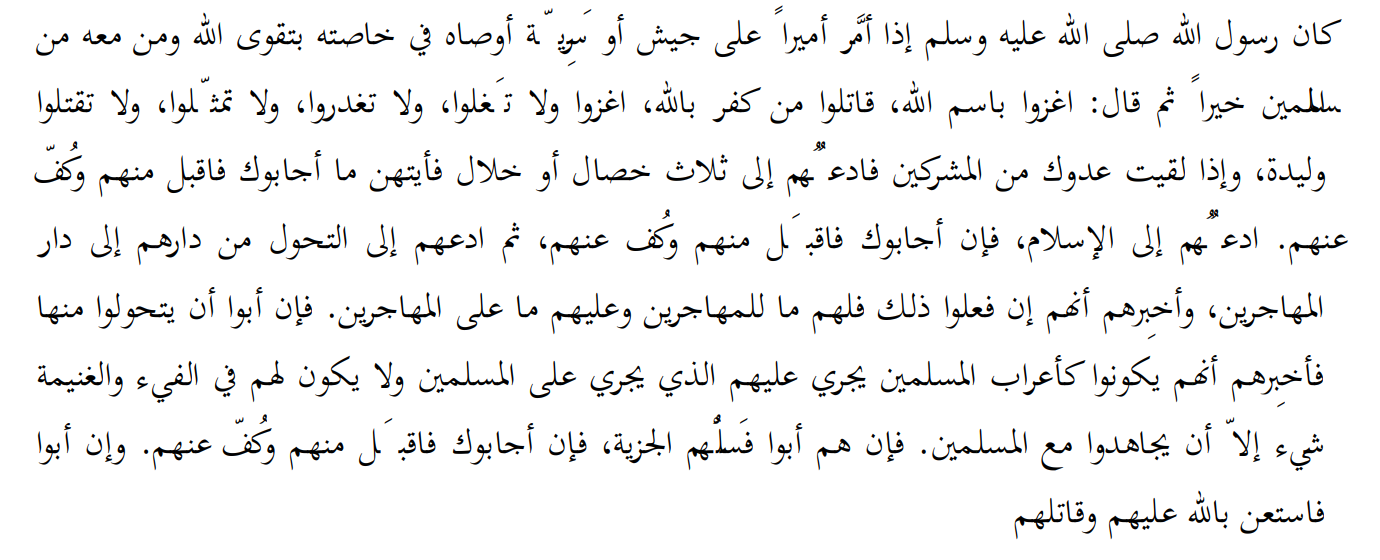
« Chaque fois qu'il nommait un homme pour diriger un détachement militaire, le Messager d'Allah ﷺ lui conseillait tout particulièrement de craindre Allah et de bien traiter les musulmans qui l'accompagnaient. Il ﷺ a dit : "Combattez au Nom d'Allah et dans la cause d'Allah. Combattez ceux qui ne croient pas en Allah. Combattez, mais ne soyez pas traîtres, ne volez pas dans le butin de guerre, ne mutillez pas et ne tuez pas les enfants. Lorsque vous rencontrerez votre ennemi parmi les polythéistes, appelez-les à l'une de ces trois choses. Quelle que soit celle à laquelle ils répondront, acceptez-la de leur part et abstenez-vous de les combattre. Invitez-les à accepter l'Islam, et s'ils répondent, alors acceptez-le de leur part et abstenez-vous de les combattre. Ensuite, invitez-les à quitter leur terre et à s'installer sur la terre des polythéistes. Dites-leur que s'ils font cela, ils auront les mêmes droits et devoirs que les polythéistes. S'ils refusent, dites-leur alors qu'ils seront comme les Bédouins musulmans (qui vivent dans le désert), soumis aux mêmes règles d'Allah que les croyants. Mais ils n'auront aucune part du Fay’ ou du butin de guerre, à moins qu'ils ne combattent aux côtés des musulmans. S'ils refusent d'entrer en Islam, demandez-leur alors de payer la Jizya (impôt par tête). S'ils font cela, alors acceptez-la de leur part et abstenez-vous de les combattre. Mais s'ils refusent, alors cherchez l'aide d'Allah contre eux et combattez-les." »
“Whenever he appointed a man to lead a military detachment, the Messenger of Allah (saw) would advise him especially to fear Allah and treat the Muslims with him well. He (saw) said: ‘Fight in the Name of Allah and in the cause of Allah. Fight those how disbelieve in Allah. Fight but do not be treacherous, do not steal from the spoils of war, do not mutilate and do not kill children. When you meet your enemy from among the polytheists, call them to one of three things. Whichever of them they respond to, accept it from them and refrain from fighting them. Invite them to accept Islam, and if they respond then accept it from them and refrain from fighting them. Then invite them to leave their land and move to the land of the polytheists. Tell them that if they do that, then they will have the same rights and duties as the polytheists. If they refuse, then tell them that they will be like the Muslim Bedouins (who live in the desert), subject to the same rulings of Allah as the believers. But they will have no share of Fay’ or war spoils, unless they fight alongside the Muslims. If they refuse to enter Islam, then ask them to pay the Poll-tax. If they do that, then accept it from them and refrain from fighting them. But if they refuse, then seek the help of Allah against them and fight them”
Et d'après ibn Abbas (ra) :
And from ibn Abbas (ra):
« Le Messager d'Allah ﷺ ne combattait jamais sans les avoir préalablement invités » (Rapporté par Ahmad).
“The Messenger of Allah (saw) never fought except that he invited them” (Narrated by Ahmad).
Et d'après Furwat bin Maseek qui a dit :
And from Furwat bin Maseek who said:
« J'ai dit au Messager d'Allah ﷺ : dois-je combattre ceux de mon peuple qui avancent contre ceux d'entre eux qui fuient ? Il dit : Oui. Quand je me suis retourné (pour partir), il m'a appelé et a dit : Ne les combatte pas avant de les inviter à l'Islam. »
“I said to the Messenger of Allah, should I fight with those of my people advancing (against) those of them fleeing? He said: Yes. When I turned (to go), he called me and said: Do not fight them until you invite them to Islam.”