2.15 La Révélation
2.15 The Revelation
Chaque musulman doit croire en la révélation, car elle est un aspect fondamental de la foi. Cependant, la preuve de la révélation n'est pas rationnelle, elle est plutôt acceptée sur la base de textes authentiques. Puisque la révélation n'a pas de sensation ou de réalité tangible, l'esprit ne peut en vérifier la validité. Par conséquent, toute tentative de prouver la révélation par le moyen de l'intellect sera incorrecte, car il n'est pas possible d'utiliser l'esprit pour prouver quelque chose qui n'a pas de réalité tangible.
Each and every Muslim must believe in revelation, as it is a fundamental aspect of belief. However, the evidence for revelation is not rational, rather it is accepted on the basis of authentic texts. Since revelation does not have a tangible sensation or reality, the mind cannot verify its validity. Therefore every attempt to prove revelation by means of the intellect will be incorrect, as it is not possible to use the mind to prove something without a tangible reality.
Par conséquent, comme mentionné précédemment, la preuve de la révélation n'est pas intellectuelle ; elle est plutôt établie sur la base de narrations authentiques. Le texte définitif du Qur’ān vérifie que le Messager Muhammad ﷺ a reçu la révélation. Allah (SWT) dit,
Hence, as mentioned earlier, the evidence for revelation is not intellectual; rather it is established on the basis of authentic narrations. The Definite text of the Qur’ān verifies that the messenger Muhammad recieved revelation. Allah says,
« De même, Allah, le Glorieux, le Sage, vous révèle, ainsi qu'à ceux qui vous ont précédés. » [TMQ Shura: 3]
"Likewise Allah, the Honourable, the all-wise, reveals to you and to those before you." [TMQ Shura: 3]
« Et de même, Nous t'avons révélé une chose vivifiante par Notre commandement. » [TMQ Shura:52]
"And likewise we have revealed to you an invigorate thing by our command." [TMQ Shura:52]
« Et il ne parle pas selon son propre désir. Certes, c'est une révélation inspirée. » [TMQ Najm: 3]
"And he doesn't utter from his own desire. Indeed it is an inspired inspiration" [TMQ Najm: 3]
« Certes, ô Prophète ! Nous t'avons révélé comme Nous avons révélé à Noah et aux prophètes après lui. » [TMQ Nisa: 163]
"Undoubtedly, O prophet! We have sent revelation to you as we sent it to Noah and the prophets after him." [TMQ Nisa: 163]
« Et suis ce qui t'est révélé et patiente jusqu'à ce qu'Allah décrète, et Il est le meilleur des juges. » [TMQ 10:109]
"And follow that which is revealed to you and have patience until Allah decrees and He is the best of judges." [TMQ 10:109]
La révélation qui descendit sur le Messager ﷺ comportait trois états ; tous les prophètes avant lui ne reçurent la révélation qu'à travers ceux-ci et aucun autre. Ces états sont tous classés sous la révélation que Allah (SWT) explique dans le Qur’ān. Il (SWT) dit :
The revelation that descended on the messenger had three states, all prophets before him recieved the revelation through these only and not another. These states are all categorised under the revelation which Allah explains in the Qur’ān. He says,
« Il ne convient pas à un homme qu'Allah lui parle sans que ce soit par révélation, ou que l'homme soit de l'autre côté du voile de majesté, ou en envoyant des messagers et en inspirant qui Il veut. » [TMQ Shura: 51]
"And it is not fit for any man that Allah should speak to him but through revelation, or that the man may be at the other side of the veil of grandeur, or by sending messengers and inspiring whom he wills." [TMQ Shura: 51]
C'est-à-dire qu'Allah (SWT) ne communique avec l'homme que par inspiration, par contact verbal à travers un voile ou en envoyant des messagers. La révélation qui est descendue sur le Messager ﷺ avait deux états. Il ﷺ en a informé lorsqu'on lui a demandé une fois : « Comment la révélation te parvient-elle ? ». Il ﷺ a répondu,
That is, Allah only communicates with man through inspiration, through verbal contact via a veil or by sending messengers. The revelation that descended upon the messenger had two states. He informed about them when he was once asked, "How does the revelation come to you?" He replied,
« Parfois, cela vient comme le cliquetis ou le tintement d'une cloche, ce qui est le plus éprouvant pour moi, et lorsqu'il me quitte, j'ai tout assimilé. Et parfois, l'ange vient à moi sous la forme d'un homme, me parle, et je suis conscient de ce qui est dit. » [Bukhari]
"Sometimes it comes like the clattering or the jingling of a bell which is severest on me and when it leaves me, I have absorbed everything. And sometimes the angel comes to me in a form of a man and speaks to me and I am aware of what is being said." [Bukhari]
Ces deux états sont les suivants : Premièrement — l'ange inspire le Prophète ﷺ par indication et sans utiliser de mots ou de langage. La révélation est inspirée dans l'esprit du Prophète ﷺ, tout comme il ﷺ l'a dit,
These two states are as follows: Firstly- the angel inspires the prophet by indication and without using words or language. The revelation is inspired into the mind of the prophet , just as he said,
« Ruh Al-Quds (Jibril) m'a inspiré qu'aucune âme ne mourra avant d'avoir accompli son Rizq et son Ajal. Par conséquent, craignez Allah (SWT) ô gens, et acquérez les moyens de faire le bien. » [Extraced by AlHakim]
"Ruh Al-Quds (Jibril) inspired in to me that no soul shall die until it has completed its Rizq and its Ajal. Therefore fear Allah O people and acquire the means to do good" [Extraced by AlHakim]
De même, le Messager ﷺ, durant ses rêves, avait des visions qu'il recevait d'Allah (SWT) tant dans l'état de conscience que durant le sommeil. Une partie lui était inspirée alors qu'il était éveillé et il avait certaines visions dans ses rêves, lesquelles étaient toutes une révélation. Comme l'a dit la mère des croyants, Aisha ,
Also the messenger whilst dreaming had visions that he received from Allah both in the states of consciousness and sleep. Some of it was inspired to him whilst he was awake and he would have certain visions in his dreams all of which were revelation. As the mother of the believers, Aisha said,
« Premièrement, le Messager ﷺ commença à avoir de véritables visions durant son sommeil. Chaque vision qu'il avait était aussi vraie et claire que l'aurore. »
"Firstly, the messenger began seeing true visions in his sleep. Every vision he had was true as clear as the morning."
Le Messager ﷺ ressentait également qu'une forme de révélation était sur le point de venir, mais elle ne venait pas. Aisha a rapporté que Harith ibn Hashim a demandé au Messager ﷺ : « Ô Messager, comment la révélation te parvient-elle ? » Le Messager ﷺ a dit,
The messenger would also feel that some form of revelation was about to come, but it didn't come. Aisha narrated that Harith ibn Hashim asked the messenger , "O messenger, how does the revelation come to you?" The messenger said,
« Parfois, cela vient comme le tintement d'une cloche, ce qui est le plus éprouvant pour moi, et lorsqu'il me quitte, j'ai tout assimilé. » [Bukhari]
"Sometimes it comes like the clattering /jingling of a bell which is severest on me and when it leaves me, I have absorbed everything." [Bukhari]
Toutes ces variations, c'est-à-dire l'inspiration, le rêve, la révélation sans parole et tout ce qui est similaire, constituent un seul état et relèvent des paroles d'Allah (SWT),
All these variations i.e. inspiration, dream, revelation without talk and everything similar constitute one state and fall within the saying of Allah ,
« Rien d'autre que la révélation » [TMQ Shura: 51]
"Nothing but revelation" [TMQ Shura: 51]
Car linguistiquement, lorsque le verbe « révéler à quelqu'un » est utilisé, cela signifie indiquer ou faire un signe de la tête. Ainsi, Allah (SWT) lui révèle et l'inspire. Allah (SWT) dit,
Because linguistically when the verb "to reveal to someone" is used it means to indicate or shake ones head. Thus Allah reveals to him and inspires him. Allah says,
« Et ton Seigneur inspira à l'abeille », [TMQ Nahl: 68]
"And your lord inspired the bee", [TMQ Nahl: 68]
Ainsi, l'inspiration donnée à l'abeille est : l'inspiration et la connaissance innée au sein du cœur de l'abeille.
Thus the inspiration to the bee is: the inspiration and the innate knowledge within the bee’s heart.
Le deuxième état est la révélation inspirée par le moyen de la communication orale de l'ange. Elle est transmise oralement au Prophète ﷺ après qu'il a appris, par une preuve décisive, qu'il s'agit de la révélation et que le porteur du message est l'ange, c'est-à-dire Jibril. Allah (SWT) dit :
The second state is the revelation inspired by means of oral communication from the angel. It is transmitted orally to the prophet after he learns through decisive evidence that this is revelation and the message bearer is the angel, i.e. Jibril. Allah says,
« L'Esprit fidèle l'a fait descendre avec lui, sur ton cœur, afin que tu avertisses. » [TMQ Shuara: 193]
"The trusted spirit has descended with it. On your heart that you may warn." [TMQ Shuara: 193]
En d'autres termes, Allah (SWT) envoie Jibril qui s'adresse au Messager ﷺ, lequel entend et préserve simultanément ses paroles. Aisha (RA) a rapporté que le Prophète ﷺ a dit,
In other words, Allah sends Jibril who speaks with the messenger who simultaneously both hears and preserves his words. Aisha narrated that the prophet said,
« Et parfois, l'ange vient à moi sous la forme d'un homme, il me parle et je suis conscient de ce qu'il dit. » [Bukhari]
"And sometimes the angel comes to me as a man and he talks to me and I am conscious of what he is saying." [Bukhari]
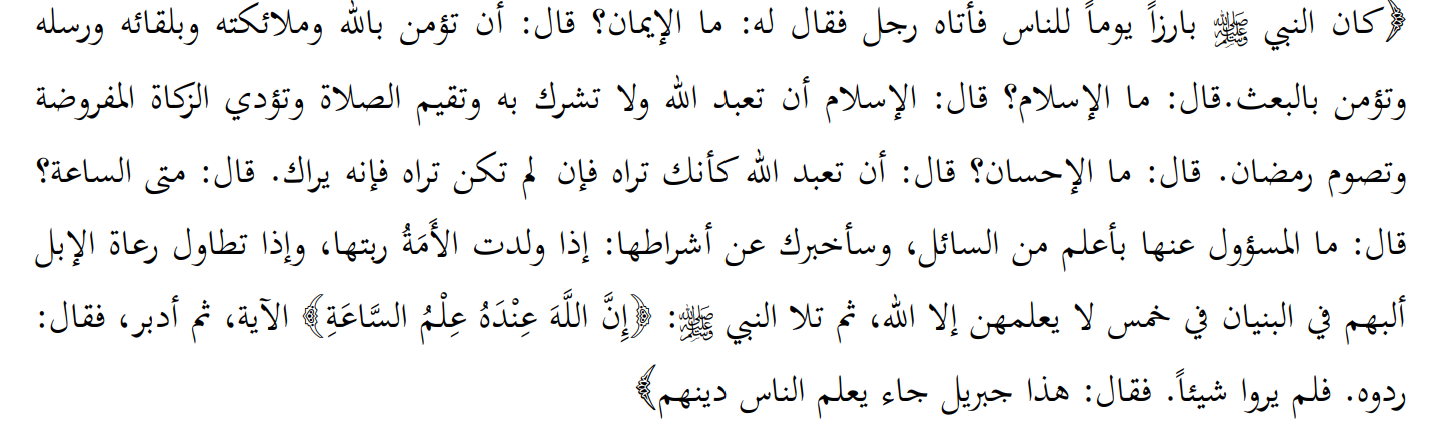
Abu Hurairah a rapporté que le Prophète ﷺ était avec les gens un jour lorsqu'une personne vint et lui demanda ﷺ : « Qu'est-ce que l'Emaan ? » Il ﷺ dit : « C'est la croyance en Allah (SWT), en Ses anges, en la rencontre avec Lui (SWT), en Ses messagers et en la résurrection. » Il demanda : « Qu'est-ce que l'Islam ? » Il ﷺ dit : « L'Islam consiste à adorer Allah (SWT) et à ne pas commettre d'association (Shirk), à accomplir la prière, à verser l'aumône obligatoire (Zakah) prescrite et à jeûner pendant le ramadan. » Il dit : « Qu'est-ce que l'Ihsaan ? » Il ﷺ dit : « C'est que tu adores Allah (SWT) comme si tu Le voyais, et si tu ne Le vois pas, certes Il te voit. » Il dit : « Quand l'Heure aura-t-elle lieu ? » Il ﷺ dit : « Celui qui est interrogé à ce sujet n'en sait pas plus que celui qui pose la question. Je vais vous en citer les signes : quand la mère donnera naissance à son maître et quand le berger construira de hauts bâtiments. Cela fait partie des cinq choses que nul ne connaîtra si ce n'est Allah (SWT). » Puis le Prophète ﷺ récita les versets (Ayah) : « Certes, la connaissance de l'Heure appartient à Allah. » Puis l'homme se détourna et partit. Le Prophète ﷺ dit aux compagnons (Sahabah) de l'appeler, mais ils ne virent rien. Il ﷺ dit : « C'était Jibril, il est venu pour enseigner aux gens leur religion (Deen). » [Bukhari]
Abu Hurairah narrated that the prophet was with the people one day when a person came and asked him, "What is Emaan?" He said, "It is the belief in Allah , his angels, in the meeting with him , his messengers and the resurrection." He asked, "What is Islam?" He said, "Islam is that you worship Allah and do not commit Shirk, establish the prayer, pay the enjoined Zakat and you fast in Ramadan." He said, "What is Ihsaan?" He said, "That you worship Allah as if you see him, and if you can not see him, surely he sees you." He said, "When is the hour?" He said, "The one questioned about it knows no better then the questioner. I will tell you of its signs. When the mother will give birth to her Master and when the shepherd will build tall buildings. It is one of the five things that no one will know them except Allah ." Then the prophet recited the Ayat, "Indeed Allah has the knowledge of the hour." Then the man turned and left. The prophet said to the Sahaba call him but they didn't see anything. He said, "This was Jibril, he came to teach people their Deen." [Bukhari]
Il y a un certain nombre d'incidents mentionnés dans les hadiths dans lesquels Jibril est descendu et a parlé au Prophète ﷺ et celui-ci l'écoutait. C'était une forme de révélation pour le Messager, car l'ange transmettait au Messager les significations sous la forme d'une conversation. La révélation par les mots et le sens est restreinte au Noble Qur’ān. Quant à la révélation par le sens, le Messager ﷺ l'exprimait en utilisant ses propres mots, par l'application, c'est-à-dire ses actions, ou par le silence, et cela est la sunna.
There are a number of incidents mentioned in Ahadith in which Jibril descended and talked to the prophet and he would listen. This was a form of revelation for the messenger, as the angel would tell the messenger the meanings in the form of a conversation. The revelation by words and meaning is restricted to the Noble Qur’ān. As for revelation by meaning, the messenger would express this by using his own words, through application i.e. his actions, or by silence and this is the Sunnah.
Le hadith qudsi est considéré comme faisant partie de la sunna car, bien que son sens soit révélé par Allah (SWT), ses paroles proviennent du Prophète ﷺ. Les paroles du hadith qudsi ne proviennent pas d'Allah (SWT) car les paroles qui proviennent d'Allah (SWT) sont spécifiquement réservées au Coran, ce qui est prouvé par son inimitabilité. Bien que la sunna se manifeste sous forme d'inspiration, de rêve ou soit déposée directement dans le cœur, elle survient également tant à l'état de veille que sous la forme d'un dialogue entre Jibril et le Messager ﷺ.
The Hadith Qudsi is regarded as Sunnah because although its meaning is revealed from Allah its words are from the prophet . The words of the Hadith Qudsi are not from Allah because the words that are from Allah are specifically for the Qur’ān and this is proven by its inimitability. Although the Sunnah comes in the forms of inspiration, dream and is cast directly in the heart, it also comes both in wakefulness and as a dialogue between Jibril and the messenger .
Le Qur’ān n'a été révélé qu'à travers le Messager ﷺ car ses paroles proviennent d'Allah (SWT). Il existe de nombreux ayats détaillant la révélation du Qur’ān. Allah (SWT) dit,
The Qur’ān is only revealed through the messenger because its words are from Allah . There are numerous ayats detailing the revelation of the Qur’ān. Allah says,
« Et Nous avons fait descendre vers toi le Coran en arabe » [TMQ Shura:7]
"And we have revealed the Quran to you in Arabic" [TMQ Shura:7]
« Et ce que Nous avons révélé à toi (O Muhammad ﷺ) de ce Livre, c'est la vérité même » [TMQ Fatir: 31]
" And what We have revealed to you (O Muhammad [saw]) of the Book, it is the (very) truth " [TMQ Fatir: 31]
Le livre mentionné est le Qur’ān et « min » signifie ici la représentation.
The book referred to is the Qur’ān and “min” here is to indicate representation.
« Ce Coran m'a été révélé afin que je puisse, par lui, vous avertir, vous ainsi que quiconque il atteindra. » [TMQ An’aam: 6]
“This Qur'ân has been revealed to me that I may therewith warn you and whomsoever it may reach " [TMQ An’aam: 6]
« Nous te racontons, ô Muhammad ﷺ, la meilleure des histoires à travers Nos Révélations qui te sont transmises de ce Qur'ân » [TMQ Yoosuf: 3]
" We relate to you (Muhammad [sal-Allâhu 'alayhi wa sallam]) the best of stories through Our Revelations to you, of this Qur'ân" [TMQ Yoosuf: 3]
« Et récite ce qui t'a été révélé du Livre ﷺ de ton Seigneur. Nul ne peut changer Ses Paroles, » [TMQ alKahf: 27]
" And recite what has been revealed to you (O Muhammad PBUH) of the Book (the Qur'ân) of your Lord. None can change His Words, " [TMQ alKahf: 27]
C'est le Qur'ān. Il y a d'autres ayats également, qui mentionnent la révélation en général, y compris la sunna. Par exemple, Allah (SWT) dit,
It is the Qur’ān. There are other ayats as well, which mention the revelation in general including the Sunnah. For example, Allah says,
« Si je demeure guidé, c'est grâce à la Révélation de mon Seigneur qui m'est parvenue » [TMQ As-saba: 50]
" If I remain guided, it is because of the Revelation of my Lord to me” [TMQ As-saba: 50]
Et Il (SWT) dit,
And He says,
« En vérité, Nous t'avons fait descendre la Révélation (O Muhammad ﷺ) comme Nous avons fait descendre la Révélation à Nûh (Noah) et aux Prophètes après lui » [TMQ Nisa: 163]
" Verily, We have sent the Revelation to you (O Muhammad [saw]) as We sent the Revelation to Nûh (Noah) and the Prophets after him" [TMQ Nisa: 163]
Et Il (SWT) dit,
And He says,
« Et suis ce qui t'est révélé par ton Seigneur. Certes, Allâh est parfaitement Connaissant de ce que vous faites. » [TMQ Ahzaab: 2]
"And follow that which is revealed to you from your Lord. Verily, Allâh is Well-Acquainted with what you do" [TMQ Ahzaab: 2]
Ces deux états mentionnés ont été abordés dans les textes, le troisième état est mentionné dans Sa parole (SWT) :
These two mentioned states have been discussed in the texts, The third state is mentioned in His saying,
« Ou de derrière un voile » [TMQ Shura: 51]
"Or from behind a veil” [TMQ Shura: 51]
Voici ce qui est arrivé à Musa . Ce verset (Ayah) indique l'incident dans lequel Allah (SWT) a parlé à Musa de derrière un voile. C'est-à-dire, tout comme une personne voilée s'adresse à des dignitaires et à des personnes de distinction. Elle parle de derrière un voile et, bien que l'on entende la voix de l'autre personne, on ne la voit pas. C'est de cette manière qu'Allah (SWT) a parlé à Musa .
This is what happened with Musa . This Ayat is indicating to the incident in which Allah spoke to Musa from behind a veil. That is, just as the veiled person speaks with some dignitaries and with people of distinction. He speaks from behind a veil and although one hears the other person’s voice, he does not see him. This is the manner in which Allah spoke with Musa .
Un tel incident n'est survenu qu'une seule fois avec le Prophète ﷺ lors de l'al-Isra wal-Miraj, ce qui a non seulement été mentionné dans un hadith authentique, mais a également été indiqué par la sourate al-Najm. Allah (SWT) dit,
Such an incident only occurred once with the prophet during the al-Isra wal-Miraj, which has not only been mentioned in an authentic Hadith, but has also been indicated by Sura al-Najm. Allah says,
« Ce n'est qu'une révélation qui est révélée. Il lui a été enseigné (ce Coran) par un être doué d'une grande puissance [Jibril]. Un être exempt de tout défaut de corps et d'esprit, puis il (Jibrîl) s'est élevé et s'est stabilisé. Alors qu'il [Jibrîl] se trouvait dans la partie la plus haute de l'horizon, alors il [Jibrîl] s'est approché et s'est rapproché, et se trouvait à une distance de deux arcs ou (même) plus près. Ainsi (Allah) a révélé à Son serviteur [Muhammad ﷺ par l'intermédiaire de Jibrîl {as}] tout ce qu'Il a révélé. » [TMQ Najm: 4-10]
"It is only a Revelation revealed.He has been taught (this Qur'ân) by one mighty in power [Jibril].One free from any defect in body and mind then he (Jibrîl) rose and became stable.While he [Jibrîl)] was in the highest part of the horizon, Then he [Jibrîl] approached and came closer, And was at a distance of two bows' length or (even) nearer. So (Allâh) revealed to His slave [Muhammad [saw] through Jibrîl [as]] whatever He revealed." [TMQ Najm: 4-10]
À l'exception de cet événement, à savoir al-Isra wal-Miraj, la révélation descendait sur le Prophète ﷺ sous la forme d'une inspiration et par l'intermédiaire d'un messager.
With the exception of this event i.e. al-Isra wal-Miraj, the revelation descended upon the prophet in the form of an inspiration and through a messenger.
Tous les types de révélation sont des formes de preuves. La communication entre l'ange et le Messager ﷺ par la parole, l'indication ou la conversation est une révélation claire. L'inspiration et les visions sont des révélations claires, et le fait qu'Allah (SWT) parle aux prophètes est également une forme de révélation. Cette révélation est une preuve catégorique, car elle a été rapportée dans les textes les plus authentiques et les plus définitifs au sens certain.
All the types of revelation are forms of evidence. The communication between the angel and the messenger by talk or indication or conversation is a clear revelation. The inspiration and visions are clear revelations and Allah speaking to the prophets is also a form of revelation. This revelation is a categorical proof as it has been reported in the most authentic and definite texts of definite meaning.