2.13 Les Prophètes et les Messagers
2.13 The Prophets And Messengers
« Prophète (Nabi) » et « Messager (Rasul) » sont deux termes contrastés, mais ils se rejoignent dans la mesure où une charia est révélée à tous deux. La différence entre le Messager (Rasul) et le prophète (Nabi) est que le premier reçoit l'inspiration d'une charia qu'il a pour commandement de propager, tandis que le second, c'est-à-dire le prophète (Nabi), reçoit également l'inspiration, mais a pour commandement de propager la charia des messagers (Rasul). En d'autres termes, le messager (Rasul) a pour commandement de propager la charia lui-même, tandis que le prophète (Nabi) propage la charia des messagers (Rasul).
‘Prophet’ (nabi) and ‘Messenger’ (rasul) are two contrastive terms but they share in the respect that a shari’a is revelaed to both of them. The difference between the Messenger and the prophet is that the former is inspired with a Sharī’ah which he is commanded to propagate, whereas the latter, i.e. the prophet is also inspired, but commanded to propagate the Sharī’ah of the messengers. In other words, the messenger is commanded to propagate the Sharī’ah himself, whilst the prophet propagates the Sharī’ah of the messengers.
le juge (Qadi) al-Baydawi dans son commentaire de la parole d'Allah (SWT),
Qadi al-Baydawi in commentary of the saying of Allah ,
« Nous n'avons jamais envoyé un Messager ou un Prophète avant toi, mais lorsqu'il a formé un désir » {TMQ Hajj: 52} ;
"Never did we send an apostle or a prophet before thee, but, when he framed a desire" [TMQ Hajj: 52];
Il dit : « Le Messager est envoyé par Allah (SWT) avec une charia vivifiée ou nouvelle à laquelle il appelle les gens, tandis que le prophète est envoyé par Allah (SWT) pour confirmer la charia précédente. » Ainsi, Musa était un prophète parce qu'il a reçu l'inspiration d'une charia, et un messager parce que cette charia était destinée à sa mission. D'un autre côté, bien qu'Aaron fût également un prophète parce qu'il a reçu l'inspiration d'une charia, il n'était pas un messager car la charia qui lui fut révélée n'était pas destinée à sa mission, mais plutôt à la mission de Musa . De la même manière, Muhammad ﷺ était à la fois un prophète et un messager parce qu'il a reçu l'inspiration d'une charia qui était destinée à sa mission.
Says, ‘The messenger is sent by Allah with a revived or new Sharī’ah which he calls people to, whereas the prophet is sent by Allah to affirm the former Sharī’ah.’ Thus, Musa was a prophet because he was inspired with a Sharī’ah and a messenger because this Sharī’ah was for his mission. On the other hand, although Aaron was also a prophet because he was inspired with a Sharī’ah, he was not a messenger because the Sharī’ah, which was revealed to him was not for his mission, rather it was for the mission of Musa . By the same token, Muhammad was a prophet and a messenger because he was inspired with a Sharī’ah, which was for his mission.
Le message est l'intermédiaire entre Allah (SWT) et les serviteurs afin d'expliquer et de clarifier la méthode pour satisfaire les besoins de ce monde et de l'au-delà. La sagesse nécessite l'envoi de messagers car ils apportent des lois et des bienfaits pour les gens.
The message is the mediation between Allah and the slaves in order to explain and clarify the method of satisfying the needs of this world and the hereafter. Wisdom necessitates the sending of messengers as they bring laws and benefits for people.
Ainsi, l'envoi de Messagers a effectivement eu lieu. Allah (SWT) a désigné des messagers parmi les hommes et les a envoyés comme porteurs de bonnes nouvelles du paradis et de la récompense pour les gens de la foi et de l'obéissance. Ils étaient des avertisseurs du feu de l'enfer et du châtiment pour les gens de la mécréance et de la désobéissance, et ils ont clarifié les besoins et les exigences de ce monde et de l'au-delà pour l'homme. Tout cela parce que l'esprit est incapable soit de décider du bien et du mal, soit de comprendre l'homme lui-même et ses affaires.
Thus, the sending of Messengers has actually occurred. Allah appointed messengers from amongst mankind and sent them as bearers of glad tidings of paradise and reward to the people of belief and obedience. They were warners of the hell fire and punishment to people of disbelief and disobedience and they clarified the needs and requirements of this world and the hereafter for man. All because the mind is incapable of either deciding the good and bad or able to comprehend man himself and his affairs.
« Adam a enfreint l'ordre de son Seigneur, puis ce qu'il avait désiré, il n'y est pas parvenu. Par la suite, son Seigneur l'a choisi et s'est tourné vers lui avec Sa miséricorde et lui a montré la voie de Sa proximité privilégiée. » [TMQ Tā Hā: 121-2]
"Adam slipped the commandment of his Lord then what he had desired, did not get the way to it. Thereafter his Lord chose him and turned to him with his mercy and showed him the way to his favoured nearness" [TMQ Tā Hā: 121-2]
La signification d'Ijtaba dans ce contexte signifie l'avoir choisi. Le Coran prouve également qu'Allah (SWT) a à la fois ordonné et interdit certaines choses à Adam. Ainsi Allah (SWT) dit,
The meaning of Ijtaba in this context means selecting him. The Quran also proves that Allah both commanded and prohibited Adam certain things. Hence Allah says,
« Et Nous dîmes : "Ô Adam, habite, toi et ton épouse, le Paradis, et mangez-y à votre guise, mais n'approchez pas de cet arbre, sinon vous seriez du nombre des injustes" » [TMQ Baqarah: 35]
"And we said, O Adam, dwell you and your wife in paradise and eat freely thereof where you will, but do not approach this tree lest you become of the transgressors" [TMQ Baqarah: 35]
Ceci prouve catégoriquement qu'il n'y avait pas d'autre prophète à son époque. Par conséquent, Adam était un prophète par révélation et rien d'autre. Un prophète qui a reçu l'inspiration d'une charia, car chaque commandement [amr] ou interdiction [nahi] est une charia. Ainsi, puisqu'il a reçu l'inspiration, il est un prophète.
This categorically proves that there was no other prophet during his time. Therefore, Adam was a prophet by revelation and nothing else. A prophet who was inspired with a Sharī’ah, as every commandment [amr] or prohibition [nahi] is Sharī’ah. Thus since he received inspiration he is a prophet.
La deuxième source est la sunna. Tirmidhi a rapporté d'après Abu Said al-Khudri que le Prophète ﷺ a dit,
The Second source is the Sunnah. Tirmidhi reported from Abu Said al-Khudri that the prophet said,
« Je serai le chef des fils d'Adam au jour de la résurrection, mais je ne m'en vante pas. Je tiendrai la bannière de al-Hamd dans ma main, mais je ne m'en vante pas, et ce jour-là, tous les prophètes, d'Adam inclus, seront sous ma bannière. »
"I will be the leader of the sons of Adam on the day of resurrection but I do not boast. I will have the banner of al-Hamd in my hand but I do not boast and on that day, all the prophets from Adam will be under my banner."
Enfin, le consensus des compagnons (Sahabah) prouve également qu'Adam était un prophète.
Lastly, the consensus of the Sahaba also proves that Adam was a prophet.
Quant à la prophétie de Muhammad ﷺ, puisqu'il a également revendiqué la prophétie et apporté des miracles, la prophétie est connue par des narrations transmises par de multiples voies (Mutawatir), ce qui l'établit au-delà de tout doute. Quant au miracle (c'est-à-dire le Coran), il est la parole d'Allah (SWT), qui a défié et bravé les orateurs éloquents et illustres de La Mecque. Ils furent incapables de s'opposer à la plus courte sourate du Coran, bien qu'ils se soient efforcés de le faire. Ils ont alors abandonné leurs styles d'opposition basés sur la parole et la rhétorique, bien qu'ils fussent les linguistes les plus éminents et les plus respectés de leur époque, pour recourir à la force et à l'épée. Pas même un seul des mécréants Kuffar n'a jamais rapporté que quelqu'un ait pu produire quoi que ce soit de similaire au Coran, malgré le fait qu'ils aient eu les moyens de rapporter cette information si nécessaire. Tout cela prouve catégoriquement que le Coran, c'est-à-dire le miracle donné à Muhammad ﷺ, provient d'Allah (SWT) et vérifie sans aucun doute la véritable revendication du Prophète ﷺ.
As for the prophethood of Muhammad , as he also claimed prophethood and brought forth miracles, the prophethood is known by Mutawatir narrations, which substantiates it beyond any doubt. As for the miracle (i.e. the Qur’ān) it is the speech of Allah , which challenged and defied the eloquent and great speakers of Mecca. They were unable to oppose the shortest Sura of the Qur’ān, although they strived to do so. They then abandoned their styles of opposition from talk and rhetoric, even though they were the best and most revered linguists of their time, to force and the sword. Not even one of the disbelieving Kuffars ever related that someone was ever able to produce anything similar to the Qur’ān, despite the fact that they had the means to relate this information if required. All this categorically proves that the Qur’ān, i.e. the miracle given to Muhammad is from Allah and without any doubt verifies the true claim of the prophet .
Le nombre de prophètes et de messagers est inconnu car Allah (SWT) informe Son messager ﷺ,
The number of prophets and messengers are unknown because Allah informs his messenger,
« Nous avons envoyé des messagers avant toi ; nous t'avons rapporté certains de leurs récits, et nous ne t'avons pas rapporté d'autres. » [TMQ Ghafir:78]
"We have sent messengers before you, we have mentioned some of their stories to you, whilst we have not mentioned others." [TMQ Ghafir:78]
Bien que ce nombre ait été mentionné dans certains hadiths, les hadiths en question appartiennent à la catégorie des Ahad. Par conséquent, ils n'ont aucune valeur en matière de croyance (Aqeedah) ; c'est-à-dire qu'ils ne font pas partie de la croyance (Aqeedah). En supposant que le hadith Ahad remplisse tous les prérequis de l'Usul-al-fiqh, cela ne mènerait qu'à la conjecture, et la conjecture ne peut être acceptée comme faisant partie de la croyance. Par conséquent, le nombre est limité aux prophètes et aux messagers mentionnés dans le Qur’ān car cela est définitif. De plus, le nombre de prophètes n'est pas mentionné dans les hadiths transmis par de multiples voies (Mutawatir). Concernant les prophètes mentionnés dans le Qur’ān, Allah (SWT) dit :
Although the number has been mentioned in some Ahadith, the Ahadith in question are of the Ahad category. Thus they do not have any value in ‘aqīdah (creed); i.e. they do not form part of the ‘aqīdah (creed). Assuming that the Ahad Hadith met all the pre-requisites of Usul-al-fiqh, it would only lead to conjecture, and conjecture can not be accepted as part of belief. Therefore the number is limited to the prophets and messengers mentioned in the Qur’ān because that is definite. Moreover, the number of prophets is neither mentioned in the Mutawatir Hadith. In respect to the prophets mentioned in the Qur’ān, Allah says,
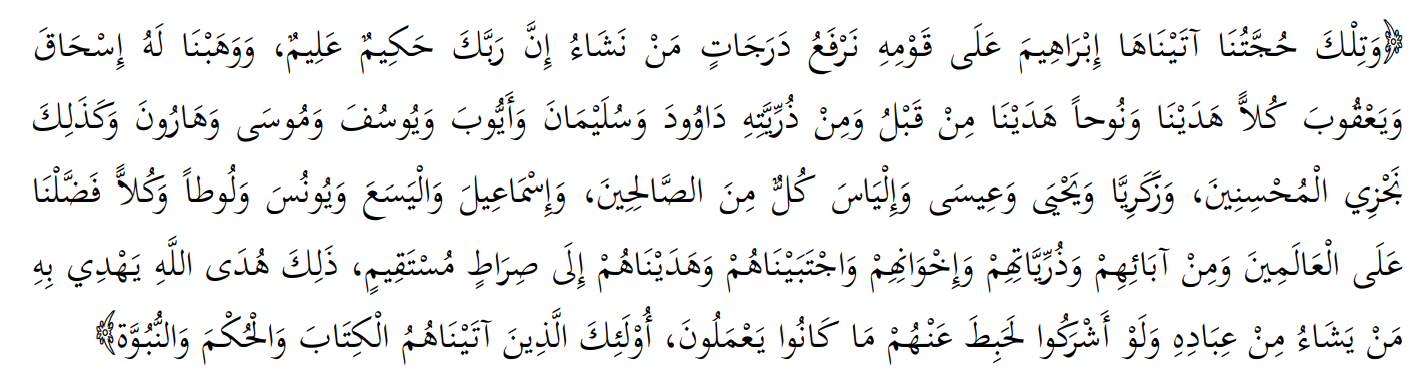
« Et voici l'argument que Nous avons donné à Abraham contre son peuple ; Nous élevons en degrés qui Nous voulons. Certes, ton Seigneur est Sage et Omniscient. Et Nous lui avons donné Ishaq et Yaqub, et Nous leur avons montré la voie à tous, et Nous avions montré la voie à Nuh avant eux, ainsi qu'à sa descendance, à Daud, Sulaiman, Ayub, Yusuf, Musa et Haroon, et c'est ainsi que Nous récompensons les vertueux. Et à Zakaria, Yahya, Isa et Ilyas. Ceux-là sont tous dignes d'être Nos proches. Et à Ismail, Yasa, Yunus et Lot, et Nous avons préféré chacun d'eux sur tous les autres en son temps. Et aussi à certains de leurs pères, de leur descendance et de leurs frères ; Nous les avons choisis et leur avons montré la voie droite. Telle est la guidance d'Allah. Il donne à qui Il veut de Ses serviteurs, et s'ils avaient commis un polythéisme, alors certes tout ce qu'ils avaient déjà accompli aurait été anéanti. Ceux-là sont ceux à qui Nous avons donné le Livre, l'autorité et la prophétie. » [TMQ An’ām: 83-89]
"And this is our argument that we gave to Abraham against his people, we raise in degrees whom we please, undoubtedly, your lord is wise, knowing. And we gave him Ishaq and Yaqub, we showed the path to all of them and showed the path to Nuh before them, and of his progeny, to Daud and Sulaiman and Ayub and Yusuf and musa and Haroon, and thus we recompense the righteous. And to Zakaria, Yahya, Isa and Ilyas. These are all entitled to be our near ones. And to Ismail and Yasa and Yunus and lot, and to each one we preferred above all in his time. And also to some of their fathers and their progeny and some of their brothers, and we chose them and showed them the straight path. This is the guidance of Allah. He gives whom he will of his bondmen, and if they would have committed polytheism, then surely all that they had already done would have been destroyed. These are they to whom we gave the book and order and prophet hood" [TMQ An’ām: 83-89]
« Et Ismaïl, Idrees et Dhul-Kifl, tous étaient du nombre de ceux qui faisaient preuve de patience, et Nous les avons comblés de Notre miséricorde. Ils étaient certes du nombre des vertueux. » [TMQ Anbiya: 85-86]
"And Ismail and Idrees and Dhul-Kifl all were from the patient ones who we took into our mercy. Indeed they are from the righteous." [TMQ Anbiya: 85-86]
« Et à Madyan, Nous avons envoyé leur frère Shu'aib. » [TMQ Araf: 85]
"And to Madyan, we sent their brother Shu'aib." [TMQ Araf: 85]
« Et à Thamud, Nous avons envoyé leur frère Salih. » [TMQ Araf: 73]
"And to Thamud, we sent their brother Salih." [TMQ Araf: 73]
« Et à 'Aad, Nous avons envoyé leur frère Hud. » [TMQ Araf:65]
"And to A'ad, we sent their brother Hud." [TMQ Araf:65]
« Et Nous dîmes : "Ô Adam, habite le Paradis, toi et ton épouse." » [TMQ Baqarah: 35]
"And we said, o Adam dwell you and your wife in paradise." [TMQ Baqarah: 35]
« Muhammad est le Messager d'Allah ﷺ. Ceux qui sont avec lui sont durs envers les mécréants (Kafir) et compatissants entre eux. » [TMQ Fath: 29]
"Muhammad is the messenger of Allah. Those with him are severe on the Kuffar and merciful between themselves." [TMQ Fath: 29]
Tous les prophètes et messagers étaient des informateurs d'Allah (SWT) car c'est là le sens de la prophétie et de la messagerie. Ils sont véridiques, des avertisseurs pour la création de peur que la mission et le message ne deviennent vains, et ils sont infaillibles quant au mensonge et à l'erreur dans leur propagation, tout comme ils sont infaillibles quant à la commission de tout péché. De plus, il n'existe aucune preuve textuelle certaine [Qati] dans le Qur'ān ou la sunna du Prophète ﷺ informant de l'erreur des prophètes après leur prophétie ou leur messagerie. Tout ce qui a été rapporté se trouve soit dans les hadiths dont la transmission est indéfinie [dhanni athuboot], soit dans les versets (Ayah) dont la preuve est indéfinie [dhanni ad-dalala], et l'indéfini [dhanni] ne peut l'emporter sur la preuve rationnelle certaine concernant l'infaillibilité. Quant à ce qui a été révélé concernant Adam dans le Qur'ān au sujet de son acte de manger de l'arbre qu'Allah (SWT) lui avait interdit de manger, cela ne contredit pas l'exigence d'infaillibilité dans la propagation du message aux gens sur la terre, car ce qui est arrivé à Adam s'est déroulé au Paradis, dont la sagesse n'est connue que d'Allah (SWT). Par conséquent, il s'agit d'une question distincte (c'est-à-dire le fait qu'Adam ait mangé le fruit de l'arbre) car l'infaillibilité est liée à la propagation du message aux gens sur la terre.
All the prophets and messengers were informers from Allah because this is the meaning of prophethood and messengerhood. They are truthful, admonishers to creation lest the mission and message become futile and they are infallible from lying and error in their propagation, just as they are infallible from committing any sin. Further there is no definite [Qati] textual evidence in the Qur’ān or the Sunnah of the prophet informing about the erring of the prophets after their Prophethood of Messengership. Whatever has been reported is either in the ahadith that are indefinite in their transmission [dhanni athuboot] or in the ayat that are indefinite in their evidence [dhanni ad-dalala] and the Indefinite [dhanni] cannot over ride the definite rational evidence on infallibility. As for what was revealed regarding Adam in the Qur’ān about him eating from the tree which Allah had prohibited him to eat from, this does not contradict the requirement of infallibility in the propogation of the message to the people on the earth because what happened from Adam was in the Paradise, the wisdom of which is only known to Allah . Therefore this is separate matter (i.e Adam’s eating of the fruit of the tree) because infallibility is related to the propogation of the message to the people on the earth.