Ils en firent ainsi, et lorsqu'ils eurent écrit de nombreux exemplaires, 'Uthman rendit les manuscrits originaux à Hafsa . 'Uthman envoya une copie de ce qu'ils possédaient à chaque province musulmane, et ordonna que tous les autres supports coraniques, qu'ils soient écrits sous forme de manuscrits fragmentaires ou de copies complètes, soient brûlés. Le nombre de copies réalisées était de sept. Les sept mushaf furent envoyés à Makkah, al-Sham, Yemen, Bahrain, Basra, Kufah, et une copie fut conservée à Madinah.
They did so, and when they had written many copies, 'Uthman returned the original manuscripts to Hafsa . 'Uthman sent one copy of what they have copies to every Muslim province, and ordered that all the other Qur’ānic materials, whether written in fragmentary manuscripts or whole copies, be burnt. The number of copies made was seven. The seven mushaf’s were sent to Makkah, al-Sham, Yemen, Bahrain, Basra, Kufah, and one copy was kept in Madinah.
Par conséquent, l'action de 'Uthman n'était pas la compilation du Qur’ān, mais consistait seulement en la copie et la transcription de la chose même qui avait été transcrite du Messager d'Allah ﷺ telle qu'elle était. Il n'a rien fait d'autre que de faire sept copies à partir de la copie préservée en la possession de Hafsa , la mère des Croyants, et d'unir les gens sur cette écriture unique et d'interdire toute autre écriture ou dictée que celle-ci. La question fut réglée sur cette copie en tant qu'écriture et dictée. C'est la même écriture et la même dictée dans lesquelles les feuillets ont été écrits, comme cela fut écrit en présence du Messager d'Allah ﷺ lorsque la révélation fut révélée. Et c'est la même copie qu'Abu Bakr avait compilée. Ensuite, les musulmans commencèrent à faire des copies à partir de cette copie et non d'une autre copie. Rien ne resta sinon le mushaf de 'Uthman dans son écriture. Lorsque les imprimeurs apparurent, le mushaf fut imprimé à partir de cette copie avec la même écriture et la même dictée.
Therefore, 'Uthman's action was not the compilation of the Qur’ān rather it constituted in only the copying and transcription of the same thing transcribed from the Messenger of Allah as it was. He did not do anything other than make seven copies from the preserved copy in the possession of Hafsa , the mother of the Believers and unite the people on this single script and forbade any other script or dictation other than it. The matter was settled on this copy as a script and dictation. It is the same script and dictation in which the sheets were written as was written in the presence of Allah's Messenger when the revelation was revealed. And it is the same copy which Abu Bakr had compiled. Then the Muslims began to make copies from this copy and not any other copy. Nothing remained except the mushaf of 'Uthman in its script. When printers came about, the mushaf was printed from this copy with the same script and dictation.
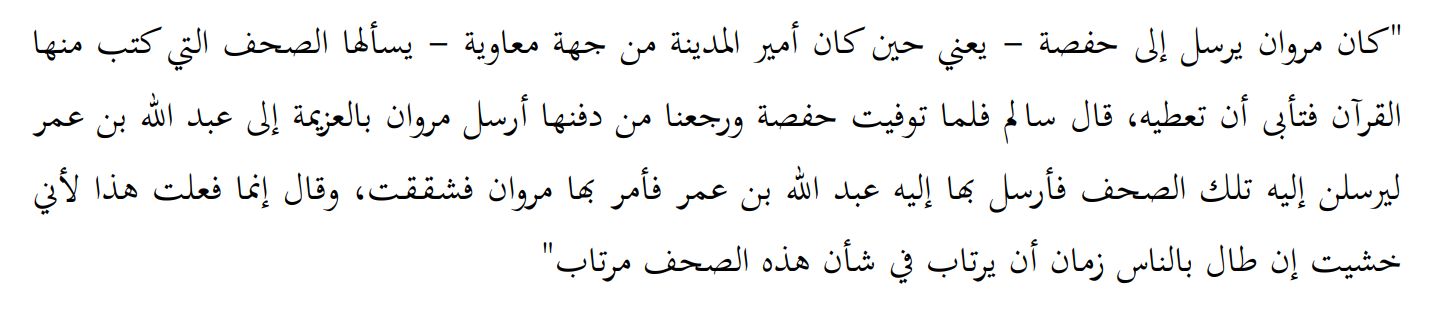
La différence entre la compilation d'Abu Bakr et celle de 'Uthman est que la compilation d'Abu Bakr a eu lieu par crainte que quelque chose ne soit perdu du Qur’ān si l'un de ses porteurs (mémorisateurs) venait à disparaître, la raison étant que, bien qu'il fût écrit sur des feuillets, il n'avait pas été rassemblé en un seul endroit comme un livre unique. Ainsi, il fut compilé en pages. La compilation de 'Uthman a eu lieu parce que les divergences se sont accentuées concernant certains aspects du Qur’ān, certains le lisant dans leurs propres dialectes, ce qui a conduit certains à accuser d'autres d'avoir commis une erreur. On craignait que la situation ne s'aggrave, c'est pourquoi ces feuillets furent copiés en un seul mushaf. Le mushaf que nous avons devant nous est le même mushaf révélé au Messager d'Allah ﷺ et c'est le même qui fut écrit sur les feuillets qui furent écrits en présence du Messager d'Allah ﷺ. Et c'est le même mushaf qu'Abu Bakr ﷺ a rassemblé lorsque les feuillets furent compilés en un seul lieu. Et c'est le même à partir duquel 'Uthman a transcrit les sept copies et a ordonné que le reste soit brûlé. Et c'est le même Noble Qur’ān dans l'arrangement de ses versets les uns par rapport aux autres, dans leur arrangement au sein de leurs sourates respectives, son écriture et sa dictée. Quant à la copie dictée par le Messager d'Allah ﷺ à partir de la révélation, dont les feuillets furent compilés ensemble puis copiés, elle resta protégée dans la possession de Hafsa , la mère des croyants, jusqu'à ce que Marwan devienne le Wali (gouverneur) de Madinah et qu'il la déchire, car elle n'était plus considérée comme importante puisque les copies du mushaf s'étaient répandues partout. Ibn Shihab a rapporté que Salim ibn 'Abd Allah ibn 'Umar l'a informé :
The difference between the compilation of Abu Bakr and that of 'Uthman is that the compilation of Abu Bakr took place due to the fear that something would be lost from the Qur’ān if any of its carriers (memorisers) were lost, the reason being that even though it was written on sheets but it had not been collected in one place like a single book. Thus, it was compiled in pages. The compilation of 'Uthman took place because the differences increased regarding certain aspects of the Qur’ān which some read in their own dialects and this led some to accuse others of making an error. It was feared that the matter would escalate therefore those sheets were copied into one mushaf. The mushaf that we now have before us is the same mushaf revealed to the Messenger of Allah and it is the same one which was written in the sheets which were written in the presence of the Messenger of Allah . And it is the same mushaf that Abu Bakr brought together when the sheets were compiled in one place. And it is the same one from which 'Uthman transcribed the seven copies and ordered that the rest be burned. And it is the same Noble Qur’ān in its verse arrangement in relation to each other and their arrangment in their respectives Sura’s, script and dictation. As for the copy dictated by the Messenger of Allah from the revelation, whose sheets were compiled together and then copied it remained protected in the possession of Hafsa , the mother of the believers until Marwan became the Wali (governor) of Madinah and he tore it up since it was not considered important because copies of the mushaf had spread everywhere. Ibn Shihab narrated that Salim ibn 'Abd Allah ibn 'Umar informed him: