20.3 Le Martyr
20.3 The Martyr
Les martyrs (shuhadaa) sont de trois types : le shaheed de l'au-delà (Akhirah) mais pas selon les règles du monde ; le shaheed du monde uniquement, et le shaheed du monde et de l'au-delà (Akhirah). Quant au shaheed de l'au-delà (Akhirah) uniquement et non de ce monde, ils sont mentionnés dans les hadiths. Dans certaines narrations, ils sont sept, dans d'autres huit, dans d'autres neuf et dans d'autres onze. La position authentique, telle qu'elle figure dans Muslim, est qu'ils sont cinq, à savoir : (al-mat’un), qui est celui qui meurt de la peste, c'est-à-dire la contagion célèbre ; le (mabtun), qui est celui qui meurt de diarrhée ; la personne noyée qui meurt à cause de l'eau ; celui qui meurt de (al-hadm), c'est-à-dire l'effondrement d'un bâtiment ; et celui qui meurt dans le but d'élever la parole d'Allah en dehors du champ de bataille. Muslim a rapporté d'après Abu Hurayra (ra) que le Messager d'Allah ﷺ a dit :
Martyrs (shuhadaa) are of three types; the shaheed of the Akhirah but not by the rules of the world; the shaheed of the world only and the shaheed of the world and Akhirah. As for the shaheed of the Akhirah only and not of this world, they are mentioned in the ahadith. In some narrations they are seven, in some eight, in some nine and in some eleven. The authentic (position) as what came in Muslim is that they are five who are: (al-mat’un) who is the one who dies in the plague i.e. the famous pestilence, the (mabtun) who is the one with diarrhoea, the drowned person who dies because of water, the one who dies of (al-hadm) i.e. the collapsed building, and the one who dies in the way of raising the word of Allah outside the battlefield. Muslim narrated from Abu Hurayra (ra) that the Messenger of Allah (saw) said:
« Un homme marchant le long de la route trouva une branche épineuse sur son chemin et l'enleva. Allah lui fut reconnaissant et lui pardonna. Le Prophète ﷺ a dit : Les martyrs (shuhadaa) sont au nombre de cinq : (al-mat’un), (al-mabtun), celui qui s'est noyé, celui qui est mort dans un (bâtiment) effondré et le shaheed dans le sentier d'Allah ‘azza wa jalla. »
“A man walking along the road found a thorn-branch in the road and removed it. Allah was grateful to him and forgave him. He (saw) said: The martyrs (shuhadaa) are five: (al-mat’un), (al-mabtun), the drowned one, the one who died in a collapsed (building) and the shaheed in the way of Allah ‘azza wa jalla.”
Muslim a rapporté d'après Abu Hurairah (ra) qui a dit : Le Messager d'Allah ﷺ a dit :
Muslim narrated from Abu Hurairah (ra) who said: The Messenger of Allah (saw) said:
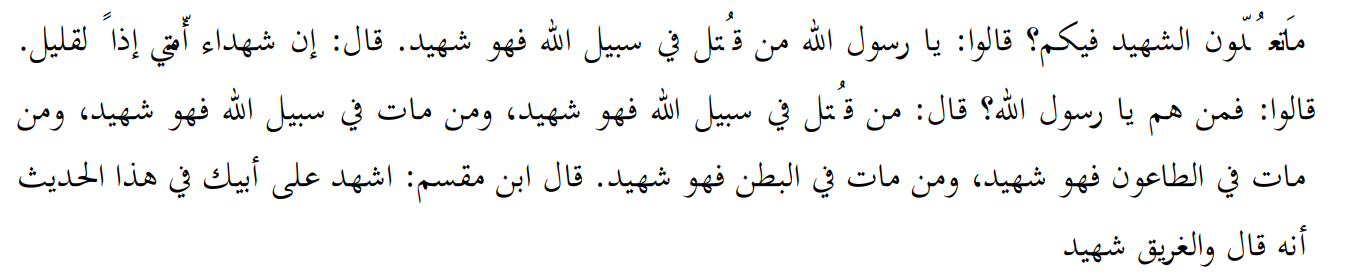
« Qui considérez-vous comme un shaheed parmi vous ? Ils dirent : Ô Messager d'Allah ﷺ, celui qui est tué dans le sentier d'Allah est un shaheed. Il dit : Alors les shuhadaa parmi ma communauté (Ummah) seraient peu nombreux. Ils dirent : Alors qui sont-ils, ô Messager d'Allah ﷺ ? Il dit : Celui qui est tué dans le sentier d'Allah est un shaheed, celui qui meurt dans le sentier d'Allah est un shaheed, celui qui meurt de la peste est un shaheed, celui qui meurt de maux d'estomac est un shaheed (ibn Muqsim a dit : je témoigne de ce qui est rapporté de ton père dans ce hadith qu'il a dit) et celui qui se noie est un shaheed. »
“Whom do you consider a shaheed among you? They said: O Messenger of Allah, the one killed in the way of Allah is a shaheed. He said: Then the shuhadaa among my Ummah would be few. They said: Then who are they, O Messenger of Allah? He said: The one killed in the way of Allah is a shaheed, the one who dies in the way of Allah is a shaheed, the one killed in pestilence is a shaheed, the one killed due to the stomach is a shaheed (ibn Muqsim said: I testify that upon your father in this hadith that he said) and the drowned person is a shaheed.”
La signification de ces shuhadaa est qu'il y a pour eux, dans l'au-delà (Akhirah), la récompense des shuhadaa ; quant à ce bas monde, ils sont lavés et on prie sur eux. Lorsque le mot « shaheed » est prononcé en relation avec la récompense et le hadith à ce sujet, il est correct de le généraliser à ces (personnes). Cependant, si le mot « shaheed » est utilisé de manière non restreinte sans aucune connotation, il n'est pas entendu pour désigner ces (personnes), mais plutôt pour désigner uniquement ceux qui ont été tués dans le sentier d'Allah.
The meaning of these shuhadaa is that there is for them in the Akhirah the reward of the shuhadaa; as for this world, they are washed and prayed over. When the word “shaheed” is said in connection with reward and the hadith about that, it is correct to generalize it to these (persons). However, if the word “shaheed” is used in an unrestricted manner without any connotation, then it is not taken to denote these (persons) but rather to denote only those killed in the way of Allah.
Quant au martyr de ce monde et non de l'au-delà (Akhirah), il est celui qui suit les règles du martyr de ce monde dans la mesure où il n'est ni lavé ni prié, mais plutôt enterré dans ses vêtements. Cependant, il ne reçoit pas dans l'au-delà (Akhirah) la récompense du martyr qui a combattu pour élever la parole d'Allah la plus haute. Il s'agit de celui qui combat dans un autre que le sentier d'Allah, comme combattre pour la renommée ou le butin uniquement, ou en battant en retraite. Cela est parce que les hadiths ont spécifié la récompense du martyr pour le martyr qui combat dans le sentier d'Allah (SWT), et celui qui combat en avançant et non en battant en retraite. Muslim a rapporté d'après Abu Musa al-Ash’ari
As for the shaheed of the world not the Akhirah, he is the one who takes the rules of the shaheed of the world in so far as he is not washed nor prayed over but rather buried in his clothes. However he does not take in the Akhirah the reward of the shaheed who fought to raise the word of Allah the highest. This is the one who fights in other than the way of Allah such as fighting for fame or booty alone or while retreating. This is because the ahadith specified the shaheed’s reward for the shaheed who fights in the way of Allah (swt), and the one fighting advancing not retreating. Muslim narrated from Abu Musa al-Ash’ari
« Un homme vint au Prophète ﷺ et dit : Ô Messager d'Allah, l'homme qui combat pour le butin, l'homme qui combat pour être mentionné et l'homme qui combat pour que son rang soit vu. Lequel est dans le sentier d'Allah ? Le Messager d'Allah ﷺ dit : "Celui qui combat pour que la parole d'Allah soit la plus haute est celui qui est dans le sentier d'Allah." »
“That a man came to the Prophet (saw) and said: O Messenger of Allah, the man who fights for booty, the man who fights to be mentioned and the man who fights so that his rank is seen. Which one is in the way of Allah? The Messenger of Allah (saw) said: ‘The one who fights so that the word of Allah be highest is the one in the way of Allah.”
Muslim a rapporté d'après Abu Musa
Muslim narrated from Abu Musa
On a interrogé le Messager d'Allah ﷺ au sujet de l'homme qui combat pour faire preuve de courage, de celui qui combat par colère, et de celui qui combat par ostentation (hypocritement). Le Messager d'Allah ﷺ a dit : « Celui qui combat pour que la parole d'Allah soit la plus haute est dans le sentier d'Allah. »
“The Messenger of Allah (saw) was asked about the man who fights (to show his) courage, the one who fights out of anger, and the one who fights to show off (hypocritically). The Messenger of Allah (saw) said: The one who fights so that the word of Allah is highest is in the way of Allah.”
Le Messager ﷺ a posé comme condition pour que le shaheed soit pardonné de ses péchés qu'il combatte en avançant et non en battant en retraite. Muslim a rapporté d'après Abdullah bin Abi Qatadah, d'après Qatadah, qu'il l'a entendu être rapporté du Messager d'Allah ﷺ.
The Messenger made a condition of the shaheed being forgiven his sins that he fights advancing not retreating. Muslim narrated from Abdullah bin Abi Qatadah from Qatadah that he heard it being narrated from the Messenger of Allah
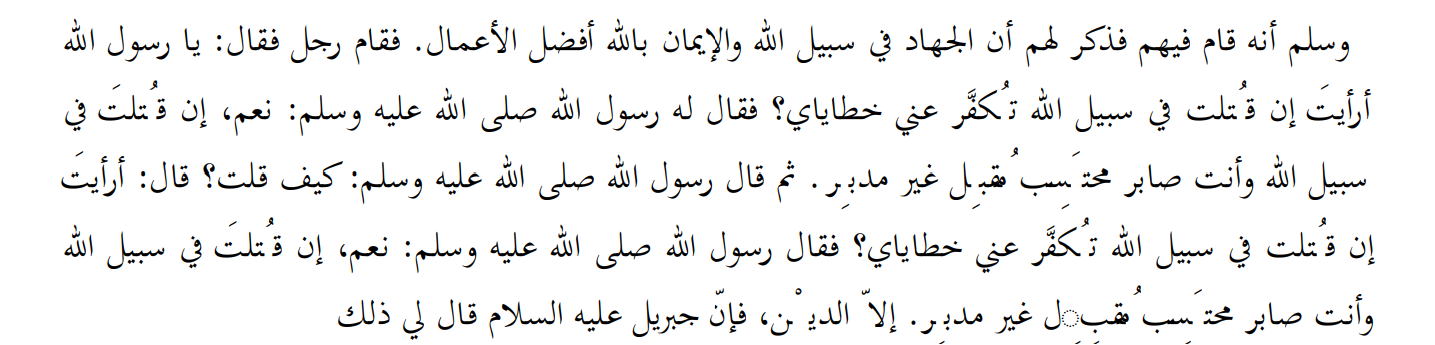
« Qu'il se tint parmi eux et leur rappela que le jihad dans le sentier d'Allah et la foi décisive en Allah sont les meilleures des œuvres. Alors un homme se leva et dit : Ô Messager d'Allah ﷺ, considères-tu que si je combats dans le sentier d'Allah, toutes mes erreurs seront pardonnées ? Le Messager d'Allah ﷺ lui dit : Oui, si tu combats dans le sentier d'Allah et que tu es patient, plein d'espoir, en avant et ne reculant pas. Puis le Messager d'Allah ﷺ dit : Qu'as-tu dit ? Il dit : Considères-tu que si je combats dans le sentier d'Allah, tous mes péchés seront pardonnés ? Le Messager d'Allah ﷺ dit : Oui, si tu es patient, plein d'espoir, en avant et ne reculant pas, excepté pour les dettes, comme Jibril (paix sur lui) me l'a dit. »
“That he stood among them and reminded them that jihad in the way of Allah and decisive belief in Allah is the best deeds. So a man stood up and said: O Messenger of Allah, do you see that if I fought in the way of Allah that all my errors would be forgiven? The Messenger of Allah (saw) said to him: Yes, if you fought in the way of Allah and you are patient, hopeful, advancing and not retreating. Then the Messenger of Allah (saw) said: What did you say? He said: Do you see that if I fought in the way of Allah that all my sins would be forgiven? The Messenger of Allah (saw) said: Yes, if you are patient, hopeful, advancing and not retreating except for debts as Jibril (AS) told me that.”
La compréhension de cela est que les péchés du combattant qui bat en retraite ne sont pas pardonnés et qu'il ne reçoit pas la récompense du shaheed. Quant à celui qui combat pour la renommée, le Messager ﷺ a clarifié qu'il serait puni et (pourtant) l'a qualifié de shaheed. Muslim a rapporté de Sulayman bin Yasar qui a dit : Les gens se sont dispersés autour d'Abu Hurairah (ra) et Natil, qui était parmi les gens de Sham, lui dit : Ô Cheikh, rapporte-nous un hadith que tu as entendu du Messager d'Allah ﷺ. Il dit : Oui, j'ai entendu le Messager d'Allah ﷺ dire :
The understanding of this is that the retreating fighter’s sins are not forgiven nor does he have the reward of the shaheed. As for the one fighting for fame, the Messenger (saw) clarified that he would be punished and (yet) called him shaheed. Muslim narrated from Sulayman bin Yasar who said: People dispersed about Abu Hurairah (ra) and Natil who was from the people of Sham said to him: O Sheikh related to us a hadith you heard from the Messenger of Allah (saw). He said: Yes, I heard the Messenger of Allah (saw) saying:
« Certes, la première personne à être jugée le Jour du Jugement est un homme qui a été tué en tant que shaheed. Il est amené à Lui (Allah) et Il l'informe de Ses bienfaits, et il les reconnaît. Il (SWT) dit : "Qu'as-tu fait de ceux-ci ?" Il répond : "J'ai combattu pour Toi jusqu'à être tué en tant que shaheed." Il dit : "Tu as menti. Plutôt, tu as combattu pour que l'on dise 'il est brave', et cela a été dit." Ensuite, Il ordonne à son sujet et il est traîné sur son visage jusqu'à ce qu'il soit jeté dans le Feu. »
“Verily the first person(s) to be judged on the Day of Judgement is a man who was killed as a shaheed. He is brought to Him (Allah) and He informs him of the bounties (of Allah) and he acknowledges them. He (swt) says: What did you do with them? He answers: I fought for you until I was killed as a shaheed. He says: You lied. Rather you fought so that it be said ‘(he is) brave’ and it has been said. Then He commands regarding him and he is dragged upon his face until he is thrown into the Fire”
Jusqu'à la fin du hadith. Cela indique que celui qui est tué pour la renommée, même s'il bénéficie des règles du shaheed dans ce monde, n'obtiendra pas la récompense du shaheed au Jour du Jugement mais sera châtié.
Till the end of the hadith. This indicates that the one killed for fame, even if he takes the rules of the shaheed in this world, will not gain the reward of the shaheed on the Day of Judgement but would be punished.
Quant au shaheed de ce monde et de l'au-delà (Akhirah), il est celui qui combat les mécréants pour élever la parole d'Allah et qui a été tué sur le champ de bataille entre les musulmans et les mécréants, que le combat ait eu lieu sur la terre de la guerre ou sur la terre de l'Islam. Allah (SWT) a dit :
As for the shaheed of the world and the Akhirah, he is the one who fights the disbelievers to raise the word of Allah and was killed in the battle (field) between Muslims and disbelievers, whether the fighting was in the land of war or the Islamic land. Allah (swt) said:
« Ne pense pas que ceux qui sont tués dans le sentier d'Allah sont morts. Au contraire, ils sont vivants et reçoivent leur subsistance auprès de leur Seigneur » [TMQ 3:169].
“Do not think that those killed in the way of Allah are dead. Rather they are alive and receiving sustenance before their Lord” [TMQ 3:169].
Ce shaheed est celui dont les droits sont établis par les règles de la charia. Il est spécifié comme étant celui qui a été tué lors de la guerre contre les mécréants ; de même, celui qui a été blessé sur le champ de bataille puis est mort de la blessure reçue sur le champ de bataille est également considéré comme celui qui a été tué sur le champ de bataille. Quant aux autres, ils ne sont pas considérés comme shaheed. En conséquence, celui qui est tué en combattant des rebelles (bughat) n'est pas considéré comme shaheed, pas plus que celui qui est blessé sur le champ de bataille, puis guérit de sa blessure, puis meurt à cause de celle-ci. Le shaheed qui possède des règles spécifiques, et celui au sujet duquel Allah a déclaré qu'il est vivant, est spécifié comme étant celui qui a été tué sur le champ de bataille avec les mécréants pour élever la parole d'Allah, ainsi que celui qui a été blessé sur le champ de bataille puis est mort à cause de cette blessure.
This shaheed is the one upon whose rights came in the Shari’ah rules. He is specified as the one killed in the war with disbelievers; similarly the one who was wounded in the battlefield then died of the wound he received in the battlefield is also considered like the one killed in the battlefield. As for other than these, they are not considered shaheed. Accordingly the one killed in fighting with rebels (bughat) is not considered shaheed nor the one wounded in the battlefield then recovered from the wound then died because of it. The shaheed who has specific rules, and the one about whom Allah stated that he is alive, is specified to the one killed in the battlefield with the disbelievers to raise the word of Allah and the one injured in the battlefield then died due to this wound.
La règle concernant ce shaheed mentionné est qu'il n'est ni lavé ni enveloppé dans des linceuls de sépulture ; il est plutôt enterré dans son sang et ses vêtements, car le shaheed sera ressuscité au Jour du Jugement avec l'odeur de son sang semblable à la plus douce des odeurs de musc. Quant au fait de ne pas laver le shaheed, cela est dû à ce qu'Al-Bukhari a rapporté de Jabir qui a dit :
The rule of this mentioned shaheed is that he is neither washed nor shrouded in burial shrouds; rather he is buried in his blood and clothes because the shaheed is resurrected on the Day of Judgement with the smell of his blood like the sweetest-smelling musk. As for not washing the shaheed, this is due to what Al-Bukhari narrated from Jabir who said:
« Le Messager d'Allah ﷺ rassemblait deux hommes parmi ceux qui furent tués à Uhud dans un même linceul, puis il disait : "Lequel des deux connaissait le mieux le Coran ?" Si l'un des deux lui était indiqué, il le plaçait en avant dans la niche funéraire (lihd) et disait : "Je suis témoin pour eux." Il ordonna qu'ils soient enterrés avec leur sang et ne pria pas sur eux et ne les lava pas. »
“The Messenger of Allah (saw) would collect two men of those killed in Uhud in one cloth, and then he would say: Which one of them knew more of the Qur’an? If one of the two was indicated to him, he brought him forward in the grave-niche (lihd) and said: I am a witness over these. He commanded their burial with their blood and did not pray over them nor wash them.”
Et Ahmad (a rapporté) que le Prophète ﷺ a dit à propos de ceux qui ont été tués à Uhud :
And Ahmad (narrated) that the Prophet (saw) said about those killed in Uhud:
« Ne les lavez pas, car chaque blessure ou (chaque goutte de) sang diffusera du musc le Jour du Jugement », et il n'a pas accompli la prière funéraire sur eux.
“Do not wash them because each wound or (each drop of) blood will diffuse musk on the Day of Judgement and he did not pray over them.”
Il est rapporté que le Prophète ﷺ a dit à propos de ceux qui ont été tués à Uhud :
It is narrated that the Prophet (saw) said about those killed in Uhud:
« Couvrez-les de leur sang et ne les lavez pas, car il n'y a aucune blessure infligée dans le sentier d'Allah qui ne vienne au Jour du Jugement avec sa veine jugulaire coulant du sang dont la couleur est la couleur du sang et l'odeur est l'odeur du musc. »
“Cover them in their blood and do not wash them as there is no wound wounded in the way of Allah save that it will come on the Day of Judgement with its jugular vein flowing blood whose colour is the colour of blood and the odour is the odour of musk.”
Il a été rapporté d'après Anas
It has been narrated from Anas
« Que le Prophète ﷺ n'a pas accompli la prière funéraire pour ceux qui ont été tués à Uhud ou n'a pas prié pour eux. »
“That the Prophet (saw) did not pray over those killed in Uhud or pray over them.”
Tout comme il n'a pas lavé ceux qui ont été tués à Uhud, il n'a pas lavé les shuhadaa de Badr ; de même, il n'a pas lavé les shuhadaa de Khandaq et de Khayber. Il est donc devenu clair que le shaheed n'est pas lavé. De même, le shaheed n'est pas enveloppé dans un linceul comme le défunt est enveloppé ; il est plutôt enveloppé dans les vêtements qu'il portait, en raison de la parole du Messager d'Allah ﷺ concernant ceux qui ont été tués à Uhud :
Just as he did not wash those killed in Uhud, he did not wash the shuhadaa of Badr; similarly he did not wash the shuhadaa of Khandaq and Khayber. So it became clear that the shaheed is not washed. Similarly the shaheed is not enshrouded as the dead person is shrouded; rather he is shrouded in the clothes that he has due to the Messenger of Allah (saw)’s statement about those killed in Uhud:
« Couvrez-les de leurs blessures et de leur sang » (rapporté par Ahmad)
“Cover them in their wounds and blood” (narrated by Ahmad)
Et également en raison de ce qu'a rapporté ibn Abbas (ra)
And also due to what ibn Abbas (ra) narrated
« Que le Messager d'Allah ﷺ a ordonné concernant ceux qui ont été tués à Uhud que le fer et les peaux soient retirés d'eux et qu'ils soient enterrés avec leur sang et leurs vêtements » (rapporté par Abu Dawud).
“That the Messenger of Allah (saw) commanded about those killed in Uhud that the iron and skins be removed from them and that they be buried with their blood and clothes” (narrated by Abu Dawud).
Quant à la prière sur le shaheed, il est permis de prier sur lui et il est permis de ne pas prier sur lui. Quant à la permission de prier sur lui, cela est dû aux narrations qui sont parvenues selon lesquelles le Messager ﷺ a prié sur ceux qui ont été tués à Uhud après leur enterrement et a prié sur Hamza et un homme tué sur le champ de bataille. Dans Al-Bukhari, il est rapporté d'après Uqbah bin ‘Amir
As for the prayer over the shaheed, it is allowed to pray over them and it is allowed not to pray over them. As for the permissibility of prayer over them, this is due to the narrations which came that the Messenger (saw) prayed over those killed in Uhud after their burial and prayed over Hamza and a man killed in the battlefield. In Al-Bukhari it is narrated from Uqbah bin ‘Amir
« Il ﷺ a accompli la prière funéraire pour ceux qui ont été tués à Uhud huit ans plus tard ; la prière pour les morts était comme un adieu à ceux qui étaient vivants et à ceux qui étaient morts. »
“He (saw) prayed over those killed in Uhud after eight years, the prayer over the dead was like a farewell to those alive and those dead.”
Et d'après Abu Dawud, d'après Malik al-Ghiffari
And from Abu Dawud from Malik al-Ghiffari
« Il ﷺ a prié sur ceux qui ont été tués à Uhud par groupes de dix, avec Hamza dans chaque groupe de dix, jusqu'à ce qu'il prie soixante-dix fois sur lui. »
“He (saw) prayed over those killed in Uhud in groups of ten with Hamza in each ten until he prayed seventy times over him.”
Abu Dawud a rapporté d'après Abu Salim, d'après un homme parmi les compagnons (Sahabah) du Prophète ﷺ qui a dit :
Abu Dawud narrated from Abu Salim from a man of the Prophet (saw)’s Sahabah who said:

« Nous avons attaqué par surprise une tribu de Juhainah. Un homme parmi les musulmans a cherché un homme parmi eux pour le frapper, mais il a manqué sa cible et s'est frappé lui-même. Le Messager d'Allah ﷺ a dit : "Ton frère, ô communauté de musulmans". Les gens se sont alors précipités et l'ont trouvé mort. Le Messager d'Allah ﷺ l'a couvert avec ses vêtements et son sang, a prié sur lui et l'a enterré. Ils ont demandé : "Est-il un shaheed ?" Il a dit : "Oui, et j'en suis témoin pour lui." »
“We attacked by surprise a tribe from Juhainah. A man of the Muslims sought a man of them to strike him, but he missed and struck himself. The Messenger of Allah (saw) said: Your brother, O community of Muslims so the people hastened and found him dead. The Messenger of Allah (saw) covered him in his clothes and blood, prayed over him and buried him. They said: Is he a shaheed? He said: Yes, and I am a witness for him.”
« Que le Prophète ﷺ n'a pas accompli la prière funéraire sur ceux qui ont été tués à Uhud, ni ne les a lavés. »
“That the Prophet (saw) did not pray over those killed in Uhud or wash them.”
Et Ahmad a rapporté d'après Anas
And Ahmad narrated from Anas
« Les shuhadaa d'Uhud n'ont pas été lavés. Ils ont été enterrés dans leurs vêtements et la prière funéraire n'a pas été accomplie sur eux. »
“The shuhadaa of Uhud were not washed. They were buried in their clothes and not prayed over.”
Al-Bukhari a rapporté d'après Jabir bin Abdullah (ra) qui a dit :
Al-Bukhari narrated from Jabir bin Abdullah (ra) who said:

« Le Prophète ﷺ réunissait deux hommes parmi ceux qui furent tués à Uhud, puis disait : "Lequel des deux a mémorisé le plus de Coran ?" Lorsqu'un des deux lui était désigné, il le plaçait en avant dans la niche funéraire et disait : "Je suis le témoin de leur sort au Jour du Jugement ; Il a ordonné leur enterrement dans leur sang et ne les a ni lavés ni a fait prier sur eux." »
“The Prophet (saw) would combine between two men of those killed in Uhud then say: Which one of them memorized more of the Qur’an? When one of the two was indicated to him, he would bring him forward in the grave-niche and he said: I am the witness over these on the Day of Judgement, commanded their burial in their blood and did not wash them or pray over them.”
Ces hadiths sont établis et constituent une indication explicite que le shaheed ne fait pas l'objet d'une prière funéraire. Ash Shafi’ a répondu au hadith d'ibn Abbas (qu'Allah l'agrée) et à ce qui en découle concernant la prière sur ceux qui ont été tués à Uhud avant leur enterrement : « que l'information est parvenue comme si elle était spécifique face au caractère mutawatir que le Messager ﷺ n'a pas prié sur ceux qui ont été tués à Uhud. » Tous ces hadiths sont établis, que ceux qui rapportent que le Messager ﷺ a prié sur les shuhadaa ou ceux qui rapportent qu'il n'a pas prié sur eux. Il n'est pas possible d'en rejeter aucun en raison de leur authenticité, et parce qu'ils font partie de ceux utilisés comme preuves dans la narration et le sens. Il n'est pas possible de faire prévaloir l'un sur l'autre, car il est peu probable que les compagnons (Sahabah) aient oublié de prier sur ces shuhadaa, tout comme il est également peu probable qu'ils aient délaissé une question opposée à ce qui est établi à son sujet ﷺ concernant la prière sur les morts. Comment l'un pourrait-il donc prévaloir sur l'autre ? De même, on ne devrait pas dire que la prière dans les hadiths qui ont établi la prière sur le shaheed est l'invocation (Du’a), de sorte que son expression « a prié » signifie « a fait une invocation (Du’a) ». On ne peut pas dire cela puisque les réalités de la charia précèdent les réalités linguistiques tant qu'il n'y a pas de connotation. Ici, il n'y a pas de connotation, il est donc inévitable que le sens de la prière soit la prière de la charia sur les morts. On ne devrait pas non plus dire que les hadiths sur la prière sur les morts abrogent les hadiths sur la non-prière sur eux, puisque l'un d'eux, qui est la prière sur ceux qui ont été tués à Uhud après huit ans, est rapporté plus tard que tous les hadiths, car il est apparu dans la narration d'ibn Hibban.
These ahadith are established and of explicit indication that the shaheed is not prayed over. Ash Shafi’ responded to the hadith of ibn Abbas (ra) and what came of its meaning regarding praying over those killed in Uhud before their burial “that the information came as if it were specific ones in the face of mutawatirah that the Messenger did not pray over those killed in Uhud.” All these ahadith are established whether those narrated that the Messenger (saw) prayed over the shuhadaa or those narrated that he didn’t pray over them. There is no way to reject any of them due to their authenticity, and because they are of those used as proofs in narration and meaning. There is no way to outweigh one over the other as it is remote that the Sahabah forgot to pray over those shuhadaa, just as it is also remote for them to leave an issue which is opposite of what is established about him (saw) of praying over the dead. So how can one be outweighed over the other? Nor should one say that the prayer in the ahadith which established the prayer over the shaheed is the du’a so that his saying “prayed” means made du’a. One cannot say this since the Shari’ah realities precede the linguistic (realities) as long as there is no connotation. Here there is no connotation so it is inevitable that the meaning of prayer is the Shari’ah prayer over the dead. Nor should one say that the ahadith of praying over the dead abrogates the ahadith of not praying over them since one of them, which is the prayer over those killed in Uhud after eight years is prayed to later than all the ahadith since it came in the narration of ibn Hibban
« Puis il entra dans sa maison et ne sortit pas avant qu'Allah ne lui ôte la vie. »
“Then he entered his house and did not go out until Allah caused him to die.”
On ne doit pas dire cela car la tardivité du hadith n'est pas, à elle seule, une indication suffisante d'abrogation ; il doit plutôt y avoir une autre connotation de laquelle l'abrogation est comprise. Ici, aucune connotation n'est présente, il n'y a donc pas d'abrogation. Ainsi, toutes les narrations restent reconnues et sont interprétées comme signifiant que ne pas prier sur le shaheed est autorisé. Il n'est pas rapporté que le Messager de Allah ﷺ a prié sur ceux qui ont été tués à Badr, Khandaq ou Khayber. Elles sont également interprétées comme signifiant que si l'on prie sur le shaheed, il n'y a rien de mal à cela et que les gens ne sont pas empêchés de prier sur eux. Le shaheed est nommé shaheed (témoin) car le Paradis lui est témoigné par le texte explicite du Qur'an. Allah (SWT) a dit :
One should not say that because the lateness of the hadith alone is not sufficient indication of abrogation; rather there must be another connotation from which abrogation is understood. Here no connotation is present so there is no abrogation in it. So all the narrations remain recognized and are taken to mean that not praying over the shaheed is allowed. It is not narrated that the Messenger (saw) prayed over those killed in Badr, Khandaq or Khayber. They are also taken to mean that if one prays over the shaheed there is nothing (wrong) in that and people are not prevented from praying over them. The shaheed is named shaheed (witness) as Paradise is witnessed for him by the explicit text of the Qur’an. Allah (swt) said:
« Certes, Allah a acheté aux croyants leurs âmes et leurs biens en échange du Paradis. Ils combattent dans le sentier d'Allah, tuant et étant tués » [TMQ 9:111].
“Verily Allah purchased from the believers there souls and wealth in return for paradise. They fight in the way of Allah, killing and being killed” [TMQ 9:111].
Muslim a rapporté d'après Jabir qui a dit :
Muslim narrated from Jabir who said:
« Un homme dit : Où serai-je, ô Messager d'Allah ﷺ, si je suis tué ? Il dit : Au Paradis. Alors il jeta les dattes qui étaient dans ses mains et combattit jusqu'à ce qu'il soit tué, et cela se trouve dans le hadith de Suwaid. Un homme dit au Prophète ﷺ le jour d'Uhud. »
“A man said: Where am I, O Messenger of Allah, if I am killed? He said: In Paradise. So he threw the dates that were in his hands and fought until he was killed and in the hadith of Suwaid. A man said to the Prophet (saw) on the day of Uhud.”
Il est rapporté d'Anas bin Malik (ra) que le Messager d'Allah ﷺ est parti avec ses compagnons (Sahabah) jusqu'à ce qu'ils devancent les polythéistes à Badr. Les polythéistes arrivèrent et le Messager d'Allah ﷺ dit :
It is narrated from Anas bin Malik (ra) that the Messenger of Allah (saw) went with his Sahabah until they preceded the polytheists to Badr. The polytheists came and the Messenger of Allah (saw) said:
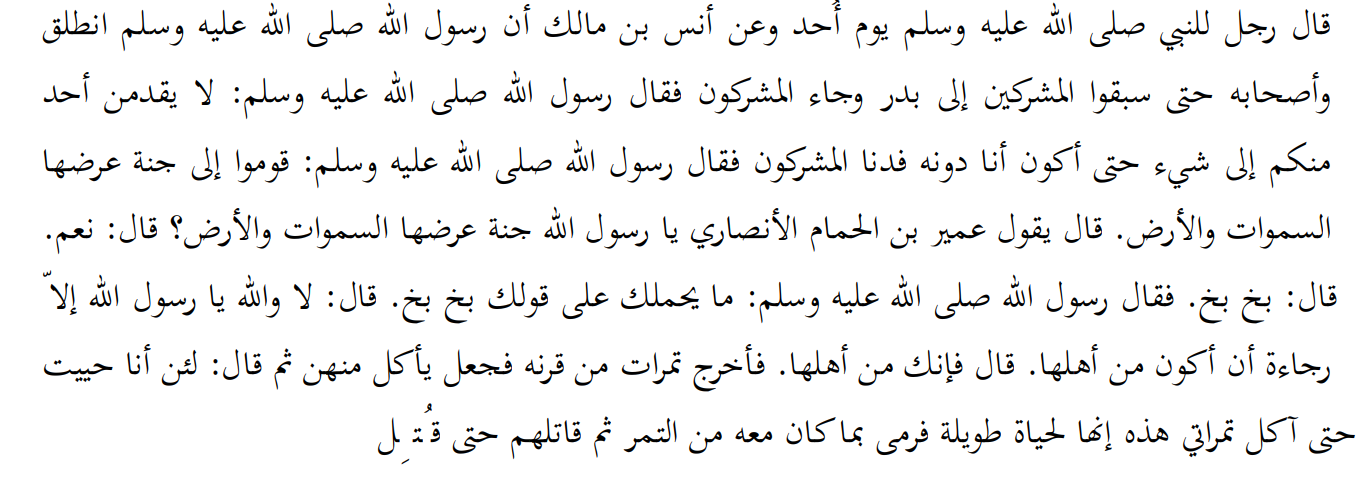
« Que nul d'entre vous ne précède quoi que ce soit sans ma présence. Les polythéistes s'étaient approchés, alors le Messager d'Allah ﷺ dit : "Avancez vers un Paradis dont la largeur est celle des cieux et de la terre." Il dit : 'Umayr bin al-Hammam al-Ansari dit : Ô Messager d'Allah, un Paradis dont la largeur est celle des cieux et de la terre ?" Il dit : (Bakh! Bakh!). Alors le Messager d'Allah ﷺ dit : "Qu'est-ce qui t'a poussé à dire (Bakh! Bakh!) ?" Il dit : "Rien, par Allah, si ce n'est l'espoir que je sois de ses gens." Il dit : "Certes, tu es de ses gens." Il retira des dattes de son (qaran) et commença à en manger. Puis il dit : "Si je vivais jusqu'à manger ces dattes, ce serait alors une longue vie !" Il jeta les dattes qu'il avait alors combattues jusqu'à ce qu'il soit tué » (Narré par Muslim).
“Let none of you precede to anything without my being. The polytheists came close so the Messenger of Allah (saw) said: Stand forth to a Paradise whose breadth is that of the heavens and the earth. He said: ‘Umayr bin al-Hammam al-Ansari said: O Messenger of Allah, a Paradise whose breadth is that of the heavens of the earth? He said: (Bakh! Bakh!). So the Messenger of Allah (saw) said: What carried you to your statement, (Bakh! Bakh!). He said: Nothing, by Allah, except the hope that I be one of its people. He said: Verily you are one of its people. He removed dates from his (qaran) and began eating from them. Then he said: If I were to live until I ate these dates, it would then be a long life! He threw the dates that had then fought them until he was killed” (Narrated by Muslim).
Ainsi, Allah (SWT) et le Messager d'Allah ﷺ ont témoigné du Paradis pour le shaheed. Quant à la vie du shaheed, elle est établie par le texte explicite du Coran. Allah (SWT) a dit :
So Allah (swt) and the Messenger of Allah (saw) have witnessed the Paradise for the shaheed. As for the life of the shaheed, it is established by the explicit text of the Qur’an. Allah (swt) said:
« Ne pense pas que ceux qui sont tués dans le sentier d'Allah sont morts, bien au contraire, ils sont vivants auprès de leur Seigneur, pourvus de subsistance. Ils sont satisfaits de ce qu'Allah leur a donné de Ses bienfaits et ils reçoivent de bonnes nouvelles pour ceux qui les suivent, qui ne les ont pas encore rejoints, qu'il n'y aura aucune crainte pour eux et qu'ils ne seront point affligés. Ils ont la bonne nouvelle de bénédictions d'Allah et de Sa grâce ; et certes, Allah ne laisse pas perdre la récompense des croyants » [TMQ 3:169].
“Do not think that those killed in the way of Allah are dead, rather (they are) alive with sustenance before their Lord. Pleased with what Allah gave them of His favours and with good tidings for those behind them who have not met them, that there is no fear for them nor do they grieve. They have glad tidings of blessings from Allah and His favour, and verily Allah does not cause the reward of the believers to be lost” [TMQ 3:169].
Cette vie pour les shuhadaa est invisible, ce que nous ne comprenons ni ne percevons, car elle se trouve dans la demeure éternelle. Bien que nous ne comprenions pas cette vie cachée et que nous ne la percevions pas, nous croyons néanmoins en son existence, sans pour autant en comprendre la réalité. Notre conviction en son existence est une question inévitable, car elle est établie par un texte coranique définitif. Allah (SWT) a dit :
This life for the shuhadaa is unseen which we do not understand nor perceive as it is in the eternal abode. Although we do not understand this hidden life nor perceive it, nevertheless we believe in its existence but do not understand its reality. Our conviction in its existence is an inevitable matter as it is established by a definite Qur’anic text. Allah (swt) said:
« Ne dites pas de ceux qui sont tués dans le sentier d'Allah qu'ils sont "morts"... Au contraire, ils sont vivants, mais vous ne le savez pas » [TMQ 2:154].
“Do not say of those killed in the way of Allah (are) ‘dead’... Rather they are alive but you do not know” [TMQ 2:154].
La vie des shuhadaa relève de l'invisible (matters) dans lequel la foi (Iman) est obligatoire. Quant à la vertu des shuhadaa, c'est une grande vertu sans équivalent et le Prophète ﷺ l'a clarifiée dans de nombreux hadiths. Al-Bukhari a rapporté de Qatadah qui a dit : J'ai entendu Anas bin Malik (ra) dire d'après le Prophète ﷺ qui a dit :
The life of the shuhadaa is from the unseen (matters) in which iman is obliged. As for the virtue of the shuhadaa, it is a great virtue without an equivalent and he (saw) clarified it in numerous ahadith. Al-Bukhari narrated from Qatadah who said: I heard Anas bin Malik (ra) from the Prophet (saw) who said:
« Quiconque entrera au Paradis ne souhaitera pas retourner dans ce bas monde pour obtenir tout ce qui s'y trouve, excepté les shuhadaa qui souhaiteraient retourner dans ce bas monde pour être tués dix fois en raison de ce qu'ils voient de l'honneur (karamah). »
“No one who enters Paradise would like to return to the world to obtain all that is upon the world except the shuhadaa who would wish to return to the world to be killed ten times due to what he sees of the honour (karamah).”
Et dans Al-Bukhari :
And in Al-Bukhari:
« Al-Mughira bin Shu’bah a dit que notre Prophète ﷺ nous a informé du message de notre Seigneur : quiconque est tué parmi nous entre au Paradis, et Umar a dit au Prophète ﷺ : « Nos morts ne sont-ils pas au Paradis et leurs morts en Enfer ? » Il a dit : « Oui. » »
“Al-Mughira bin Shu’bah said that our Prophet (saw) informed us of the message of our Lord that whoever is killed among us goes to Paradise and Umar said to the Prophet (saw): ‘Are not our dead in Paradise and their dead in the Fire. He said: Yes.”
Et d'après Abdullah bin ‘Amru bin al-‘Aas, le Messager d'Allah ﷺ a dit :
And from Abdullah bin ‘Amru bin al-‘Aas that the Messenger of Allah (saw) said:
« Tous les péchés du shaheed sont pardonnés, sauf la dette » (rapporté par Muslim).
“All the shaheed’s sins are forgiven except the debt” (narrated by Muslim).
« Tous les péchés du shaheed sont pardonnés, sauf la dette » (rapporté par Muslim).
“All the shaheed’s sins are forgiven except the debt” (narrated by Muslim).
« Celui qui est tué dans le sentier d'Allah voit tous ses péchés effacés, excepté la dette. »
“The one killed in the way of Allah has all his sins wiped out except the debt.”
Et Al-Bukhari et Muslim ont rapporté d'après Abu Hurairah (ra), d'après le Prophète ﷺ qui a dit :
And Al-Bukhari and Muslim narrated from Abu Hurairah (ra) from the Prophet (saw) who said:
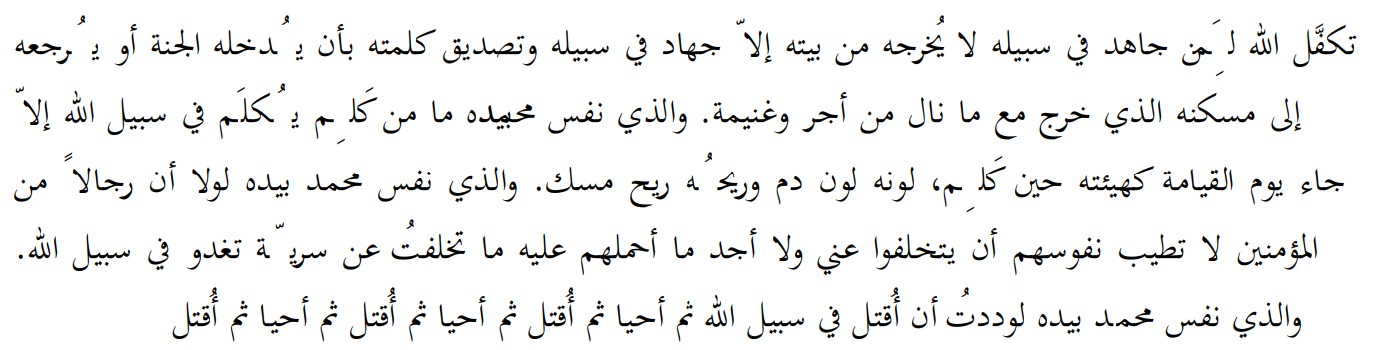
« Allah garantit la sécurité à celui qui meurt en faisant le jihad dans Sa voie, n'ayant quitté sa maison pour aucune autre raison que le jihad dans Sa voie et croyant en Ses paroles, qu'Il le fera entrer au Paradis ou qu'Il le fera retourner à sa demeure d'où il est parti, accompagné de ce qu'il a acquis comme récompense ou butin. Par Celui dans la main de qui se trouve l'âme de Muhammad ﷺ, quiconque est blessé dans la voie d'Allah ne viendra au Jour du Jugement que sous sa forme lorsqu'il a été blessé, sa couleur étant la couleur du sang et son odeur l'odeur du musc. Par Celui dans la main de qui se trouve l'âme de Muhammad ﷺ, s'il n'y avait pas parmi les croyants des hommes dont les âmes ne sont pas disposées à rester derrière moi (quand je pars) et que je ne trouve personne pour les porter, je ne resterais derrière aucune expédition qui part dans la voie d'Allah le matin. Par Celui dans la main de qui se trouve l'âme de Muhammad ﷺ, j'aimerais mourir dans la voie d'Allah, puis être ressuscité, puis tué, puis ressuscité, puis tué, puis ressuscité, puis tué. »
“Allah guarantees security for the one who dies jihad in His way, not leaving his house for any other reason except jihad in His way and believing in His words, that He will enter him into Paradise or return him to his abode from which he left together with what he achieved of reward or booty. By the One in whose hand lies the should of Muhammad, whoever is wounded in the way of Allah will not come on the Day of Judgement except in his form when he was wounded, his colour the colour of blood and his odour the odour of musk. By the one in whose hand lies the soul of Muhammad, were it not that there were men among the believers whose souls are not pleased to stay behind me (when I go) nor do I find that could carry them upon, I would not stay behind any expedition that goes out in the way of Allah in the morning. By the One in whose hand lies the soul of Muhammad, I would love to die in the way of Allah then I am resurrected then killed, then resurrected then killed, then resurrected then killed.”