2.7 Al-qadā’ Wa‘l-qadar
2.7 Al-qadā’ Wa‘l-qadar
Al-qadā’ wa‘l-qadar, sous ce nom, c'est-à-dire en reliant deux mots pour un seul sens, possède un référent spécifique ; c'est-à-dire al-qadā’ lié à al-qadar, en faisant d'eux deux questions concomitantes dont l'une n'est pas séparable de l'autre, et qui possèdent un sens qui leur est exclusif. Il n'est pas correct d'y inclure autre chose que ce sens qui n'a pas été utilisé par les compagnons (Sahabah) ou les successeurs (Tabi’un). En étudiant les textes islamique (Shar’i) et linguistiques et en étudiant les paroles des compagnons (Sahabah), des successeurs (Tabi’un) et de ceux qui les ont suivis parmi les savants (Ulama), il apparaît que les termes al qadā’ wa‘l-qadar ensemble n'ont pas été utilisés avec un sens technique [istilāhī] spécifique par aucun des compagnons (Sahabah) ou successeurs (Tabi’un), et qu'ils ne sont pas apparus ensemble avec un sens technique spécifique dans le Coran ou le hadith ; bien qu'ils soient apparus ensemble dans leur sens linguistique dans ce qu'al Bazzār a rapporté du hadith de Jabir avec une chaîne hasan d'après le Prophète ﷺ qui a dit :
Al-qadā’ wa‘l-qadar, with this name, that is, by connecting two words together for one meaning, has a specific referent; that is, al-qadā’ linked to al-qadar, by making them two concomitant matters whereby one is not separable from the other, and they have a meaning that is exclusive to them. It is not correct to include in it other than this meaning which has not been used by the Sahabah or the Tabi’een. By studying the shar’i and linguistic texts and studying the sayings of the Sahabah, Tabi’een and those who came after them from the Ulama’, it is apparent that the terms al qadā’ wa‘l-qadar together, have not been used with a specific technical [istilāhī] meaning by any of the Sahabah or Tabi’een, nor have they come together with a specific technical meaning in the Qur’ān or the Hadīth; though they have come together in their linguistic meaning in what al Bazzār reported from the hadīth of Jabir with a hasan chain on the authority of the Prophet (PBUH) that he said:
« La plupart de ma communauté (Ummah) meurent après le qadā’ d'Allah et Son destin (Qadar) avec les âmes [anfūs]. »
“Most of my Ummah die after the qadā’ of Allaah and his qadar with the souls [anfūs].”
Par conséquent, ce sens terminologique qui fait allusion à ce nom n'est trouvé que chez les Mutakallimūn, après que le premier siècle fut passé et après la traduction de la philosophie grecque. Il n'existait pas à l'époque des compagnons (Sahabah), et il n'y avait aucune dispute ou discussion concernant ces deux termes comme étant un seul nom pour un sens technique spécifique. Tout au long de l'ère des compagnons (Sahabah), les musulmans ne connaissaient pas « al-qadā’ wa’l-qadar », bien que le mot qadā’ soit apparu seul et que le mot qadar soit apparu seul dans les hadiths, tout comme les deux étaient apparus ensemble dans le hadith de Jabir mentionné précédemment, mais dans tous ces cas, ils étaient apparus dans le sens linguistique. Ils ne sont pas apparus dans le sens technique. Le mot qadā’ est apparu dans le hadith d'al-qunut. Al-Hasan a dit : le Messager d'Allah ﷺ m'a enseigné des paroles que je prononce dans le qunut du witr, puis il a mentionné l'invocation (Du’a) du qunut, dont voici une partie,
Therefore this terminological meaning which alludes to this name is not found except from the Mutakallimūn, after the first century had passed and after the translation of the Greek philosophy. It did not exist in the time of the Sahabah nor was there any dispute or discussion of those two terms as one name for a specific technical meaning. Throughout the era of the Sahabah the Muslims did not know of ‘al-qadā’ wa‘l-qadar’ though the word qadā’ had come on its own and the word qadar had come on its own in the ahadīth just as the two had come together in the aforementioned hadīth of Jabir, but in all of these cases they had come in the linguistic meaning. They have not come in the technical meaning. The word qadā’ has come in the hadīth of al-qunut. Al-Hasan said, the Messenger of Allah (PBUH) taught me words I say in the qunut of the witr, then he mentioned the du’a of qunut, of which is,
« ...et préserve-moi de ce que Tu as décrété, car Tu es Celui qui décrète et Tu n'es pas soumis au décret, » [Reported by al-Darimi , Narrated by al-Hasan ibn Ali]
“...and save me from what You have decreed, for You are the one Who Decrees and you are not decreed upon,” [Reported by al-Darimi , Narrated by al-Hasan ibn Ali]
Sa signification est : protège-moi du mal de ce que Tu as décrété, car Tu juges ce que Tu veux et nul ne Te juge. Le mot destin (Qadar) est apparu dans le hadith de Jibrīl dans certaines de ses narrations : Il ﷺ a dit,
Its meaning is, protect me from the evil of what you have judged, for you judge what you wish and no one judges over you. The word qadar has come in the hadīth of Jibrīl in some of its narrations: He said,
« Et croire en al-qadar, en ce qu'il y a de bien et de mal en lui », [Reported by Muslim, Narrated by Umar ibn al-Khattab]
“And to believe in al-qadar, the good and the bad thereof”, [Reported by Muslim, Narrated by Umar ibn al-Khattab]
Et dans sa parole du ﷺ
And in his saying
«... Si quoi que ce soit vous arrive, ne dites pas : "Si j'avais fait (cela), il se serait passé telle ou telle chose", mais dites plutôt : "Allah a décrété [qaddara] et Il a fait ce qu'Il a voulu", » [Reported by Muslim, Narrated by Abu Hurairah]
“…If anything befalls you do not say, ‘had I done (this), it would have been such-and-such, but rather say, ‘Allah determined [qaddara] and He did what He willed,’”[Reported by Muslim, Narrated by Abu Hurairah]
Le sens du mot qadar dans ces deux hadiths est la Détermination [taqdīr] et la Connaissance d'Allah (SWT), c'est-à-dire que vous devez croire que les choses ont été écrites par Allah (SWT) dans le Lawh al-Mahfūdh et qu'Il (SWT) en connaît l'existence avant qu'elles ne surviennent, qu'elles soient bonnes ou mauvaises ; et dire qu'Allah (SWT) a écrit cela dans le Lawh al-Mahfūdh et qu'Il (SWT) le savait avant qu'il ne survienne et qu'Il (SWT) a fait ce qu'Il a voulu. Le mot al-qadā’ dans le sens où il est apparu dans ce hadith ou partout ailleurs où il est apparu n'a pas été contesté par les Musulmans ; ils n'ont pas eu de discussions concernant sa formulation ou sa portée.
The meaning of the word qadar in these two ahadīth is the Determination [taqdīr] and Knowledge of Allah , that is, that you should believe that the things have been written by Allah in the Lawh al-Mahfūdh and He knows of them before they come into existence, whether they be good or bad; and say Allah has written this in the Lawh al-Mahfūdh and he knew it before it came into being and he did what he wished. The word al-qadā’ in the meaning which it came in this hadīth or anywhere else it came was not disputed by the Muslims; they did not have discussions with regards to its wording or its import.
Quant au mot destin (Qadar) dans le sens mentionné dans ces deux hadiths, les musulmans, avant la présence de la philosophie grecque, ne divergeaient pas à son sujet et n'avaient pas de discussions concernant sa formulation ou sa portée. Mais après l'apparition de la philosophie grecque parmi les musulmans, un groupe de Kufa surgit et dit : il n'y a pas de destin (Qadar), c'est-à-dire qu'il n'y a personne qui (pré)détermine et que tout se produit sans aucune détermination préalable ; ils furent appelés les Qadariyyah et ce sont eux qui nient le destin (Qadar) et disent qu'Allah (SWT) a créé les fondements des choses puis les a laissées, de sorte qu'Il (SWT) n'a pas connaissance de leurs détails [juz'iyāt]. Cela est contraire à ce qui est passé dans le texte clair du Qur'ān qui stipule qu'Allah (SWT) est le Créateur de toutes choses, petites ou grandes, fondamentales ou branchiales, et qu'Il (SWT) a déterminé chaque chose avant son existence, c'est-à-dire qu'Il (SWT) l'a écrit dans le Lawh al-Mahfūdh, c'est-à-dire qu'Il (SWT) le savait avant qu'il ne survienne. Il (SWT) a dit :
As for the word qadar in the meaning mentioned in those two ahadīth, the Muslims, before the presence of Greek philosophy, did not disagree about it or have discussions with regards to its wording or import. But after the presence of the Greek philosophy amongst the Muslims, a group from Kufa arose and said: there is no qadar, that is, there is no one who (pre)determines and everything occurs without any previous determination; they were called the Qadariyyah and they are the ones who deny the qadar and say that Allah created the fundamentals of things and then left them, so He does not have knowledge of their particulars [juz'iyāt]. This is contrary to what has come in the clear text of the Qur’ān which states that Allah is the Creator of all things, small or big, fundamental or branchial, and that He determined everything before its existence, that is, He wrote it in the Lawh al-Mahfūdh, that is, He knew it before it came to be. He said:
« Il a créé toute chose et Il est l'Omniscient de toute chose » [TMQ-An’ām: 101]
“He created all things and He is the All-Knower of everything” [TMQ-An’ām: 101]
Et
And
« Et Il sait tout ce qui se trouve sur la terre et dans la mer : pas une feuille ne tombe qu'Il ne la sache. Il n'y a pas un grain dans l'obscurité de la terre, ni rien de frais ou de sec, qui ne soit écrit dans un Registre Clair. » [TMQ-An’ām: 59]
“And He knows whatever there is in the Earth and in the sea: not a leaf falls, but He knows it. There is not a grain in the darkness of the Earth nor anything fresh or dry, but is written in a Clear Record.” [TMQ-An’ām: 59]
Cependant, ce désaccord et cette discussion ne concernent que le « destin (Qadar) d'Allah » en ce qui concerne Sa Science. Ainsi, les Qadariyyah ont prétendu qu'Allah (SWT) connaît les principes fondamentaux des choses mais pas leurs aspects particuliers, tandis que l'Islam stipule qu'Allah (SWT) connaît les principes fondamentaux des choses ainsi que leurs aspects particuliers. Ainsi, la discussion concernant le destin (Qadar) d'Allah (SWT), c'est-à-dire Sa Science, porte sur le sujet de la Science d'Allah. C'est un sujet différent de celui d'al-qadā’ wa‘l-qadar. C'est une discussion différente, distincte de la discussion d'al-qadā’ wa‘l-qadar. Sa réalité qui a eu lieu est la même, c'est-à-dire qu'il s'agit d'un sujet différent de celui d'al-qadā’ wa‘l-qadar.
However, this disagreement and discussion is only with respect to the ‘qadar of Allah’ in terms of His Knowledge. So the Qadariyyah claimed that Allah knows the fundamentals of things but not their partial aspects, whilst Islam states that Allah knows the fundamentals of things as well as their partial aspects. Thus, the discussion with respect to the qadar of Allah , that is, His Knowledge, is about the subject of Allah's Knowledge. It is a subject different to that of al-qadā’ wa‘l-qadar. It is a different discussion, separate from the discussion of al-qadā’ wa‘l-qadar. Its reality that took place is the same, that is, it is a different subject to that of al-qadā’ wa‘l-qadar.
Ainsi, il est manifestement évident que les mots al-qadā’ et al-qadar sont apparus chacun de leur côté, chacun ayant une signification spécifique. Ils n'ont aucun rapport avec l'étude d'al-qadā’ wa‘l qadar. En d'autres termes, le mot al-qadā’ dans tous ses sens linguistiques et islamiques (Shar’i) provenant du Législateur, et le mot al-qadar dans tous ses sens linguistiques et islamiques (Shar’i) provenant du Législateur, n'ont aucun rapport avec l'un de ces termes, qu'ils soient mentionnés seuls ou ensemble, dans la discussion d'al-qadā’ wa‘l-qadar. Ils se limitent, quant à leur signification, à ce qu'ils comportent en tant que sens linguistiques et islamiques (Shar’i).
Thus, it is plainly apparent that the words al-qadā’ and al-qadar have each come on their own with each having a specific meaning. They do not have any relation with the study of al-qadā’ wa‘l qadar. In other words, the word al-qadā’ in all its linguistic and shar’i meanings that have come from the Legislator, and the word al-qadar in all its linguistic and shar’i meanings that have come from the Legislator, have no relation to any of these terms, whether mentioned alone or together, in the discussion of al-qadā’ wa‘l-qadar. They are confined with regards to their meaning, to that what they come with from the linguistic and shar'i meanings.
Les versets (Ayah) qui sont venus pour démontrer la Connaissance d'Allah (SWT) sont ceux qui indiquent la nature omnisciente de la Connaissance d'Allah (SWT) à l'égard de toutes choses, ainsi que Sa parole (SWT) :
« Aucun malheur ne frappe la Terre, ni vous-mêmes, sans qu'il ne soit inscrit dans un Livre, avant que Nous ne le fassions exister. Certes, cela est facile pour Allah. » [TMQ-Hadīd: 22]
“No calamity befalls on the Earth or in yourselves but is inscribed in a Book, before We bring it into existence. Indeed, that, upon Allah, is easy” [TMQ-Hadīd: 22]
Et Sa parole (SWT),
And His saying,
« Dis : "Rien ne nous arrivera, si ce n'est ce qu'Allah a décrété pour nous. Il est notre Mawla." En Allah donc, que les croyants placent leur confiance. » [TMQ Tawba: 51]
“Say: ‘Nothing shall ever happen to us except what Allah has ordained for us. He is our Mawla.’ Then in Allah let the believers put their trust” [TMQ Tawba: 51]
Et Sa parole (SWT),
And His saying,
« Rien n'échappe à Sa Science, pas même le poids d'un atome, dans les Cieux ou sur la Terre, que ce soit moins ou plus, mais tout est consigné dans un Livre Clair » [TMQ Saba: 3]
“Escapes not from His Knowledge even the weight of an atom, in the Heavens or in the Earth, or less than that, or greater, but it is in a Clear Book” [TMQ Saba: 3]
Et Sa parole (SWT),
And His saying,
« C'est Lui qui reprend vos âmes pendant la nuit, et (qui) connaît tout ce que vous avez fait pendant le jour, puis Il vous ressuscite pour qu'un terme fixé soit accompli, ensuite c'est vers Lui que sera votre retour. Puis Il vous informera de ce que vous aviez l'habitude de faire. » [TMQ An’ām: 60]
“It is He, Who takes your souls by night, and (Who) has knowledge of all that you have done by day, then He raises (wakes) you up again that a term appointed be fulfilled, then unto Him will be your return. Then He will inform you what you used to do” [TMQ An’ām: 60]
Ces versets ont été révélés au Messager ﷺ et ils ont été mémorisés et compris par les compagnons (Sahabah) ; il ne leur est pas venu à l'esprit de discuter d'al-qadā’ wa‘l-qadar. De plus, la formulation, la compréhension et l'indication de ces versets stipulent qu'ils sont une clarification concernant la Science d'Allah (SWT) et n'ont aucun rapport avec l'étude d'al-qadā’ wa‘l-qadar. De même pour le verset (Ayah),
These verses were revealed to the Messenger (PBUH) and they were memorised and understood by the Sahabah, it did not occur to them to discuss al-qadā’ wa‘l-qadar. Furthermore, the wording, understanding and indication of these verses states that they are a clarification about the Knowledge of Allah and have no relation to the study of al-qadā’ wa‘l-qadar. Similarly the ayah,
« Et si un bien leur parvient, ils disent : "Ceci vient d'Allah", mais si un mal les frappe, ils disent : "Ceci vient de toi". Dis : "Toutes choses viennent d'Allah" ; mais qu'ont-ils donc, que ces gens ne comprennent-ils aucune parole ? » [TMQ-Nisā’: 78]
“And if some good reaches them, they say, ‘This is from Allah’, but if some evil befalls them, they say, ‘This is from you’. Say: ‘All things are from Allah’; so what is wrong with these people that they fail to understand any word?’ [TMQ-Nisā’: 78]
Cela n'a rien à voir avec la discussion sur al-qadā’ wa‘l-qadar car il s'agit d'une réfutation des mécréants (Kafir) qui ont fait une distinction entre le mal et le bien. Ainsi, ils ont fait venir le mal du Messager ﷺ et le bien d'Allah (SWT). Alors Allah (SWT) les a réfutés en déclarant que toute chose provient d'Allah (SWT). La discussion ne porte pas sur le bien qu'un être humain accomplit et le mal qu'il poursuit ; la discussion porte plutôt sur le combat et la mort. Le verset (Ayah) lui-même et ce qui le précède clarifient cela :
It has nothing to do with the discussion of al-qadā’ wa‘l-qadar because it is a refutation of the kuffār who differentiated between bad and good. Thus, they made bad to come from the Messenger and good from Allah . So Allah refuted them by declaring that everything is from Allah . The discussion is not about the good that a human being does and the evil that he pursues; rather the discussion is about fighting and death. The ayah itself and that what precedes it clarifies this:
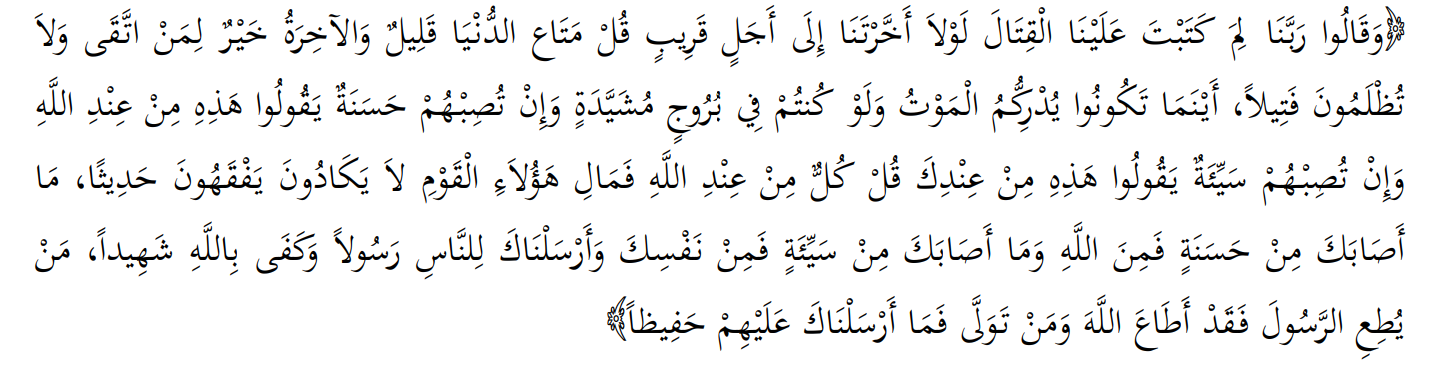
« Ils disent : "Ô notre Seigneur ! Pourquoi nous as-tu prescrit le combat ? Si seulement Tu nous avais accordé un délai pour un court moment !" Dis : "Le plaisir de ce monde est court. L'au-delà est certes meilleur pour celui qui craint Allah, et vous ne serez point traités injustement, pas même le moins." Où que vous soyez, la mort vous atteindra, même si vous vous trouvez dans des forteresses bâties, solides et hautes ! Et si un bien leur parvient, ils disent : "Ceci vient d'Allah", mais si un mal les frappe, ils disent : "Ceci vient de toi." Dis : "Tout vient d'Allah", qu'ont-ils donc que ces gens ne parviennent pas à comprendre la moindre parole ? Quel que soit le bien qui vous parvient, il vient d'Allah, mais quel que soit le mal qui vous frappe, il vient de vous-mêmes. Et Nous t'avons envoyé (O Muhammad ﷺ), ô Messager, comme envoyé vers les hommes, et Allah suffit comme Témoin. Celui qui obéit au Messager ﷺ a certes obéi à Allah, mais celui qui se détourne, alors Nous ne t'avons pas envoyé comme un gardien sur eux. » [TMQ-Nisā’: 77-80]
“They say: Our Lord! Why have you ordained for us fighting? Would that you have granted us respite for a short period?’ Say: ‘Short is the enjoyment of this world. The Hereafter is (far) better for him who fears Allah, and you shall not be dealt with unjustly in the least. Wheresoever you may be, death will overtake you even if you are in fortresses built up strong and high! And if some good reaches them, they say, ‘This is from Allah,’ but if some evil befalls them, they say, ’This is from you.’ Say: ‘All things are from Allah’, so what is wrong with these people that they fail to understand any word? Whatever of good reaches you, is from Allah, but whatever of evil befalls you, is from yourself. And We have sent you (O Muhammad) as a Messenger to mankind, and Allah is sufficient as Witness. He who obeys the Messenger, has indeed obeyed Allah, but he who turns away, then we have not sent you as a watcher over them.” [TMQ-Nisā’: 77-80]
Ainsi, le sujet est ce qui leur arrive et non ce qu'ils font. Par conséquent, cela n'a aucun rapport avec l'étude d'al-qadā’ wa‘l-qadar.
So the subject is what befalls them and not what they are doing. Thus it has nothing to do with the study of al-qadā’ wa‘l-qadar.
Par conséquent, tout ce qui a été mentionné ci-dessus n'a rien à voir avec l'étude d'al-qadā’ wa‘l qadar ; cela ne rentre pas dans son sens et n'a absolument aucun rapport avec ce qui a été mentionné plus haut. Au contraire, al-qadā’ wa‘l-qadar en tant que concept provient de la philosophie grecque qui a été transmise par les Mu'tazilah qui ont émis une opinion à ce sujet. Ahl al-Sunnah et les Jabriyyah les ont réfutés, et Ahl al-Sunnah a (également) réfuté les Jabriyyah. La discussion était limitée au même sens et reposait sur la même prémisse. Ainsi, la question est un sens/concept issu de la philosophie grecque et il est apparu au premier plan dans le débat qui avait lieu entre les musulmans et les mécréants (Kafir) qui étaient armés de la philosophie grecque. C'est un sens qui a une pertinence avec la croyance (Aqeedah), ainsi ce qui est souhaité est de donner l'opinion de l'Islam concernant ce sens. Les Mu'tazilah ont donné une opinion, les Jabriyyah les ont réfutés et ont donné une autre opinion. Ahl al-Sunnah les a tous réfutés et a donné une opinion, en disant à son sujet qu'il s'agit d'une troisième opinion issue des deux autres opinions, et ils l'ont décrite comme « le lait pur, doux à boire, qui sort entre les excréments et le sang ».
Therefore, all that has been mentioned above has nothing to do with the study of al-qadā’ wa‘l qadar; they do not come under its meaning and have no relation whatsoever with what has been mentioned above. Rather, al-qadā’ wa‘l-qadar as a meaning has come from Greek philosophy which was transmitted by the Mu'tazilah who gave an opinion with regards to it. Ahl al-Sunnah and the Jabriyyah refuted them and Ahl al-Sunnah (also) made a refutation of the Jabriyyah. The discussion was confined to the same meaning and preceded upon the same premise. Thus the issue is a meaning/sense that came from Greek philosophy and it came to the fore in the debate which used to take place between the Muslims and the kuffar who used to be armed with the Greek philosophy. It is a meaning which has a relevance to the ‘aqīdah (creed), thus what is desired is to give Islam's opinion regarding this meaning. The Mu'tazilah gave an opinion and the Jabriyyah refuted them and gave another opinion. Ahl al-Sunnah refuted all of them and gave an opinion, and said about it that it is a third opinion which has come out from the two opinions and they described it as ‘the pure milk, sweet to drink, that comes out from between excrement and blood’.
Par conséquent, le sujet de discussion, issu de la philosophie grecque, est devenu connu, et puisqu'il est lié à la croyance (Aqeedah), le musulman doit être clair sur ce qu'est sa croyance concernant ce sujet. Les musulmans ont en réalité exprimé leur opinion et trois écoles de pensée ont surgi. Ainsi, il n'est pas permis de se référer à la question d'al-qadā’ wa'l-qadar par ce qui découle du sens d'al-qadā’ ou d'al-qadar, linguistiquement et dans la charia, ni il n'est permis d'imaginer ou de concevoir pour al-qadā’ ou al-qadar un quelconque sens issu de la simple supposition, de la conception ou de l'imagination, et de dire, par exemple, qu'al-qadā’ est le jugement universel portant uniquement sur les universaux et qu'al-qadar est le jugement universel sur les aspects particuliers et leurs détails, ou de dire qu'al-qadar est le plan éternel des choses et qu'al-qadā’ est l'exécution et la création selon cette prédétermination et ce plan. En vérité, cela n'est pas permis car il ne s'agit que d'imagination, d'hypothèse et d'une tentative infructueuse d'appliquer certaines expressions linguistiques et islamiques (Shar’i) parce qu'elles ne s'y appliquent pas, mais indiquent plutôt des sens généraux ; ce serait alors une action arbitraire que de restreindre les deux mots à ces sens spécifiques sans preuve.
« Chaque âme est l'otage de ce qu'elle a acquis, » [TMQ Muddathir: 38]
“Every soul is a pledge for what it earns,” [TMQ Muddathir: 38]