10.2 ムファッスィルーンの注釈的アプローチ
10.2 The Exegetical Approaches Of Mufassirun
サハーバ(教友)たちは、高貴なクルアーンの節の解釈(タフスィール)を、自らのイジュティハード(独自の努力による理解)によって行うこともあれば、預言者ムハンマド ﷺ から聞いたことによって行うこともありました。多くの場合、彼らは節の啓示の原因を説明したり、その節が誰に関して啓示されたのかを説明したりしました。節を解説するにあたっては、その節から理解された言語的な意味を、最も簡潔な言葉で明らかにすることに努めました。たとえば、彼らの「ghayr mutajanif li ithm(罪に傾いていない)」という表現は、すなわち「ghayr muta'arrid li ma'siyya(罪へと身を晒していない、罪に陥りやすくない)」、つまり罪へと予め傾いていないことを意味します。同様に、彼らの次の言葉、すなわち神の御言葉についての発言も同じです。
The Sahabah made tafsīr for the verses of the Noble Qur’ān either as their own Ijtihād in tafsīr or by hearing it from the Messenger of Allah . Many a time they would explain the cause of revelation for a verse or explain with respect to whom it had been revealed. In explaining a verse they would restrict themselves to elucidating the linguistic meaning which they understood from the verse with the most concise of words like their saying: ghayr mutajanif li ithm (not inclined to sin) i.e, not predisposed to sin (ghayr muta'arrid li ma'siyya). Similarly their statement regarding His saying:
「また、吉凶を占うために矢を用いることも禁じられている」 [TMQ Mā’idah: 3]
“(Forbidden) also is to use arrows seeking luck or decision” [TMQ Mā’idah: 3]
ジャーヒリーヤの人々は、誰かが(旅に)出かけようとすると、矢を一本取り、「この矢は私に出かけるよう命じている」と言った。もし彼が旅に出れば幸運に出会うのだ、と。そしてもう一本の矢を取り、「この矢は私に留まるよう命じている」と言った。そうすれば旅では幸運に恵まれないのだ、と。不運な矢は二本の矢のうちの一方である。それゆえアッラーは、この慣行を彼らに禁じられた。その例として、イブン・アッバースについて伝えられていること、すなわち彼の次の言葉に関するものがある:
The people of jahiliyya when one of them wanted to go out (on a journey) he would take an arrow and say: This one orders me to go out. So if he goes out on his journey will meet good luck. And he will take another arrow and say: This one orders me to stay, so he will not be lucky in his journey. The unlucky arrow is one of the two arrows. So Allah forbade them from this practice. An example would be what has been narrated about Ibn 'Abbas regarding His saying:
「まことに、かれは必ずあなたを帰還の地(マアード)へ連れ戻されるでしょう」 [TMQ Qasas: 85]
“ He will surly bring you back to the ma'ad (place of return)” [TMQ Qasas: 85]
彼は言った。「マッカへ」。もしこれに何かが付け加えられているとすれば、それは啓示の原因や、その節が誰について下されたのかに関して伝えられていることであろう。アブー・フライラについては、次の御言葉に関して伝えられている。
He said: to Makkah. If they added anything to that it would be what has been narrated about the cause of revelation and with regards to whom the verse in question was revealed. It has been narrated about Abu Hurairah regarding His saying:
「まことに、あなた(ムハンマドよ)は、あなたが望む者を導くことはできない」 [TMQ Qasas: 56]
“Verily ! You (O Muhammad (saw)) guide not whom you like” [TMQ Qasas: 56]
彼が、その節は預言者ムハンマド ﷺ がおじのアブー・ターリブをイスラームに帰依させようとした際に下されたものだと述べた、と伝えている。その後、サハーバ(教友)の後に来たのがタービウーン(追随者)であり、彼らはサハーバが語ったすべてのことを同じ方法で伝えた。タービウーンの中には、クルアーンの節を解説し、啓示の原因を述べた者もいたが、それは自らのタフスィールにおけるイジュティハード(独自の努力による判断)によるものか、あるいは(他の典拠から)聞いたことによるものであった。タービウーンの後にウラマーが現れ、タフスィールを拡充し、ユダヤ教徒やキリスト教徒からの伝承を引用した。各時代、各世代において、ムファッシルーン(注釈者)が次々と現れ、クルアーンを解説し、先人の業の上にそれぞれの時代のタフスィールを拡充していった。ムファッシルーンは、節から法規定を導き出すことに関心を向け、自由意志(イフティヤール)と予定説(ジャブル)の観点から自らの学派を説明するようになった。また、立法、スコラ神学(イルム・アル=カラーム)、修辞学(バラーガ)、語形論(サルフ)、文法などに従い、自らの傾向に沿った見解を証明する節を解説するようになった。サハーバの時代から現在に至るまでの各時代のタフスィール書を検討すると明らかになるのは、クルアーンのタフスィールは、どの時代においても、その時代の学術運動の影響を受けてきたということである。それはその時代の見解、理論、学派を反映した姿を示していた。その時代の意見、思想、規範の影響を免れたタフスィール書はまれであった。
that he said the verse had been revealed concerning the Messenger of Allah when he tried to win over his uncle Abu Talib to Islam. Then came the Tabi'un after the Sahabah who reported everything the Sahabah mentioned in this manner. From among the Tabi'un there were those who explained the verses of the Noble Qur’ān or stated the cause of revelation, either as their own Ijtihād in tafsīr or by hearing it from (other authorities). After the Tabi'un the 'Ulama came and expanded the tafsīr and quoted reports from the Jews and Christians. The mufassirun succeeded one after another in every age and generation, who explained the Qur’ān and expanded the tafsīr in each age on what had come before. The mufassirun began to give their attention to the verses to deduce rulings from them and explain their schools of thought in terms of freewill (ikhtiyar) and predestination (jabr). And they began to explain verses proving their opinions according to their inclinations in legislation, scholasticism ('ilm al-Kalam), rhetorics (balaagha), declension (sarf) and grammar etc. What is apparent from an examination of the tafaseers through the different ages since the time of the Sahabah until now is that the tafsīr of the Qur’ān in every age was influenced by the scholarly movement of the time, it presented a picture which reflected the views, theories and schools of thought of the time. Seldom were there tafsīrs that were free from the influence of opinions, thoughts and rules of the time.
しかし、これらのタフスィールはすべて、ムファッスィルーンが存在し始めた当初から書物にまとめられていたわけではない。むしろ、それらは時代を経るにつれて状況に応じて変化してきたのである。当初、タフスィールはハディースの一部であり、その一章をなしていた。ハディースは、イスラームのあらゆる学問分野を包含する非常に広範な主題であった。そのため、ハディースの伝承者は、法的な裁定を含むハディースを伝えるのと同様に、クルアーンの節の注釈を含むハディースも伝えたのである。 その後、アッバース朝の初期およびウマイヤ朝の末期、すなわちヒジュラ暦第2世紀の初頭に、著述家たちは類似し関連するすべてのハディースを一つの主題のもとにまとめ、他の主題から分離し始めた。こうして、ハディースに含まれていたタフスィールやフィクフといった学問が互いに分かれていった。その学問分野から生じたものが、ハディース、シーラ、法学、タフスィールの各面で生じた結果である。こうしてタフスィールの学問が成立し、それ自体として独立して研究される学問となった。 しかしながら、タフスィールはまだ体系的な形式をとってはいなかった。すなわち、クルアーンの節はムスハフ(クルアーン)にある配列のように秩序立てて挙げられ、それに続いてその注釈が示されるということはなかった。むしろ、伝えられたタフスィールはあちこちに散在していた。ハディースの場合と同様に、それらは様々な節に対する注釈であった。この状況は、タフスィールがハディースから分離し、独立した学問として立つようになるまで続いた。ムスハフの順序に従ってクルアーンの各節、あるいは節の一部ごとにタフスィールが書かれるようになったのである。クルアーンを節ごとに引用し、一つ一つ順に解説する形でタフスィールを著した最初の人物は、アル=ファッラー(没、ヒジュラ暦207年)であった。イブン・アル=ナディームは、その著書『アル=フィフリスト』で次のように伝えている。
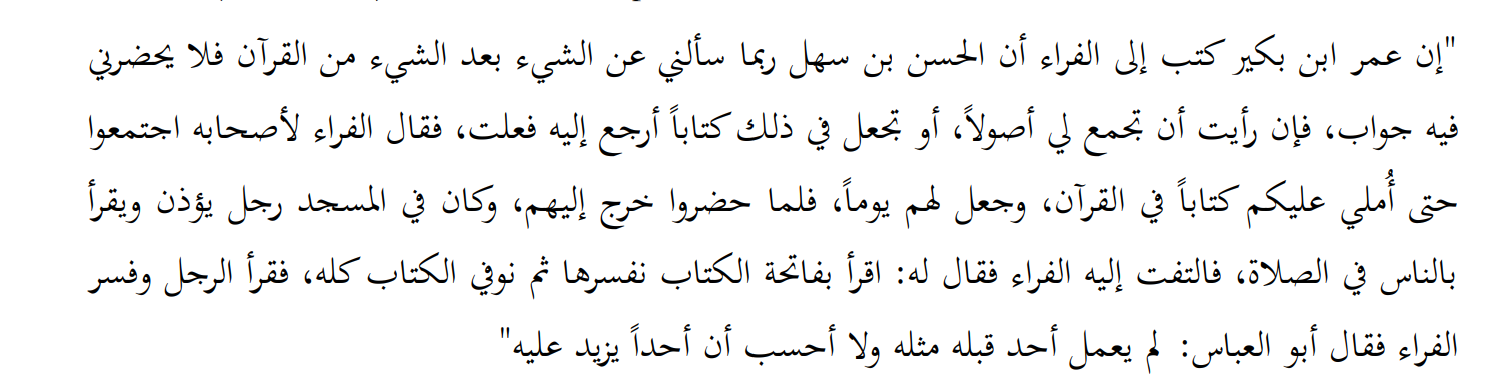
「ウマル・イブン・ブカイルはアル=ファッラーゥに手紙を書き、アル=ハサン・イブン・サfrを挙げた。アル=ハサン・イブン・サフルは、クルアーンについて次々と質問してくるかもしれないが、そのすべての答えを思い出せないだろう、と伝えた。そこで、要点をまとめてひとつの本にし、それを参照できるようにしてはどうか、と勧めた。するとアル=ファッラーゥは弟子たちに言った。『集まってくれ。クルアーンについての本を口述するから。』彼は弟子たちに一日の猶予を与えた。弟子たちが集まると、彼はモスクへ行った。そこにはアザーンを唱え、人々と共に礼拝でクルアーンを朗誦している男がいた。アル=ファッラーゥは彼の方を向き、言った。『クルアーンの冒頭の章(ファーティハ・アル=キターブ)を朗誦しなさい。私たちがそれを解説し、それから書物全体について詳しく語ろう。』男が朗誦すると、アル=ファッラーゥはタフスィールを行った。アブー・アル=アッバースは言った。『彼のようなことをした者は以前いなかったし、誰もそれに付け加えることはできないと私は思う。』」
“Umar ibn Bukayr wrote to al-Farra' that al-Hasan ibn Sahl perhaps may ask me one thing after another from the Qur’ān but I will not be able to recall all the answers. I think you should bring together the essential points and compile them in a book I will refer to it, so al-Farra' said to his students; gather together so that I can dictate to you a book about the Qur’ān. He gave them a day. When they came he went to them, in the mosque there was man giving azan and reciting the Qur’ān with the people in prayer. Al-Farra' turned to him and said: recite the opening chapter of the Qur’ān (fatihatul kitab), we will explain it and then we will speak fully about the whole book. The man recited and al-Farra' made tafsīr. Abu al-'Abbas said: no one did anything like him before and I don't think anyone can add to that.'
その後、アル=タバリー・イブン・ジャリール(没後310年ヒジュラ)が登場し、彼の有名なタフスィールを著しました。イブン・ジャリールのタフスィール以前にも、イブン・ジュライジュのタフスィールのように、いくつものタフスィールが広く知られるようになりました。彼の状況は、初期のムハッディス(ハディース学者)たちの状況と同じでした。彼らは、自分たちに伝えられたものをすべて、正しい(サヒーフ)報告と誤った報告を区別することなく収集したのです。彼らは「イブン・ジュライジュの目的は真正性ではなかった。むしろ、すべての節について伝えられたことを、それが正しい(サヒーフ)ものであれ弱い(サキーム)ものであれ、すべて報告した」と言いました。これらのタフスィールには、アル=スッディー(没後127年ヒジュラ)のタフスィールやムカーティル(没後150年ヒジュラ)のタフスィールも含まれます。アブドゥッラー・イブン・アル=ムバーラクはムカーティルのタフスィールについて次のように述べました。「彼のタフスィールは何と素晴らしいことか、彼が信頼できる人物(サカ)であったならば。」その中には、ムハンマド・イブン・イスハークのタフスィールもあります。彼はユダヤ教徒やキリスト教徒から伝承しており、ワフブ・イブン・ムナッビフ、カアブ・アル=アフバールその他の言葉を引用していました。彼らはタウラー(律法)、聖書およびそれらの註解から伝えられたことを報告していました。これらのタフスィールは私たちのもとには伝わっていませんが、イブン・ジャリール・アル=タバリーはその大部分を集め、自身の書物に収録しています。その後、タフスィール学者(ムファッスィルーン)たちが次々と現れ、完全かつ体系的な書物において、整然と完備した方法でクルアーンを解説しました。
Then, after him came Ibn Jarir al-Tabari (d.310 A.H.) who wrote his famous tafsīr. A number of tafsīrs before the tafsīr of Ibn Jarir became well known such as the tafsīr of Ibn Jurayj. His situation was the situation of the first muhaddithin who compiled everything that reached them without differentiating between the correct (Sahih) and incorrect reports. They said 'that Ibn Jurayj's aim was not authenticity; rather he reported everything that was reported about every ayah whether it was correct (Sahih) or weak (saqim).' Also from these tafsīrs is the tafsīr of al-Suddi (d.127 A.H.) and the tafsīr of Muqatil (d.150 A.H.). 'Abd Allah ibn al-Mubarak said about the tafsīr of Muqatil: How excellent is his tafsīr, if only he were reliable (thiqa).' Amongst them is also the tafsīr of Muhammad ibn Ishaq. He used to transmit from the Jews and Christians and he used to quote sayings of Wahb ibn Munabbih, Ka'b al-Ahbar and others, who reported thing from the Torah, Bible and their commentaries. These tafsīrs have not reached us, although Ibn Jarir al-Tabari has collected most of it and included it in his book. Then came mufassirun one after another explaining the Qur’ān in an complete and well-ordered manner in books that were complete and systematic.
しかし、タフスィールを調べる者なら誰でも、ムファスィルーン(注釈者たち)が様々な観点からタフスィールに取り組んだことに気づくだろう。ある者たちは、啓典の文体や意味、そして修辞学(バラーガ)の形式においてそれが含むものを観察することに関心を寄せ、他の種類の言葉と比べて最高で卓越した言葉の形式を知ろうとした。そのため彼らのタフスィールでは修辞的な側面が優勢であった。その一人が、『アル=カッシャーフ』と題したタフスィールを著したムハンマド・イブン・アル=ザマフシャリーである。信仰の基礎を探究し、偽りの主張者と戦い、(イスラームに)異を唱える者と論争することに取り組んだ者たちもいた。その代表が、有名なタフスィール『アル=タフスィール・アル=カビール』を著したファフル・アッディーン・アル=ラーズィーである。また、シャリーアの規定を研究し、節からそれを導き出すことに関心を持った者たちもいた。彼らは関心をアフカーム(法的節)に向けた。例えば、『アフカーム・アル=クルアーン』という、よく知られたタフスィールで知られるアブー・バクル・アル=ラーズィー、通称アル=ジャッサースがそうである。歴史書やイスラーイーリーヤート(ユダヤ・キリスト教伝承)から、クルアーンの物語に付け加えることに専念し、耳にしたものを、それがどれほど乏しくとも豊富であろうとも、すべて集めた者たちもいた。シャリーアに反するもの、理性に合わないもの、意味の確定したクルアーンの節と矛盾するものを吟味することなく集めたのである。そのような人物の一人が、スーフィーとして知られ、アル=ハーズィンとも呼ばれるアラーウッディーン・アリー・イブン・ムハンマド・アル=バグダーディーであり、彼は『バーブ・アル=タウウィール・フィー・マアアーニ・アル=タンズィール』というタフスィールでそれを行った。さらに、自らの学派(マズハブ)を支持し、節を、自派を支持するものに従って説明することに専念した者たちもいた。シャイフ・アル=ティブリスィーの『アル=バヤーン』のタフスィールやシャイフ・アル=トゥーシーの『アル=ティバーン』のタフスィールがその例である。この両者は、信仰(アカーイド)と法的規定(アフカーム)に関してシーア派の見解とその学派を支持した。そして、いかなる観点にもとらわれず、ただクルアーンの節と規定を説明することだけに関心を持った者たちもいた。 それらはタフスィールの学者(ムファッスィルーン)であり、その注釈はタフスィール書の精髄とみなされています。彼らはタフスィールおよびその他の分野の大イマームとされています。例えば、イブン・ジャリール・アル=タバリーのタフスィール、アブー・アブドゥッラー・ムハンマド・アル=クルトゥビーのタフスィール、アン=ナサフィーのタフスィールなどです。一方、この時代に書かれたもの、また衰退期の終わり頃に書かれたタフスィール、例えばムハンマド・アブドゥフのタフスィール、タンタウィー・ジャウハリーのタフスィール、アフマド・ムスタファ・アル=ムラーギーのタフスィールなどは、タフスィール文献の一部とはみなされず、それらに信頼が置かれることもありません。なぜなら、多くの節の解釈において、例えばムハンマド・ラシード・リダーのある節のタフスィールのように、アッラーの宗教に危険を及ぼすものがあるからです。
However, anyone who inspects the tafaseer will find that the mufassirun approached the tafsīr from various perspectives. Some were interested in looking at the styles and meanings of the Book and whatever it included in terms of the forms of rhetorics (balaagha) to know the highest and distinguished forms of speech as compared to other types of speech. So the rhetorical aspect prevailed in their tafsīrs. One of those people is Muhammad ibn al-Zamakhshari in his tafsīr entitled al-Kashaf. There were those who looked into the foundations of belief, the fighting of pretenders and debating those who disagreed (with Islam) like Fakhr al-Din al-Razi in his famous tafsīr: al-Tafsīr al-Kabir. And some of them studied the Sharī’ah rules and were interested in deducing them from the verses. So they channelled their interest towards the verses of ahkām like Abu Bakr al-Razi commonly known as al-Jassas in his well known tafsīr Ahkām al-Qur’ān. There were those who went after stories and added to the Qur’ānic stories from the books of history and israiliyyat (Judaica) and began to collect everything they heard however meagre or abundant without revising the things that contradicted the Sharī’ah, did not agree with the mind or contradicted Qur’ānic ayāt which are definite in meaning. One such person is 'Ala' al-Din 'Ali ibn Muhammad al-Baghdadi, the sufi otherwise known as al-Khazin who did this in his tafsīr Bab al ta'weel fi ma'ani al-tanzeel. And there were those that concerned themselves with supporting their mazhab (school) and explaining the verses in accordance with whatever supports their faction like the tafsīr al-Bayan of al-Shaykh al-Tibrisi and the tafsīr al-Tibyan of al-Shaykh al-Tusi. Both of them supported the views of the Shi'a and their mazhab regarding belief ('aqaid) and ahkām. And there were those that were only concerned with the tafsīr in order to explain the verses and rulings of the Qur’ān regardless of any perspective. They are the mufassirun whose tafsīrs are considered the essence of the books of tafsīr. And they are considered the imams of tafsīr and other topics. Like the tafsīr of Ibn Jarir al-Tabari, the tafsīr of Abu 'Abd Allah Muhammad al-Qurtubi, and the tafsīr of al-Nasafi and others. As for the tafsīrs written in this age and towards the end of the period of decline like the tafsīr of Muhammad 'Abduh, the tafsīr of Tantawi Jawhari and the tafsīr of Ahmad Mustafa al-Muraghi and others, they are not considered part of the tafsīr literature and nor is there any trust put in them. This is because there is a risk in the deen of Allah in the explanation of many verses like Muhammad Rasheed Ridha’s tafsīr of the verse:
「アッラーが下されたものによって裁定しない者、そのような者こそファーシク(背教者・不信仰な逸脱者)である」 [TMQ Mā’idah: 44]
“And whosoever does not judge by what Allahhas revealed, such are the Fasiqun (transgressors)” [TMQ Mā’idah: 44]
彼はインドのムスリムがイギリスの法律を採用し、イギリスの裁判官の判決に従うことを許可した。シャイフ・ムハンマド・ラシード・リダーは、広く「アル=マナール」として知られる『偉大なクルアーンの解釈(タフスィール)』第六巻において、スーラ・アル=マーイダの解釈の中で、次の御言葉を説明した際にこのことに言及している。
He permitted the Muslims of India to adopt English laws and submit to the rulings of English judges. Shaykh Muhammad Rasheed Ridha mentioned in volume six of the Tafsīr of the Noble Qur’ān widely known as al-Manar in the tafsīr of sura al- Mā’idah when he explained His saying:
「アッラーが下されたものによって裁定しない者、そうした者こそ不信仰者(ファースィクーン)である。」 [TMQ Mā’idah: 44]
“And whosoever does not judge by what Allah has revealed, such are the Fasiqun (transgressors)” [TMQ Mā’idah: 44]
ページ406〜409で、彼は次のように尋ねられた。
In pages 406-409 he was asked:
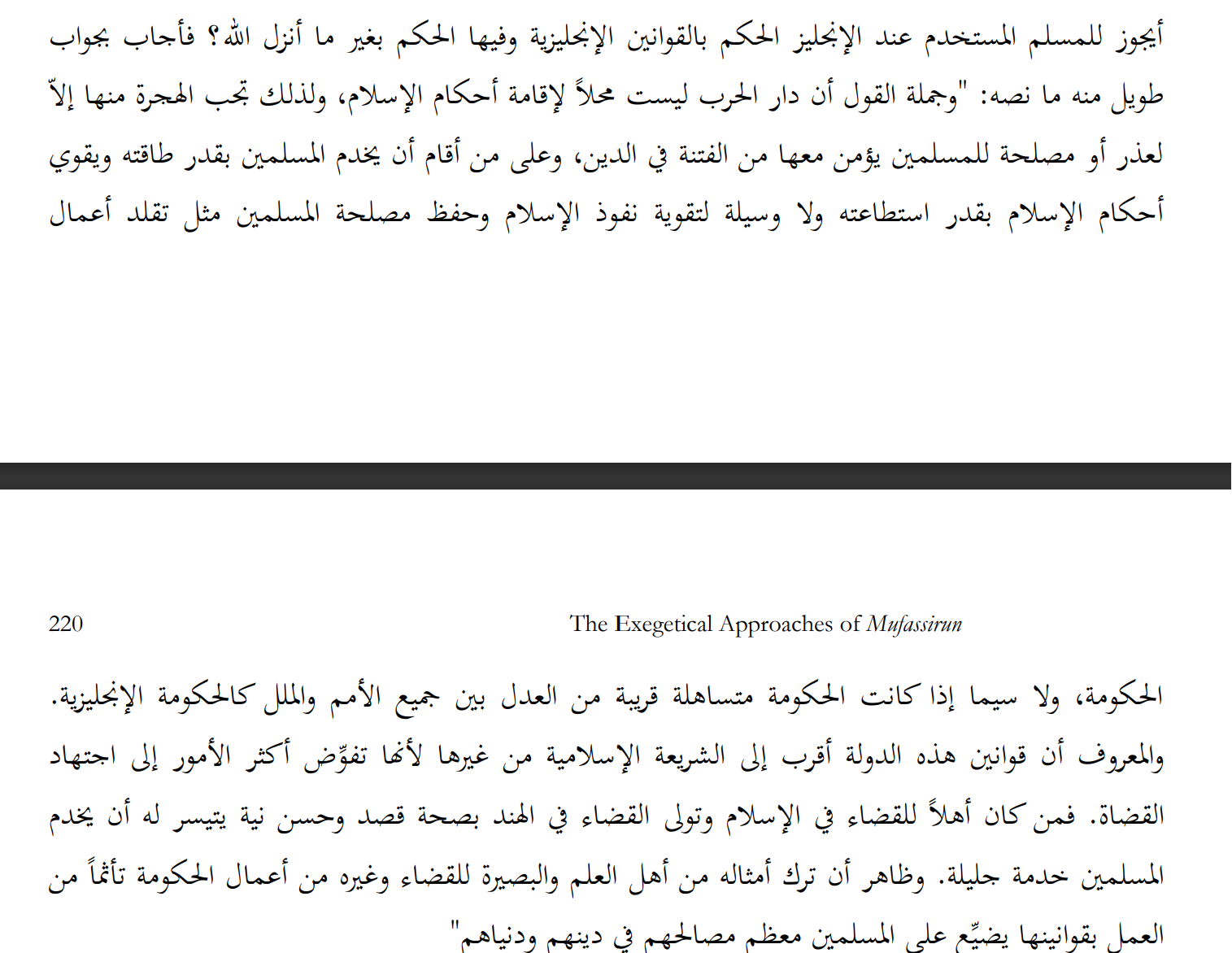
イギリス人に雇われ、イギリスの法律によって統治することは、アッラーが下されたものによらない統治を一部含むが、ムスリムにとって許されるか。彼は長い回答を与えた。要約すると次のとおりである。戦争の地(ダール・アル=ハルブ)はイスラームの法を確立する場ではない。したがって、そこに住むことで信仰(ディーン)に対する試練(フィトナ)から身を守れる恩恵や正当な理由がない限り、ヒジュラを行うことは義務である。(インドに住む)者は、自らの能力の限りムスリムに仕え、できる限りイスラームの法を強化する責務がある。イスラームの影響力を強め、ムスリムの利益を守る手段は、特にイギリス政府のように、すべての人々と宗教の間で寛容かつ公正な政府である場合には、政府の職に就くこと以外にない。この国の法律は、多くの事柄を裁判官のイジュティハードに委ねているため、他の国の法律よりもイスラームのシャリーアに近いことはよく知られている。したがって、イスラームにおいて裁判官となる資格があり、正しい目的と善い意図をもって、インドの司法その他の政府機関で職に就く者は、ムスリムのために大きな貢献をすることが可能である。もし知識と洞察を備えた人々が、イギリスの法律に従って働くことは罪であるとして、司法や他の政府の職を捨ててしまえば、ムスリムのディーンと現世における利益が失われることは明らかである。
Is it permitted for a Muslim to be employed by the English to rule by English laws some of which constitutes ruling by other than what Allah has revealed ? He gave a long reply: 'In short, the abode of war (dar al-harb) is not a place for the establishment of the rules of Islam, therefore it is obligatory to make hijra unless there is an excuse or benefit for the Muslims due to which he will be safe from the fitna (test) on his deen. It is incumbent on the one who resides (in India) to serve the Muslims according to the best of his abilities and to strengthen the rules of Islam as much as he can. And there is no means of strengthening the influence of Islam and protecting the interests of the Muslims except by assuming the government posts especially if the government is lenient and fairly just between all people and religions like the English government. It is well known that the laws of this country are closer to the Islamic Sharī’ah than others because it delegates most matters to the Ijtihād of judges. So whoever is qualified to be a judge in Islam and takes up a post in the judiciary in India with the correct aim and good intention, it is possible for him to do a great service for the Muslims. It is obvious that the abandonment of the judiciary and other government posts by the people of knowledge and insight due to being sinful for working according to their (i.e The English) laws will forfeit the interests of the Muslims in their deen and dunya.'
それから彼は言った:
Then he said:
「以上のことから明らかなように、イギリス政府のインドにおける勤務(およびそれに類する他の任務)をムスリムが受け入れること、またその法に従って統治することは、「アズィーマ(原則的な規定)」がない場合に、より大きな害より小さな害を選ぶという原則に含まれる、レフサ(特例・許容)である。その際、アズィーマとは、イスラームを支え、ムスリムの利益を守ることを目的とするものである……」
“It is obvious from all of this that the Muslim's acceptance to work in the English government in India 'and any other similar work' and his ruling according to their laws is a dispensation (rukhsa) which comes under the principle of doing the lesser of two evils if there is no 'azeema by which support of Islam and protecting the interests of Muslims is intended…”
同様に、タンターウィー・ジャウハリーの tafsīr は、現代の諸科学や諸学問がクルアーンの中に存在すると述べ、そうした事柄をクルアーンが説明していることを示すために、鳥や動物の絵で自らの tafsīr を満たしました。また、ムスタファー・ザイドの tafsīr は、天使やシャイターンの存在を解釈によって否定し、拒絶しました。したがって彼は、その tafsīr によって kufr を犯し、自らをイスラームの外に置いたのです。これらの tafsīr やそれに類するものは、ムスリムによって tafsīr の書物とはみなされず、その解釈も何ら考慮されることはありません。
Much similar is the tafsīr of Tantawi Jawhari where he mentioned that there are modern sciences and disciplines in the Qur’ān and he filled his tafsīr with pictures of birds and animals to demonstrate that the Qur’ān did explain such things. And the tafsīr of Mustafa Zayd in which he interpreted and rejected the existence of angels and Shayateen. So he committed kufr by his tafsīr and took himself outside of Islam. These tafsīrs and their likes are not considered books of tafsīr by the Muslims and nor are their explanations given any consideration