21.2 スパイ行為
21.2 Spying
スパイ行為とは情報を調査することである。言語においては「その情報をスパイした、そしてそれについて調査している」と言われ、そこからスパイ(ジャーシス)という語が生まれる。人が情報を調査すれば、その情報をスパイしたことになり、その人はスパイである。公開された情報を調査しても、秘密の情報を調査しても同じである。情報の調査がスパイ行為となるための条件として、その情報が隠されている、すなわち秘密であることは必要ではない。むしろ、スパイ行為とは、秘密であるか公開されているか、すなわち秘密のものも秘密でないものも含めて、情報を調査することである。 一方、調査することなく、また自らの行為が情報の調査や、それを公表するための情報収集、あるいは報道への関心にあたらない形で、自然に物事を見ているのであれば、それはスパイ行為ではない。こうした状況で情報を追いかけていたとしても、それがスパイ行為でないのは、スパイ行為となる情報の調査とは、それを追跡し精査することが、それを吟味する目的で行われる場合に限られるからである。情報を収集するために追いかける者は、吟味する目的で精査するのではなく、それを人々に公表するために集めるのである。したがって、新聞や通信社の通信員のように、情報を追いかけ収集する者を、スパイだと言うことはない。ただし、彼らの仕事がスパイ行為であり、新聞や通信社の通信を隠れみのとして利用している場合は別である。この場合、その人が情報を追う通信員であるからスパイなのではなく、その仕事がスパイ行為であり、通信員という立場を隠れみのとして使っているからスパイなのである。多くの通信員がこの状況にあり、特にその中でも交戦中の不信仰者たちがそうである。一方、捜査部門や捜査局の職員およびそれに類する者たちで、情報を調査する者は、その仕事がスパイ行為であるため、スパイである。
Spying is investigating information. It is said in the language “spied the news and spying it (is) investigating regarding it” and from it is the spy. If the man investigates information then he has spied it and he is a spy, whether he investigates open or hidden information. It is not a condition in investigating information that it be hidden i.e. secret so that it is spying; rather spying is investigating news whether secret or open i.e. secret and non-secret. Whereas if he sees things naturally without investigation and without his action being investigation of news, or collection of information to publish it or is concerned with news, all this is not spying as long at it is not investigating news and investigating news is not part of his actions. Even if he follows news in these situations, it is not spying because investigating of information which is spying is only where following and scrutinising it is for the objective of examining it. As for the one who follows information to collect it, he does not scrutinize it for the objective of examining it but rather he collects it to publish it to the people. Accordingly it is not said about the one who follows news and collects it like the correspondents of gazettes and news agencies that they are spies, except if their work is spying and they take the correspondence of gazettes and agencies as a tool. In this situation he is a spy not because of his being a correspondent who is following the news but rather because his work is spying and he takes correspondence as a tool for cover as is the situation with many correspondents and particularly the belligerent disbelievers among them. As for the officers of investigative departments and the investigative office and their like who investigate news, they are spies because their work is spying.
これはスパイ行為の現実と、スパイの実態である。スパイ行為の規定は、監視される対象によって異なる。もし監視の対象がムスリムや、ムスリムと同じくイスラーム国家の市民である庇護民であるならば、それは haram であり許されない。もし監視の対象が交戦中の不信仰者である場合、それが事実上の交戦であっても、規定上の交戦であっても、ムスリムにとって許され、カリフにとっては義務である。ムスリムやイスラーム国家の市民を監視することが haram であることは、クルアーンによって明確に定められている。アッラー(SWT)は次のように仰せられた:
This is the reality of spying and the reality of the spy. As for the rule of spying, it differs according to those spied upon. If it is spying upon Muslims or dhimmis who are citizens like Muslims, then it is haram and not allowed. If it is spying upon belligerent disbelievers, whether they are belligerent in actual fact or by rule, this is allowed for Muslims and obligatory upon the Khalifah. As for spying upon Muslims and citizens of the Islamic State being haram, this is established by the Qur’an explicitly. Allah (swt) said:
「信仰する者たちよ、多くの疑念(ザン)を避けなさい。疑念の中には罪となるものがあるのですから。また、互いを詮索してはなりません。」 [TMQ 49:12]
“O you who believe avoid much suspicion (dhann) as some suspicion is sin and do not spy” [TMQ 49:12]
アッラーは、そのアーヤにおいてスパイ行為を禁じられた。この禁止は一般的なものであり、自分のためであれ誰かのためであれ、国家のためであれ個人やグループのためであれ、またそれを行う者が支配者であれ被支配者であれ、スパイ行為であるあらゆるものを対象とする。この言葉は一般的であり、スパイ行為であるという要件が当てはまるすべてを包含している。
So Allah prohibited spying in the ayah. This prohibition is general covering all spying whether it is spying for himself or anyone, whether it is for the State or individuals or groups, and whether the one performing it i.e. the spying is the ruler or the ruled. The speech is general covering everything applying upon it that it is spying.
イスラム教徒が尋問部門や捜査部門、あるいはその業務の一部または全部が諜報活動であるその他の部署で役人として働くことは許されるか。この問いには、状況によって答えが異なる。もしその役所がイスラム教徒やムスリムと同じく市民であるズィンミー(dhimmi)を監視するためのものであれば、明白なクルアーンの文言によって禁じられている。ズィンミーもまた、イスラムの領域(ダール・アル=イスラーム)においては、信条と礼拝に関わること以外について、自らにイスラムの規定を適用するよう求められているので、ムスリムに禁じられているのと同様にズィンミーにも禁じられている。その役所が、我々の土地に入ってくる交戦中の不信仰者のうち、保護を与えられた者や協約の下にある者を監視するためのものであれば、それは許される。実際に交戦している者であれ、規定上交戦状態にある者であれ、また彼らが自国にいようと我々の国にいようと、交戦中の不信仰者を監視することが許されるのと同様である。したがって、尋問部門や捜査部門などの存在自体は禁じられておらず、むしろ義務であり、その中で禁じられているのは、ムスリムやムスリムの市民であるズィンミーを監視することだけである。国家がムスリムやその他の市民を監視する部門を持つことは許されず、むしろそれは彼らに対して禁じられている。また、国家の利益のために市民の情報を知る必要があり、それによって陰謀を暴き犯罪者を捕らえられる、と言うこともできない。国家は警察や夜間巡回といった手段によってそれを知ることができ、諜報という手段による必要はないからである。ある事柄が理性にとって利益と見えるか否かは、禁じることにも許すことにも理由とはならない。シャリーアが利益と見なすものだけが利益である。クルアーンの節が明白に何かを禁じているとき、それを理性によって利益があるから合法とすることの余地は残されていない。明白なクルアーンの文言の前では、そのような論拠に価値はないのである。 クルアーンにはこうあります。「スパイ行為をしてはならない」。これはスパイ行為の禁止を意味し、この節が示すこと、およびその言葉の明白な意味以外に理解の仕方はありません。この節の一般性を限定する、あるいはそこから何かを除外する証拠は示されていないため、その一般性のまま残り、市民に対するあらゆるスパイ行為を含みます。したがって、市民へのスパイ行為はすべてハラームです。
Here a question arises: Is it allowed for the Muslim to work as an officer in an inquiry department or an investigative department or other departments whose work, or some of it, is spying? The response depends. If it is an office to spy upon Muslims or dhimmmis who are citizens like Muslims, then it is haram by the explicit Qur’anic text. It is prevented for the dhimmi like it is prevented for the Muslim as the dhimmi in Dar al-Islam is addressed to implement the Islamic rules upon himself except what relates to creeds and worships, and this is not part of that. If the office is spying upon belligerent disbelievers who enter our lands from the ones who have been granted security or the ones under covenant, then it is allowed as it is allowed to spy upon belligerent disbelievers whether they are belligerent in practice or by the rule and whether they are in their lands or ours. Accordingly the existence of inquiry or investigative departments and their like is not haram but obligatory and what is prohibited (haram) in them is spying upon Muslims or dhimmis who are citizens of Muslims. It is not allowed for the State to have a department to spy upon Muslims and the rest of the citizens; rather this is forbidden against them. Nor is it said that the State’s interest requires knowing the citizens’ information so as to expose conspiracies and lead to criminals because the State can know this via the method of police and night patrol not via the method of spying. Just because the mind sees benefit or not in something it is not a reason for forbiddance or allowance; only what the Shar’a sees as benefit is benefit. When the Qur’anic ayat come explicitly forbidding anything there remains no place for discussion whether there is benefit in it to reason it into making it halal, as there is no value in that in front of the explicit Qur’anic text. The Qur’an says: “Do not spy” meaning prohibition of spying, and there is no way to understand other than what the ayah indicates and the clear meaning of its words. There came no evidence specifying the generality of this ayah or excluding something from it, so it remains in its generality covering all spying so all spying upon the citizens is haram.
「この私の書物を見たならば、マッカとタイフの間にあるナフラまで進みなさい。クライシュ族を待ち伏せして、彼らの情報を私たちのために探り出しなさい。」
“When you look into this book of mine, go until you descend upon Nakhlah between Makkah and Taif. Lie in wait for Quraysh and find out their news for us.”
この本では、使徒ﷺがアブドゥッラー・ブン・ジャフシュに、クライシュ族を偵察し、その情報を自分に知らせるよう命じたとされています。しかし彼は同行者たちに、出発するかどうかを選ぶ権利を与えました。アブドゥッラー自身については、その任務を遂行することが義務づけられていました。つまり使徒ﷺは全員に偵察を求めたが、アブドゥッラーには義務とし、他の者には選択を与えたのです。これは、集団の長に対する要請は決定的な要請であり、彼と共にいる残りの者たちに対する要請は決定的でない要請であることの証拠です。また、敵を偵察することがムスリムに許されていることの証拠でもあります。敵の偵察は、イスラム軍が欠かすことのできない事柄の一つです。敵に関する偵察なしに戦争のための軍の編成を成し遂げることはできないため、軍における偵察の存在は、「〜の範疇から」という理由により、国家に義務として課されることになります。
In this book the Messenger (saw) command Abdullah bin Jahsh to spy for him upon Quraysh and to inform him of their news. However he gave a choice to his companions whether to travel or not; as for him (Abdullah), it was obliged upon him to execute the operation. So the Messenger had requested all to perform spying but obliged Abdullah and gave a choice to the rest. This is evidence that the request in relation to the leader of a group is a decisive request, and in relation to the rest together with him it is an indecisive request. It is also evidence that spying by Muslims upon the enemy is allowed. Spying upon the enemy is from the matters which the Islamic army cannot do without. It is not possible to accomplish the formation of an army for war without there being spies for it upon the enemy, so the presence of spying in the army becomes obligatory upon the State from the category (min bab) of
「それなくしては義務が果たされえないものは、それ自体も義務である。」
“That without which an obligation cannot be fulfilled is obligatory.”
これは、スパイ行為が禁止されているか、許されているか、あるいは義務であるかに関する規定です。敵対する非イスラーム教徒(不信仰者)のために諜報活動を行うスパイへの罰の規定については、そのスパイの国籍と宗教によって異なります。敵対する非イスラーム教徒がスパイである場合、その規定は「殺害」という一つの決定的な判断であり、それ以外の規定はありません。スパイであることが判明した時点、すなわちスパイであることが証明されただけで殺害されます。これは、アル=ブハーリーがサラマ・ブン・アル=アクワーゥから伝えた次のハディースに基づきます。サラマはこう述べました。
This is the rule of spying in relation to it being haram or allowed or obligatory. As for the rule on punishing the spy who spies for the belligerent disbelievers, this differs in relation to the citizenship of the spy and his deen. As for the belligerent disbeliever when he is a spy, his rule is killing as one decisive word and there is no rule for him other than that. He is killed merely upon knowing he is a spy i.e. upon mere proving that he is a spy. This is due to what Al-Bukhari narrated from Salamah bin Al-Akwa’ who said:
多神教徒の密偵が、預言者ﷺが旅をしていた時に預言者ﷺのもとへ来た。彼は預言者ﷺの教友たちと話をしていたが、やがて急いで去った。預言者ﷺは言われた。「彼を探し出して殺せ。」私は彼らより先に彼のところへ行き、彼を殺した。すると彼は私に、その戦利品を贈った。
“There came to the Prophet (saw) a spy of the polytheists while he was travelling. He sat with his (saw) Sahabah discussing then he hastened. The Prophet (saw) said: Seek him and kill him. I preceded them to him and killed him, so he gifted me his booty.”
そして、ムスリムには、イクリマ(Ikrimah)からの伝承として次の言葉がある:
And in Muslim it has been narrated from Ikrimah with the words:
「彼は(らくだの)鞍帯から革紐を一本取り、それでらくだをつなぎました。そしてそれから人々と食事を取り始め、(物珍しげにあたりを)見回しました。私たちは惨めな状態でした。私たちの中には徒歩の者もいたからです(乗る動物がなかったのです)。すると突然、彼は急いで私たちのもとを去りました。」
“He took a strip of leather from its girth and tethered the camel with it and then he began to take food with the people and look (curiously around). We were in a poor condition as some of us were on foot (being without any riding animals). All of a sudden, he left us hurriedy”
そして、アブー・ヌアイムの『アル=ムスタクラジ』における伝承では、ヤフヤー・ブン・アル=ハマーニーの伝えによって、アブー・アル=ウマイスから伝えられている。
And in the narration of Abu Nu’aym in Al-Mustakhraj via the way of Yahya bin Al-Hamani from Abu Al-‘Umays
「彼を追い越しなさい。彼はスパイだからです。」
“Overtake him for he is a spy.”
その明白な根拠として、使者(ﷺ)は、彼がスパイであるという証拠が単に示されただけで、
The is explicit in that the Messenger (saw) on the basis of merely being established before him that he is a spy said
「彼を見つけ出し、殺せ」
“Find him and kill him”
この語の含意は、要求が決定的な要求であるということです。したがってその規定は、一語で言えば殺害であり、交戦状態にある不信仰者すべてに対する一般的なものとなります。その者が契約の下にあるか、安全保障の誓約を得ているか、あるいは「ムアーヒド」や「ムスタミン」以外のいずれであるかを問いません。いずれも交戦状態にある不信仰者であり、スパイであれば殺すべきとされる規定が適用されます。
This is a connotation that the request is a decisive request. So its rule becomes killing as one decisive word and it is general for all belligerent disbelievers whether he is under a covenant or with a pledge of security or other than a mu’ahid or musta’man. All are belligerent disbelievers whose rule is to be killed if they are spies.
ذimmī の非イスラム教徒が間諜を行った場合については、詳しく検討されます。もし彼がディンマに入る際に、間諜を行わないこと、そして間諜を行えば殺されるという条件を付けられていた場合は、その条件に従って実行されます。したがって、条件に従い、間諜を行えば殺されます。しかし、その条件が付けられていなかった場合は、カリフが処罰として殺害を課すことが許されており、アフマドがフッラート・ブン・ハイヤーンから伝えた伝承に基づき、間諜を行えば殺されます。
As for the dhimmi disbelievers when he is a spy, then it is looked into. If it was made a condition when he entered into the dhimma that he should not spy and if he spied he will be killed, then the condition is acted upon. So if he became a spy, he is killed according to the condition. However, if that is not made a condition upon him then it is allowed for the Khalifah to make killing as his punishment so he is killed if he becomes a spy due to what Ahmad narrated from Furrat bin Hayyan

預言者(saw)が彼の殺害を命じたこと、そして彼はズィンミー(非ムスリムの庇護民)であったこと。彼はアブー・スフヤーンのためのスパイであり、同盟者でもあった。ある時、彼はアンサールの集団の前を通り過ぎ、「私はムスリムだ」と言った。人々は「彼はムスリムだと主張している」と言ったので、アッラーの使徒ﷺは言った。「あなた方の中には、その信仰を信頼できる者たちがいる。その中にフッラート・ブン・ハイヤーンもいる。」
“That the Prophet (saw) commanded his killing and he was a dhimmi. He was a spy for Abu Sufyan and an ally. So he passed by a circle of the Ansar and said: ‘I am a Muslim.’ They said: ‘He claims he is a Muslim’ so the Messenger of Allah (saw) said: ‘There are men among you whom we trust to their belief. Among them is Furrat bin Hayyan.”
これは明白に、使徒が非イスラム教徒の被保護民(ズィンミー)のスパイの殺害を命じたことを示している。しかし、これは指導者(イマーム)に許されるものであり、交戦中の不信仰者であるスパイの場合のように彼に義務づけられるものではない。国家によるズィンミーのスパイの殺害が許されるが義務ではないという証拠は、そのハディースが決定的な要求を示す表現と結びついていないため、これは確定的でない要求であるという点である。要求が非決定的であることを示す文脈もある。それは、ハディースの文面が、使徒ﷺがフルラトがスパイであることを知っただけで急いで殺さなかったことを示している点である。一方、サラマ・ブン・アル=アクワーのハディースに登場する交戦中の不信仰者については、預言者ﷺは、彼がスパイであることが単に確認されただけで殺害を命じ、ムスリムたちに「彼を捜し出して殺せ」と言った。預言者ﷺが急いで殺さなかった証拠は、使徒ﷺが彼を知っていたことであり、それは「彼はズィンミーであり、スパイであった」というハディースの文言、すなわち彼が知られていた人物であったことに表れている。さらに、使徒ﷺは「その中にフルラト・ブン・ハイヤーンがいる」とも言われた。加えて、使徒ﷺは交戦中の不信仰者について「彼を捜し出して殺せ」と命じたが、フルラト・ブン・ハイヤーンの件では殺害を命じながら、ムスリムに彼を捜すよう求めてはいない。ここに両者の区別が明らかである。交戦者を殺すことへの要求は決定的な要求であり、ズィンミーを殺すことへの要求は非決定的な要求であって、ズィンミーのスパイを殺すことが許されること、また殺さないことも許されることを示している。
This is explicit that the Messenger commanded the killing of a dhimmi spy. However this is allowed for the Imam and not obligatory upon him as is the case when the spy if he is a belligerent disbeliever. The evidence that the killing of a dhimmi spy by the State is allowed and not obligatory is that the hadith is not associated with a connotation indicating decisiveness so it is an indecisive request. There is a connotation which indicates the non-decisiveness in the request which is that the text of the hadith indicates that the Messenger (saw) did not hasten to kill Furrat after the mere knowledge that he is a spy whereas the belligerent disbeliever mentioned in the hadith of Salama bin Al-Akwa’, the Prophet had commanded his killing upon it being merely established before him that he is a spy and he said to the Muslims: “Seek him and kill him.” The evidence that he did not hasten to kill him is that the Messenger (saw) used to know him, which appears in the saying of the hadith “he was a dhimmi and he was a spy” i.e. he was known, and (also) the saying of the Messenger “of them is Furrat bin Hayyan.” In addition to that, the Messenger said in the matter of the belligerent disbeliever: “Seek him and kill him” whereas in the matter of Furrat bin Hayyan he commanded his killing but did not request the Muslims to seek him. It is clear therein the distinction between both of them in that the request to kill the belligerent is a decisive request and the request to kill the dhimmi is an indecisive request which indicates the permissibility of killing the dhimmi spy and the permissibility of not killing him.
イスラームを信奉する者で、ムスリムやズィンミーに対して敵のためにスパイ行為をする者について言えば、その者が殺されないのは、預言者(ﷺ)がズィンミーの殺害を命じたからではない。預言者ﷺの御前で、彼がイスラームに帰依しムスリムになったことが明らかになった時、預言者ﷺは彼から手を引いた。なぜなら、預言者ﷺはズィンミーであり、スパイでもあったフッラート・ビン・ハイヤーンの殺害を命じたことがあったからである。しかし、人々が「アッラーの使徒よ、彼は自分がムスリムだと主張しています」と申し上げた時、預言者ﷺは次のように仰った。
As for the Muslim spy who spies for the enemy upon Muslims and dhimmis, he is not killed because the Messenger (saw) commanded the killing of the dhimmi but when it was established before him that he had embraced Islam and became a Muslim he abstained from him. Since he had commanded the killing of Furrat bin Hayyan who was a dhimmi and a spy but when they said: O Messenger of Allah, he claims he is a Muslim, he said:
「あなたがたの中には、その信仰によって信頼してよい者たちがいる。そして、フッラート・ビン・ハイヤーンもその一人である」
“Among you are men whom we trust them to their belief, and Furrat bin Hayyan is among them”
このため、彼を殺さないでいる理由(イッラ)は、彼がムスリムになったことである。アリー・ブン・アビー・ターリブ(ra)から、ブハーリーが伝えている。
So the reason (‘illah) abstaining from killing him is his becoming a Muslim. Al-Bukhari narrated from Ali bin Abu Talib (ra) said:
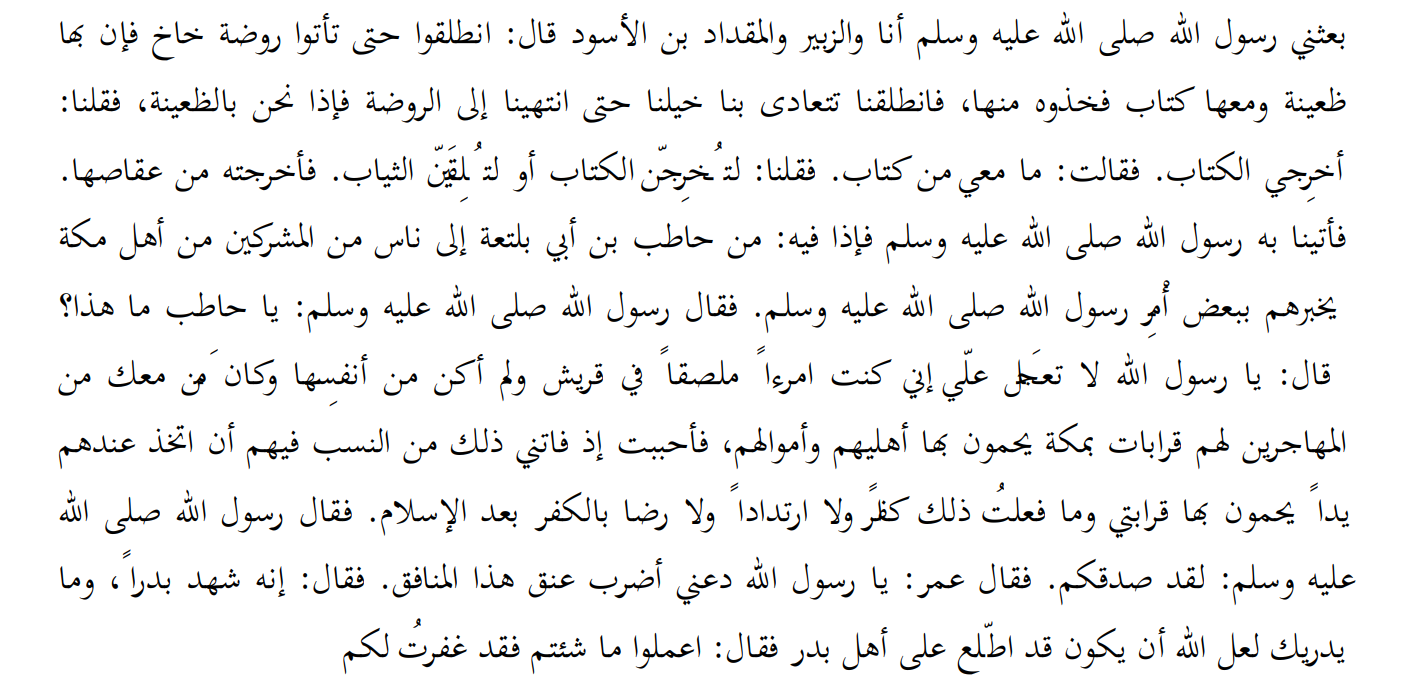
預言者の使徒(ﷺ)が私、アズ=ズバイル・ブン・アル=アウワームとアル=ミクダード・ブン・アル=アスワドを遣わして、こう言われた。「ハーハ(Khakh)の園に着くまで進め。そこには女性の輿があり、その中に一冊の書物がある。それを彼女から取り上げなさい。」そこで我々は馬を速く駆けさせて進み、女性の輿のある園に着いた。我々は言った。「書物を出せ。」すると彼女は言った。「私は書物など持っていない。」そこで我々は言った。「書物を出さなければ、お前の衣服を剥ぎ取るぞ。」そこで彼女はそれを三つ編みの中から取り出した。我々はそれを預言者の使徒(ﷺ)のもとへ持って行った。その中にはこう書かれていた。「ハーティブ・ブン・アビー・バルタァアより、メッカのある人々へ。預言者の使徒(ﷺ)に関する事柄の一部を知らせる。」すると預言者の使徒(ﷺ)は言われた。「これは何だ、ハーティブよ。」彼は言った。「預言者の使徒よ、私に対して性急になさらないでください。私はクライシュ族と同盟を結んだ者であり、クライシュ族の血筋ではありません。あなたと共にいるムハージルーンの中には、メッカに親族がいて、その親族が家族と財産を守っている者がいます。ですから私は、彼らとの縁が切れてしまうならば、親族を守るための恩義を得たいと思ったのです。私は不信仰や背教を犯したのではなく、イスラーム以後に不信仰を喜んだのでもありません。」すると預言者の使徒(ﷺ)は言われた。「彼はあなたがたに真実を語った。」ウマルは言った。「預言者の使徒よ、この偽信者の首を打たせてください。」彼は言われた。「彼はバドルの戦いに参加した者だ。あなたは知らないのか、アッラーがバドルの人々を赦し、『何をしても構わない、私はあなたがたを赦した』と言われたかもしれないのだ。」
“The Messenger of Allah (saw) sent me, Az-Zubayr bin Al-‘Awwam and Al-Miqdad bin Al-Aswad and said: ‘Go forth until you reach the garden of Khakh. There will be a woman’s litter and with her is a book, so take it from her.’ So we went with our horses in a rapid gait until we ended in the garden where there was a woman’s litter. We said: ‘Remove the book’ and she said: ‘There is no book with me.’ So we said: ‘You will remove the book or we will remove the clothes’ so she removed it from her plaits. We brought it to the Messenger of Allah (saw) and therein was: ‘From Hatib bin Abu Balta’ah to some people of the people of Makkah informing them with some of the matter of the Messenger of Allah (saw). So the Messenger of Allah (saw) said: ‘What is this, O Hatib?’ He said: ‘O Messenger of Allah, do not be hasty with me. I was a man allied to Quraysh, and I was not from her body (i.e. tribe). Those with you from the Muhajirin have relatives in Makkah who protect their families and property. So I wished if the relation with them escaped me that I take a hand with which to protect my relatives. Nor did I commit disbelief or apostasy nor was I pleased with disbelief after Islam. So the Messenger of Allah (saw) said: ‘He has spoken the truth to you.’Umar said: ‘O Messenger of Allah, leave me to strike the neck of this hypocrite.’ He said: “He witnessed Badr, and you do not know but that Allah may have overlooked the people of Badr and said: ‘Do whatever you wish for I have forgiven you.’”
ハーティブに関するこのハディースにおいて、彼がムスリムに対するスパイであったにもかかわらず預言者が彼を殺さなかったことが確立されており、これは、ムスリムのスパイは殺されないということを示している。この規定はバドルの人々に限られたものだと言ってはならない。なぜなら、そのハディースはバドルの人々であることを理由として理由づけ(タアリール)されているからである。このように言ってはならないのは、たとえ本文に理由付けを必要とする要素があり、その文脈から理由が理解できるようになっていたとしても、アフマドによるフッラート・ブン・ハイヤーンに関するハディースでは、彼がズィンミーであった後にイスラームに入信したため、彼からの殺害が解除されているからである。これはこのハディースの理由付けを無効にし、一つの事実の記述とするものである。なぜならフッラート・ブン・ハイヤーンはバドルの人々ではなかったからである。また、アブー・ダーウードにおけるフッラート・ブン・ハイヤーンのハディースの伝承経路にはアブー・ハンマーム・アッ=ダッラールとムハンマド・ブン・ムハッバブが含まれており、彼らのハディースは証拠として扱われず、彼はスフヤーン・アッ=サウリーから伝えている、と言ってもならない。このように言ってはならないのは、アフマドがこのハディースをスフヤーン・ブン・ブシュル・ブン・アッ=スィッリー・アル=バスリーから伝えており、彼はブハーリーとムスリムが、そのハディースを証拠とすることで一致した人物の一人だからである。したがって、このハディースは確立しており、そこから類推がなされるものであり、ムスリムのスパイは殺されず、裁判官やカリフの見解に従って投獄やその他の罰を受けるということの証拠である。
It was established in this hadith about Hatib that he was a spy against the Muslims and the Messenger did not kill him, which indicates that the Muslim spy is not killed. One should not say that the rule is specific to the people of Badr because the hadith is reasoned (mu’allil) on his being of the people of Badr. This should not be said became even if the text came with what requires reasoning and its context was in a way that reasoning is understood from it; nevertheless (in) the hadith of Ahmad about Furrat bin Hayyan, killing was lifted from him because he became a Muslim after he was a dhimmi which invalidates the reasoning of this hadith and makes it a description of a reality because Furrat bin Hayyan was not from the people of Badr. Nor should one say that the hadith of Furrat bin Hayyan in Abu Dawud has Abu Hammam Ad-Dalal Muhammad bin Muhabbib in its chain and his hadith are not considered as proofs, and he is narrating from Sufyan Ath-Thawri. One should not say this because Ahmad has narrated this hadith from Sufyan bin Bushr bin As-Sirri Al-Basri, and he is from those whom Al-Bukhari and Muslim agreed to consider as proof with his hadith. So the hadith is established and is extrapolated upon, and it is an evidence that the Muslim spy is not killed but is punished with imprisonment or something else according to the view of the judge or Khalifah.
これらはすべて、交戦中の不信仰者である敵のためにムスリムやズィンミー(庇護民)を密偵することに関するものです。ムスリムを密偵するものの、敵のためではなく、つまり交戦中の不信仰者のためではなく、密偵行為そのものや、ムスリムや国家のためにそうする場合、それは禁じられているものの、シャリーアはこの罪に対する特定の刑罰を定めていないため、その刑罰は裁量刑(ターズィール)となります。
All this is about the spying upon Muslims and dhimmis for the belligerent disbeliever enemy. As for spying upon Muslims (but) not for the enemy i.e. not for the belligerent disbeliever, rather for the sake of spying or for Muslims or the State; although it is haram the Shar’a has not specified a specific punishment for this sin so its punishment becomes a discretionary punishment (ta’zeer).