14.2 フィクフの発展
14.2 The Development Of Fiqh
フィクフ(イスラーム法学)は、社会に最も大きな影響を与える、イスラーム諸学の中でも最も重要な学問の一つです。イスラーム文化の中でも最も重要な分野の一つでもあります。なぜなら、イスラーム文化とはクルアーンとスンナ、そしてそれらを理解するために依拠され、定められたものすべてだからです。イスラーム文化にはアラビア語学、ハディース学、タフスィール学も含まれますが、その中で最も際立って現れるのは、人生への見方に関わる思想と、人生の問題に対処するための解決策です。言い換えれば、それは信仰(アカーイド)とシャリーアの規定の中に現れます。なぜなら、それらは人生の問題に向き合うために採用された実践的な文化であり、多くの場合、信仰に関する思想と解決策、すなわち規定を含んでいるからです。フィクフとは、まさにこれらの規定に関する知識にほかなりません。
Fiqh is one of the most important Islamic disciplines having the greatest effect on society. It is one of the most important branches of the Islamic culture. That is because the Islamic culture is the Qur’ān and Sunnah and whatever is relied upon and laid down in order to understand the Qur’ān and Sunnah. Even though the Islamic culture includes the sciences of the Arabic language, hadīth and tafsīr, the most prominent thing that appears from it are the thoughts which relate to the viewpoint about life and the solutions which treat the problems of life. In other words, it appears in the beliefs (‘aqaid) and Sharī’ah rules because they are a practical culture adopted to face lifes problems which, in most cases, contains thoughts about beliefs and solutions i.e, the rules. Fiqh is nothing other than the knowledge of these rules.
イスラム文化とシャリーアの規定の学習は、使徒が遣わされた時から始まりました。使徒ﷺは、シャリーアの規定における唯一の拠り所でした。なぜなら、彼はアッラーのディーンを人々に教えるために遣わされたからです。彼ﷺはこう言いました。
The Islamic culture and the learning of Sharī’ah rules began from the time the Messenger was sent. The Messenger was the only reference point for the Sharī’ah rules because he was sent to teach people Allah’s deen. He said:
「ラスール(使徒)よ!あなたの主からあなたに下されたものを伝えなさい。もしそうしなければ、あなたは主のメッセージを伝えなかったことになる」ﷺ Note: The Qur'an verse (Al-Ma'idah 5:67) is quoted here in the source's own wording, so the Prophet's name is not present in the form the rules would apply ﷺ to. The "(saw)" in the source refers to the Prophet, so the honorific is placed after the closing of the passage as required by the rules. [TMQ Mā’idah: 67]
“O Messenger (saw)! Proclaim (the Message) which has been sent down to you from your Lord. And if you do not, then you have not conveyed His Message” [TMQ Mā’idah: 67]
彼は言った:
He said:
「そしてわれらはあなた(ムハンマドﷺ)にも、人々に明確に説明するために、教訓と助言(クルアーン)を下した」 [TMQ Nahl: 44]
“And We have also sent down unto you (O Muhammad(saw)) the reminder and the advice (the Qur’ān), that you may explain clearly to them” [TMQ Nahl: 44]
預言者ﷺを除き、いかなるムスリムも、いかなる見解や規定についても独自に意見を提示する権利はありません。預言者ﷺが彼らの間におられたため、何か出来事に出会った際に預言者ﷺに照会することは容易でした。それでも、彼らの誰一人として、いかなる出来事についても自分の個人的な意見を述べることは許されていませんでした。そのため、出来事に遭遇したり、論争が起きたり、誰かが考えを持ったりした場合には、彼らは預言者ﷺに照会したのです。預言者ﷺは意見を示し、彼らの論争を解決し、質問に答えられました。時にはアーヤによって、時にはハディースによって。 一方、預言者ﷺの時代に一部のサハーバがイジュティハードを行い、特定の論争において自らのイジュティハードに基づいて判決を下したり、特定の出来事についての規定を自らのイジュティハードによって導き出したりしたと伝えられていることについては、これらのイジュティハードがシャリーアの規定の源泉となるわけではありません。むしろそれらは、預言者ﷺの命令に従ったシャリーアの理解を構成するものです。それらは、それらのムジュタヒド(イジュティハードを行う者)が理解したところのクルアーンとスンナに依拠した、シャリーアの適用を構成するものなのです。このことは、これらのイジュティハードが行われた状況によって示されています。預言者ﷺはアリー・イブン・アビー・ターリブ を裁判官としてイエメンに派遣された、と伝えられています。預言者ﷺは彼にこう言われました:
With the exception of the Messenger no Muslim has the right to independently put forward an opinion regarding any viewpoint or ruling. Due to the Messenger’s presence among them referring to him regarding anything they came across was easy, It was still not permitted for any of them to give his personal opinion regarding any event. That is why, when they came across an event or a dispute arose or one of them had an idea they would refer to the Messenger . And he would give an opinion, settle their disputes and answer their questions, sometimes with an ayah and sometimes with a hadīth. As for what has been reported that certain Sahabah exercised Ijtihād in the time of the Messenger and pronounced judgements according to their own Ijtihād in certain disputes or that they deduced the rule regarding certain events through their own Ijtihād. This does not make these Ijtihāds a source for Sharī’ah rules. Rather they constitute an understanding of the Sharī’ah in accordance with the order of the Messenger . They constitute the application of the Sharī’ah, relying on the Qur’ān and Sunnah as understood by those mujtahidin. This is demonstrated by the circumstance in which these Ijtihāds took place. It has been reported that the Prophet sent ‘Ali ibn Abi Talib to Yemen as a judge. He told him:
「アッラーがあなたの心を導き、あなたの舌を確かなものとされますように。二人の当事者があなたの前に座ったときは、最初の者の言い分を聞いたのと同じように後の者の言い分も聞くまで、判決を下してはならない。そうすることがより適切であり、そうすれば判断があなたにとって明らかになるであろう」[アブー・ダーウード がアリー・イブン・アビー・ターリブから伝えたもの]
“May Allah guide your heart and affirm your tongue. When two disputants sit before you, do not pronounce judgment until you have listened to the latter just as you did with the former. It is more proper ( for you to does this) so that the judgment becomes manifest to you” [Reported by Abu Dawud on the authority of ‘Ali Ibn Abi Talib
伝えられるところによると、預言者ﷺはムアーズ・イブン・ジャバルをイエメンへ遣わされた際、彼に次のように言われた。
It has been reported that the Prophet sent Mu’az ibn Jabal to Yemen and he said to him:
「あなたは、アッラーの書やそのメッセンジャーの sunnah に見いだせない判断に出会ったとき、何によって判断しますか。」ムアーズは言った。「私は自らイジュティハードを行使します。」預言者ﷺは言われた。「アッラーに讃えあれ。アッラーとそのメッセンジャーが喜ばれるものに、アッラーのメッセンジャーの使者が一致するよう導いてくださったのだから。」 [Recorded by Abu Dawud]
“With what will you judge when you come upon a judgement which you do not find in the Book of Allah or the Sunnah of His Messenger. What judgment will you give? Mu’az said: ‘I will exercise my own Ijtihād The Messenger said: ’‘Praise be to Allah who has made the messenger of the Messenger of Allah to accord with what Allah and His Messenger are pleased with” [Recorded by Abu Dawud]
伝えられるところによれば、ある人々が小屋をめぐって互いに争っていたため、フザイファが彼らの間を裁くために派遣された。ブハーリーとムスリムは、アムル・ブン・アルアースから次のように伝えている。彼は預言者ﷺが次のように言われるのを聞いた。
It is reported that some people were disputing over a hut between themselves so Hudhayfa was sent to judge between them. Bukhari & Muslim report on the authority of ‘Amr bin al-‘Aas that he heard the prophet say:
裁判官が判決を下すにあたって勤勉な努力(イジュティハード)を尽くし、その判断が正しければ、彼には二つの報酬がある。判決を下すにあたって勤勉な努力を尽くしたものの、誤りを犯した場合には、彼には一つの報酬がある。
“If the judge passes a judgment and makes ijtihaad and is right, he will have two rewards. If he passes a judgment and makes ijtihaad, and makes a mistake, he will have one reward”
これらの報告や同様の例はすべて、預言者ﷺの時代にムスリムが行ったイジュティハード(独自の判断努力)が、預言者ﷺの命令に従ったものであったことを示している。したがって、預言者ﷺこそがその源泉であった。こうして、預言者ﷺの時代は、イスラム文化全体の源泉が存在していた時代であった。それは預言者ﷺが遣わされた時から死去するまで続き、その期間は二十二年と数か月を超えないものであったが、その間に全クルアーンが下され、崇高なスンナが完成された。これらの文献こそが、イスラムにおける思想、規範、文化の源泉とみなされる唯一のテキストである。
All of these reports and other such examples indicate that the Ijtihādat that the Muslims performed during the days of the Messenger were in accordance with his order. Therefore, he was their source. Thus, the time of the Messenger was a time in which the source of the entire Islamic culture existed. That continued from the time he was sent until his death, in a period of time not exceeding twenty two years and a few months in which the whole Qur’ān was revealed and the sublime Sunnah was completed. These are the only texts considered as the source of thoughts, rules and culture in Islam.
預言者の死去、すなわちヒジュラ暦十一年にメッセンジャーﷺが亡くなられると、サハーバ(教友)の時代が始まった。それはタフスィール(解釈)の時代であり、明確な典拠を持たない問題について、イスティンバート(法的推論)の門が開かれた時代でもある。サハーバたちは、クルアーンとスンナの本文のすべてが人々の間に広く伝えられ、誰もがそれに触れられる状態にはなかったことに気づいた。クルアーンの本文は預言者ﷺの家に保管された特別な羊皮紙や、一部のサハーバの家に保存されており、スンナはまだ書き留められていなかったからである。彼らは、クルアーンとスンナの本文が規定を定めているのは、立法の時点で生じていた出来事や問題に対してであり、起こりうるにすぎない出来事や問題に対して規定が定められたわけではないことを知った。預言者ﷺの時代には起こらなかった必要や出来事、問題がムスリムの間に生じたが、後に生じたそれらの問題について、その裁定を示す本文は存在しなかった。同様に彼らは、すべてのムスリムがクルアーンとスンナの本文を自ら参照し、そこから示される裁定を理解できるわけではないことも見た。大衆はイスラームの規則を理解させてくれる者を介さなければ、本文を理解することができないからである。そこで彼らは、高貴なクルアーンと預言者ﷺのハディースをムスリムの間に広めることが自分たちの責務であると悟った。こうして彼らはクルアーンの編纂を引き受け、その編纂物から多くの写本を作成してムスリムの間に流布させ、スンナの伝承の信頼性と伝承者の吟味における信頼を確保するための注意を払った。また彼らは、クルアーンとスンナの本文について必要な解明と説明をムスリムに示すこともまた自分たちの責務であると認識した。 それから彼らは人々にディーン(宗教)を教え始めました。そして、身に降りかかる出来事や問題について、明確な典拠(テキスト)がない場合には、人々に法的な裁定(ファトワー)を示すべきだという見解を取りました。こうして彼らは、起こった問題に必要な規定を導き出し始めたのです。このことによって、彼らはディーンの義務を最善の方法で引き受けたのでした。
With the death of the Messenger in the eleventh year of the Hijra began the age of the Sahabah. It is an age of tafsīr and the opening of the doors of deduction (istinbat) for issues that did not possess a (clear) text. The Sahabah saw that not all of the texts of the Qur’ān and the Sunnah were disseminated widely amongst the people such that they were accessible to each and every person because the texts of the Qur’ān were written down on special parchments preserved in the house of the Messenger and preserved in the houses of certain Sahabah and the Sunnah had not been written down yet. They found that the texts of the Qur’ān and Sunnah legislated rules for events and issues which took place at the time of legislation. Rules were not legislated for events and issues that only had a possibility of taking place. Needs, events and issues took place amidst the Muslims which did not take place during the time of the Messenger , there were no texts for the the problems arising later which would state their ruling. Likewise, they saw that not every Muslim was qualified to refer to the texts of the Qur’ān and Sunnah by himself and understand the ruling indicated by them, since the masses cannot understand the texts except by means of someone who will make them understand the rules of Islam. Therefore, they realised that it was incumbent on them to disseminate the Noble Qur’ān and the ahadīth of the Messenger among the Muslims. So they undertook the responsibility of compiling the Qur’ān and from this compilation they made many copies which they circulated amongst the Muslims and they took precautions ensuring the trustworthiness of the narration of the Sunnah and the trust in the scrutiny of the narrators. They also realised that it was incumbent on them to demonstrate to the Muslims the necessary clarification and explanation of the texts of the Qur’ān and Sunnah. So they began to teach people the deen, then they took the view that they should provide people with legal verdicts for the events and issues happening to them for which there was no (clear) text. Thus, they began to deduce rules which were necessary for the issues that took place. Due to this they undertook the obligation of the deen in the best manner possible.
ウマルは躊躇した。一人の殺人のために多くの人々を殺すのか、と。アリーは彼に言った。「もし一つの集団が、屠られたラクダを盗み、それを互いに分け合ったとしたら、どう思いますか。彼らの手を切りますか。」彼は言った。「はい。」アリーは言った。「それなら同じことです。」そこでウマルはアリーの意見に従い、自分の代理人(アミール)に手紙を書いた。「二人とも殺せ。もしサンアアの全住民が関与していたとしても、私は彼ら全員を殺させていたであろうから。」
‘Umar hesitated: are many people to be killed for the murder of one person? ‘Ali said to him: What do you think if a group participated in the theft of a slaughtered camel such that they distributed it amongst themselves. Would you cut their hands? He said: Yes. Ali said: well it is the same thing. So Umar acted upon Ali’s opinion and wrote to his ‘Amil: ‘kill them both for if the whole population of San’aa participated I would have had them killed.
同様に、共同相続(ムシャラカ)の問題で意見が分かれた際のことです。ある女性が夫、母、母方の兄弟(異母の兄弟のうち母親を同じくする者)、そして全兄弟(同じ両親を持つ兄弟)を残して亡くなりました。ウマルは夫に半分、母に六分の一、母方の兄弟に三分の一を与えていました。そのため全兄弟には何も残りませんでした。彼に対してこう言われました。「仮に我々の父が驢馬だったとしても、我々は同じ母から生まれたのではないか」。そこで彼は自らの見解を改め、彼らにも取り分を与えました。彼らは、テキストから理解される場合には、そのテキストが示すマスラハ(利益)を見極めることに努めていました。もう一つの例は、アッラーが次のように仰せになった場合です。
Similarly when they disagreed about the question of joint share, when a woman died leaving a husband, mother, uterine brothers and full brothers. ‘Umar used to give the husband half, the mother a sixth, and the uterine brothers a third. So nothing remained for the full brothers. It was said to him: Suppose our father was a donkey. Are we not from one mother? So he changed his view and gave them a share. They used to acquaint themselves with the maslaha (benefit) for which the text came, if it was understood from the text. Another example is when Allah said:
「サダカート(ザカート)は、フカラー(貧者)、マサーキーン(困窮者)、そしてそれを徴収するために雇われた者、さらに心をイスラームへと引き寄せるべき人々のためにのみ与えられる。」 [TMQ Tawba: 60]
“As-sadaqat (zakat) are only for the Fuqara (poor), and al-masakin (needy) and those employed to collect (the funds); and for to attract the hearts of those who have been inclined (towards Islam)” [TMQ Tawba: 60]
アッラーは、心を(イスラームへと)和らげられた者たちを、ザカートの用途の一つとしてお定めになった。預言者ﷺが、心をイスラームへと和らげられた人々に金銭を与えておられたことは確立している。使徒ﷺの死後、ウマルは、心を和らげられた者たち(al-mu’allaftu qulubuhum)への支払いを禁じたと伝えられている。彼は彼らに次のように言った。
So Allah made those whose hearts have to be a reconciled (towards Islâm) an expenditure from the sources of zakat. It has been established that the Prophet used to give money to people whose hearts had been reconciled with Islam. After the death of the Messenger it is narrated about ‘Umar that he forbade the payment of those whose hearts had been reconciled (al-mu’allaftu qulubuhum). He told them:
「アッラーはイスラームを強固にされました。ゆえに、イスラームはあなた方を必要としません。あなた方がイスラームに従うか、さもなければ、あなた方と我々の間には剣があるのみです。」
‘Allah has made Islam strong and so Islam is in no need of you, either you stick to Islam or else between you and us is the sword.’
ウマルは、心を引きつける(タアリーフ・アル=クルーブ)ための配慮は国家が弱かったからこそ必要だったと考えていた。その理由は、「心を引きつける」という表現そのものがそれを示しているからである。人の心を引きつけるのは、その人々を必要としている状況にあるときのほかにあるだろうか。ウマルは、イスラームが強くなったとき、心を引きつける必要はなくなったとの見解を取った。心を引きつける必要がなければ、そのイッラ(法的根拠)は適用されず、その結果、ハUKム(法的判断)も適用されないのである。
Umar was of the view that the reconcilings of hearts towards Islam was there because the state was weak because the expression, for the expression ‘reconciling hearts’ (ta’leeful al-qulub) indicates this. For when do you reconcile hearts except when you are in a state of need for them (the people) ? Umar took the opinion that the need to reconcile hearts ended when Islam became strong, without the need to reconcile hearts, the ‘illah (legal cause) does not apply and due to this the hukm also does not apply.
サハーバ(教友たち)は、知らないことについてシャリーアの典拠について調べ、人々に尋ねていました。彼ら(アッラーが彼らに満足されますように)はヒジャーズに集まり、クルアーンとスンナについて議論していました。探している問題についてクルアーンとスンナに判断(ハクム)が見つからない場合、彼らはムスリムの中で、預言者ﷺが当該問題についてどのような判断を下されたかを知っている者がいないかを尋ねていました。そのため、彼らは互いに問い合わせ、集まって問題を論じ、それについて意見を述べていたのです。アブー・バクルとウマルは、規定を導き出し、人々に意見を求めていました。アル=バガウィーは、彼のマサービーフ・アッ=スンナにおいてこれを伝えています。
The Sahabah used to investigate and ask the people about the Sharī’ah texts regarding matters they did not know and they (may Allah be pleased with them) used to be all gathered together in the Hijaz, discussing the Qur’ān and Sunnah. If they did not find a hukm in the Qur’ān and Sunnah for the issue they were looking for they would ask Muslims if any of them knew what the Messenger of Allah passed as a judgement for the issue. That is why they used to refer to each other and get together to discuss the issues and give an opinion for it. Abu Bakr and ‘Umar used to deduce rules and refer to the people. Al-Baghawi has narrated in his Masabih al-Sunnah:
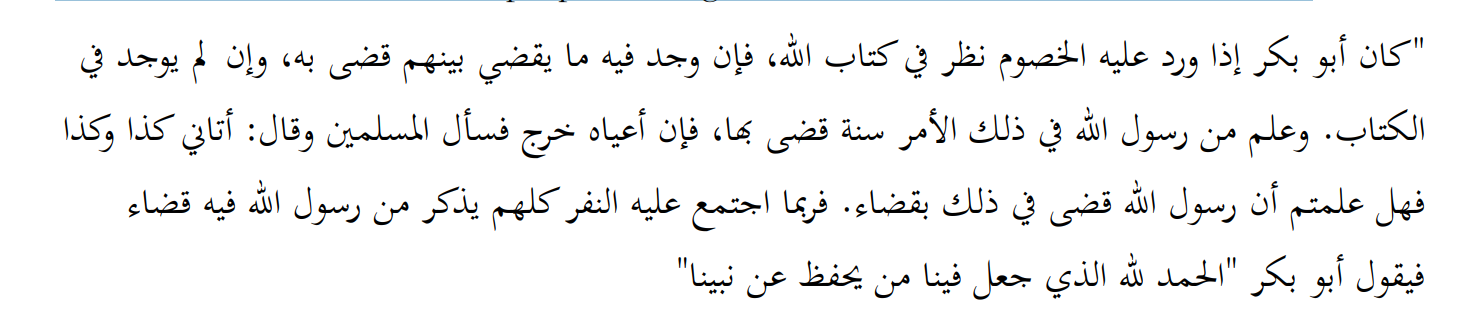
アブー・バクルのもとに争いごとが持ち込まれると、彼はまずアッラーの書を調べました。そこに両者の間を裁く根拠が見つかれば、その判断を下しました。クルアーンに見つからず、そのことについてアッラーの使徒ﷺからのスンナ(慣行)を知っていれば、それによって判断を下しました。それもなければ、彼は外に出て、ムスリムたちに尋ねました。「このような件が私のところに持ち込まれました。これについて、アッラーの使徒ﷺが下された判断をご存じの方はいますか」。するとほぼ全員が、アッラーの使徒ﷺによる判断を挙げて同意したものでした。アブー・バクルはこう言ったものです。「アッラーに讃えあれ。われわれの中に、預言者ﷺに関する事柄を記憶する人々を置かれたお方に」。
‘When a dispute was reported to Abu Bakr he used to look into the Book of Allah . If he found something to judge between them he gave that judgement and if it is not found in the Qur’ān and he knew a Sunnah from the Messenger of Allah regarding that matter he would give judgement by it. Failing that he would go out and ask the Muslims; such and such matter has come to me do you know of any judgement given by the Messenger of Allah pertaining to this?’ Probably the whole group would agree mentioning a judgment by the Messenger of Allah . Abu Bakr would say: ‘Praise be to Allah Who has made people amongst us memorise (issues) concerning our Prophet .
もし預言者ﷺの sunnah を見つけられなかった場合、彼は人々の指導者や、その中で最も優れた者たちを集め、彼らと協議した。彼らの間で一つの事柄について合意があれば、その合意に従って判断した。伝えられるところによれば、ʿUmar はフィクフの知識があったにもかかわらず、サハーバ(教友)と協議していた。ある事件が彼のもとに持ち込まれると、「ʿAlī を呼べ、Zayd を呼べ」と言ったほどである。彼はサハーバたちと協議し、彼らが合意したものによって紛争を解決した。 サハーバたちが互いに参照し合っていたため、彼らの間での意見の相違はまれであった。それは、それぞれのサハーバが他のサハーバに自らの見解と導き出した根拠を示したからである。彼らの見解は総じて正しく正確であり、それぞれが互いに立ち返っていた。いくつかの規定については意見が異なったものの、その相違はまれであり、それは理解の仕方においてではなく、理解そのものにおけるものであった。
If he failed to find a Sunnah of the Messenger of Allah he gathered the heads of people and the best amongst them and consulted them. If they had a consensus on a matter he would judge with that. It has been reported that ‘Umar used to consult the Sahabah despite his knowledge of fiqh to the extent that when an incident would be refered to him he would say: Call ‘Ali for me, call Zayd. He used to consult them and settle the dispute with whatever they were agreed upon. Due to the Sahabah’s reference to each other differences of opinion between them were rare because each Sahābi expressed to another Sahābi his own perspective and the evidences he educed. Their view on the whole was true and correct and each one referred to the other. And even though their views differed in certain rules but their differences were rare and it was in their understanding and not in the method of understanding.
征服が拡大し、サハーバ(教友)がさまざまな都市に散らばって、互いに会うことが難しくなったとき、本文(明確な典拠)のない出来事が起きるたびに、各サハーバは、都市同士が遠く離れていて会うことが困難であったため、また都市で起きた出来事について判断を下す必要があったため、他者に表明することも他者に照会することもなく、それぞれ自分の意見を述べました。どのイスラーム都市にも一人または複数のサハーバがおり、彼らは判断の拠り所でした。彼らは本文のない事柄について規則を導き出し、クルアーンとスンナを人々に教える責任を担うのと同じく、本文を明らかにし解説する任務を引き受けていました。スンナはまだ書き記されていなかったため、一つの出来事について彼らの意見は異なり、それぞれが導き出した論拠を持ち、その意見に基づいて法的裁定を下しました。しかし、これらの意見はいずれもシャリーアの規則であり、彼らの間の相違は理解の違いにすぎなかったため、皆にとって受け入れられるものでした。彼らのイジュティハード(独自の法的努力)の方法は、クルアーンとハディースの本文を検討し、それらの典拠を吟味し、認められるマスラハ(公益)がシャリーアによって示されたものだけであることを確かめ、事例や公益に類推を行うというものでした。イジュティハードの方法論の統一性は、理解の相違がいかなる影響を及ぼすことも許しませんでした。むしろそれは、フィクフの成長と拡大の理由の一つでした。彼らのファトワー(法的裁定)は、起きた出来事や事例に応じたものでした。彼らの意見の相違の範囲は広がらず、フィクフの細則(フルーウ)を越えることもありませんでした。サハーバのフルーウにおける相違は、二つの理由に帰せられます。
When the conquests expanded and the Sahabah became separated in various cities and it became difficult for these Sahabah to meet, every time an incident occurred which had no text, each Sahabah gave his own opinion without expressing it to others or referring to others due to the difficulty in meeting since the cities were distant from each other and also due to the need of giving an opinion on an incident occurring in the city in order pass judgement by it. In every Muslim city there was one or more Sahabah. They were the reference point for rulings. They used to deduce rules which had no text and assume the task of clarifying and explaining the text just as they took the responsibility of teaching the people the Qur’ān and Sunnah. The Sunnah had still not been written down, therefore the opinions of Sahabah differed about a single incident and each one had an evidence for the opinion he had educed and gave legal verdicts with. However, all of these opinions were Sharī’ah rules and were acceptable to all of them since their disagreement was only in their understanding. As for their method of Ijtihād it was one which is to consider the text of the Qur’ān and hadīth and examine the texts, and ensure that the accredited maslahas (benefit) are the ones only indicated by the Sharī’ah and make analogy to issues and maslahas. The unity of the methodology in Ijtihād did not allow the difference in understanding to have any effect. On the contrary it was one of the reasons for the growth and expansion of fiqh. Their legal verdicts (fatwas) were according to the incidents and issues that took place. The range of their disagreement did not widen and nor did it overstep the furu’ (branches of fiqh). The disagreement of the Sahabah in furu’ is attributable to two reasons: