3.1 クルアーンの編纂
3.1 The Compilation Of The Qur’ān
決定的で明確な証拠によって、預言者が亡くなった時点で、クルアーン全体が(動物の肩甲骨、ヤシの葉柄、そして薄く平らな白い石であるルカーフ(lukhaf)に)書き記されていたことが証明されている。そのすべてはサハーバ(Sahabah、彼らにアッラーの御満足がありますように)の心の中にも保存されていた。啓示されたアーヤ、あるいはアーヤートが下されると、預言者ﷺは直ちにそれを自分の前で書き記すよう命じられた。また、啓示を書き留める書記たちに預言者ﷺが口述したもの以外の形で、ムスリムがクルアーンを書き記すことを禁じることはなかった。ムスリムは、アブー・サイード・アル=フドリーから次のようなハディースを伝えている。アッラーの使徒ﷺは次のように言われた。
It has been proven by decisive and definite evidence that when the Prophet died the whole Qur’ān had been written on pieces of shoulder blades (of animals), palm risps and on lukhaf’s (a thin broad white stone). All of it was preserved in the hearts of the Sahabah (may Allah be pleased with them). When an ayah or ayāt would be revealed he would order that they be written down before him at once. He did not prevent the Muslims from writing the Qur’ān in other than what he used to dictate to the scribes who wrote down the revelation. Muslim reported a hadīth from Abu Sa'id al-Khudri that the Messenger of Allah said:
「私から何かを書き留めてはならない。クルアーン以外の私の言葉を書いた者は、それを消しなさい」ﷺ
“Do not write down anything from me, whosoever writes anything I have said other than the Qur’ān let him erase it”
啓示から書き写されたものは、書板に集められた。彼は言った:
What the scribes wrote from the revelation was collected on sheets. He said:
アッラーからの使徒であり、清められた頁(スフフ)(クルアーン)を朗誦する者。 [TMQ Bayyinah:2]
“A Messenger from Allah, reciting purified pages (suhuf) (of the Qur’ān)” [TMQ Bayyinah:2]
つまり、虚偽から清められた写本を朗誦すること。正直に手で書かれ、疑いなく真実で公正なもの。アッラーはこう仰せられた。
i.e, reciting sheets purified from falsehood, honestly handwritten unequivocally true and just. Allah said:
「いいえ、確かにそれ(クルアーンの節)は教訓(タズキラ)である。よって、望む者はそれに心を留めるがよい。(それは)尊ばれた書板に記されている。崇高で、清浄である。書記たちの手にあり、高貴で、従順である。」 [TMQ ‘Abasa: 11-16]
“Nay, indeed it (verses of the Qur’ān) are an admonition (tazkirah). So whoever wills, let him pay attention to it. (It is) in Records held (greatly) in honour. Exalted (in dignity), purified. In the hands of scribes. Honourable and obedient” [TMQ ‘Abasa: 11-16]
つまり、記録に残されたこの戒めは、アッラーのもとで尊ばれ、その価値が高く、堕落した者たちの手から守られており、それは敬虔な書記たちによって書き留められたものである。彼はムスハフの二つの表紙の間に、彼の面前で書き記されたすべてのものを残した。アブド・アル=アズィーズ・ブン・ルファイヤが伝えた。
i.e this admonition established in the records is held (highly) in honour with Allah and exalted in value, free from the hands of those that are corrupt and that they have been written down by God fearing scribes. He left everything that was written between the two covers of the mushaf which had been written down in front of him. 'Abd al-'Aziz b Rufayya' narrated:
「私とシャッダード・ビン・マアキルはイブン・アッバースのもとを訪ねました。シャッダード・ビン・マアキルが彼に尋ねました。『預言者ﷺは(クルアーンの他に)何かを遺されましたか。』彼は答えました。『預言者ﷺは、(クルアーンの)綴じられた二枚の表紙の間にあるもの以外は何も遺されなかった。』その後、私たちはムハンマド・ビン・アル・ハナフィーヤを訪ね、同じ質問をしました。彼は答えました。『預言者ﷺは、(クルアーンの)綴じられた二枚の表紙の間にあるもの以外は何も遺されなかった。』」
“Shaddad bin Ma'qil and I entered upon Ibn 'Abbas. Shaddad bin Ma'qil asked him, 'Did the Prophet leave anything (besides the Qur’ān)?' He replied. “He did not leave anything except what is between the bindings (of the Qur’ān).' Then we visited Muhammad bin al-Hanafiyya and asked him (the same question). He replied, 'The Prophet did not leave except what is between the bindings (of the Qur’ān)”
イジュマー(合意)が成立している事実として、クルアーンのすべての節は、それぞれの章(スーラ)において、啓示が下された際に預言者ﷺの目の前で書き留められ、それらは紙片(スフフ)に記されていたということがある。使徒たちの中で最も偉大な預言者ﷺは、アラブと世界に対する証明を確立した彼の最大の奇跡であるクルアーンについて満足したまま逝去された。アッラーが明確な文言によってクルアーンを守護されているため、彼はクルアーンの節が失われることを恐れなかった。
An Ijma' (consensus) has been established on the fact that all of the verses of the Qur’ān in their respective chapters (Sura’s) had been written down directly in front of the Messenger when the revelation was being revealed to him, and that they were written on sheets (suhuf). The greatest of the Messengers died content about the Qur’ān, his greatest miracle which established the proof for the Arabs and the world. He did not fear for the verses of the Qur’ān that they would be lost because Allah has preserved the Qur’ān with an explicit text:
「まことに、われこそが『ズィクル』(クルアーン)を啓示した。そして、まことに、われがそれを(改変から)守るのである。」 [TMQ Hijr: 9]
“Verily We: It is We who have sent down the Zikr (the Qur’ān) and surely, We will guard it (from corruption)” [TMQ Hijr: 9]
これらの節は、預言者ﷺの生前に書き記されていたこと、またサハーバの心に保存されていたこと、そしてムスリムにクルアーンを書き記すことが許可されていたことによって、永久に保存されていました。このため、預言者ﷺの死後もサハーバは、クルアーンを一冊の書物にまとめたり、書き記したりする必要を感じませんでした。リッダの戦争で多くのフッファーズ(クルアーンを暗記した者)が殺されるまでは、そうでした。そこでウマルは、書かれた紙葉(スフフ)が失われること、またクルラー(クルアーン全体を暗記していた者たち)が死ぬことによって、一部の節が失われてしまうことを恐れました。そこで彼は、書かれた紙葉を一つにまとめること(一冊の編纂)を考えました。彼はこの考えをアブー・バクルに提案し、こうしてクルアーンの編纂が行われました。 ウバイド・イブン・アル=シバクが伝えるところによると、ザイド・イブン・アル=サービト・アル=アンサーリーは次のように言いました。ヤママの戦い(多くのクルラーが殺された戦い)で(大きな)犠牲が出た後、アブー・バクルﷺは私を呼び寄せました。ウマルもアブー・バクルのもとにいましたが、アブー・バクルはこう言いました。「ウマルが私のところに来て言いました。ヤママの日(の戦い)で人々は大きな犠牲を出した。他の戦場でもクルラー(クルアーンを暗記している者たち)の犠牲が増えることを私は恐れている。クルアーンを集めなければ、その大部分が失われてしまうかもしれない。私は、あなたがクルアーンを集めるべきだと考えている。」アブー・バクルはさらに言いました。「私はウマルに言った、」
Because these verses had been preserved permanently via them being written down before him , and being preserved in the hearts of the Sahabah and by the permission granted to the Muslims to write down the Qur’ān. This is why after the death of the Messenger the Sahabah did not feel the need to compile the Qur’ān in one book or the need to write it down until many of the Huffaz (memorisers of the Qur’ān) had been killed in the Riddah wars. So due to this 'Umar feared for the loss of the sheets (suhuf) and the death of the Qurra' (Those who had committed the whole of the Qur’ān to memory), thereby causing some verses to be lost. So he thought about bringing the written sheets together (in one compilation). He presented his idea to Abu Bakr and so the compilation of the Qur’ān was performed. It has been narrated by 'Ubayd ibn al-Sibaq that Zayd b al-Thabit al-Ansari said: Abu Bakr sent for me after the (heavy) casualties among the warriors (of the battle) of Yamama (where a great number of Qurra' were killed). 'Umar was present with Abu Bakr who said, 'Umar has come to me and said, The people have suffered heavy casualties on the day of (the battle of) Yamama, and I am afraid that there will be more casualities among the Qurra' (those who know the Qur’ān by heart) at other battle-fields, whereby a large part of the Qur’ān may be lost, unless you collect it. And I am of the opinion that you should collect the Qur’ān.” Abu Bakr added, “I said to 'Umar ,
「預言者(ﷺ)がなさらなかったことを、どうしてあなたはなさるのですか。」
'How can you do something which Allah's Apostle did not do?'
ウマルは(私に)言った、
'Umar said (to me),
「アッラーにかけて、それは実に良いことです。」
'By Allah, it is (really) a good thing.'
そこでウマルは、アッラーが私の心を開いてその提案を受け入れさせてくださるまで、私を説得し続けました。そして私もウマルと同じ意見になったのです。(ザイド・ブン・サービトは次のように付け加えました:)ウマルは彼(つまりアブー・バクル)の傍らに座っていて、私に話しかけませんでした。「あなたは賢明な若者であり、私たちはあなたを疑いません(嘘をついたり忘れたりするとは思っていません)。あなたはアッラーの使徒ﷺのために啓示(ワフィー)を書き留めていました。だから、クルアーンを探し、(一つの写本に)集めなさい。」「アッラーに誓って、もし彼(アブー・バクル)が私に山の一つを別の場所へ動かすよう命じたとしても、クルアーンの収集について命じられたことより難しくはなかったでしょう。」私は二人に言いました。「預言者ﷺがなさらなかったことを、どうしてあなたがたはなさるのですか。」アブー・バクルは言いました。「アッラーに誓って、それは本当に良いことだ。」そこで私は、アッラーがアブー・バクルとウマルの心を開かれたことを私の心にも開いてくださるまで、彼と議論し続けました。こうして私はクルアーンの章句を探し始め、羊皮紙、肩甲骨、ナツメヤシの葉柄、そして(暗記している)人々の記憶から集めました。アブー・クザイマのもとで、他の誰のもとにも見つからなかったスーラ・アッ=タウバの二つの節を見つけました。それは次のものです:
So ‘Umar kept on trying to convince me and persuade me to accept his proposal till Allah opened my heart for it and I had the same opinion as 'Umar.' (Zayd b al-Thabit added:) Umar was sitting with him (i.e Abu Bakr) and was not speaking to me). 'You are a wise young man and we do not suspect you (of telling lies or of forgetfulness): and you used to write the revelation (wahy) for Allah's Apostle . Therefore, look for the Qur’ān and collect it (in one manuscript). 'By Allah, if he (Abu Bakr) had ordered me to shift one of the mountains (from its place) it would not have been harder for me than what he had ordered me concerning the collection of the Qur’ān. I said to both of them, “How dare you do a thing which the Prophet has not done?' Abu Bakr said, 'By Allah, it is (really) a good thing So I kept on arguing with him about it till Allah opened my heart for that which He had opened the hearts of Abu Bakr and Umar . So I started locating the Qur’ānic material and collecting it from the parchments, scapula bones, leaf-stalks of date palms and from the memories of men (who knew it by heart). I found two Verses of Sura at-Tawba with Abu Khuzaima which I did not find with anybody else, (and they were):
「まことに、あなたがたの中から、あなたがたのもとに使徒がやって来た。あなたがたが苦しみや困難に遭うことは、彼にとって辛いことである」 [TMQ Tawba: 128]
“Verily, there has come unto you a Messenger from amongst yourselves. It grieves him that you should receive any injury or difficulty” [TMQ Tawba: 128]
…スーラ・バラーアの終わりまで。クルアーンを収集した写本は、アブー・バクルが亡くなるまで彼の手元にあり、その後は彼の存命中ウマルのもとにあり、最終的にはハフサ・ビント・ウマルのもとに残されました。 ザイドによるクルアーンの編纂は、フッファーズ(すなわちクルアーンを暗記した者たち)から書き留めたものからなっていたのではありません。むしろ、彼の編纂は、彼自身がアッラーの使徒ﷺの面前で書き記したものを集めたものでした。彼は、彼に提示された各紙片について、それがアッラーの使徒ﷺの面前で書かれたものであることを二人の証人が証言しない限り、紙片を別の紙片と並べて編纂することはしませんでした。さらに、彼は次の二つの条件を満たさない紙片は受け入れませんでした。第一に、それがサハーバの一人のもとに書面の形で存在していること。第二に、それがサハーバの一人によって暗記されていたことです。書面の形と暗記された形が、編纂しようとしている紙片と一致した場合にのみ、彼はそれを受け入れました。そうでなければ受け入れませんでした。このため、ザイドは自ら思い起こして覚えていた(スーラ・バラーアの)終わりの部分でさえ、それがアブー・フザイマのもとに書面の形であることを見つけるまで、取ることを控えたのです。これは、ヤフヤー・ブン・アブドゥル・ラフマーン・イブン・ハーティブを通じて伝えられており、彼は次のように述べたとされています。
until the end of Sura Bara'ah. The manuscript on which the Qur’ān was collected, remained with Abu Bakr till he passed away, and then with 'Umar during his lifetime, and finally it remained with Hafsa bint Umar . Zayd's compilation of the Qur’ān did not consist of what he wrote down from the Huffaz (i.e the memorisers of the Qu’ran). Rather his compilation brought together what he had written himself in front of the Messenger of Allah . He did not place one sheet/page with another sheet in order to compile them unless two witnesses testified, for every sheet that had been presented to him that it was written in the presence of the Messenger of Allah . Furthermore, he did not accept a sheet unless it met two conditions; firstly, that it was present in written form with one of the Sahabah. And second, that it had been memorised by one of the Sahabah. When the written and memorised forms concurred with the sheet that was intended to be compiled, he accepted it. Otherwise he did not accept it. This is why he refrained from taking the end of sura al-Bara'ah until he found it in written form with Abu Khuzayma even though Zayd could himself recall and remember it. It has been narrated via Yahya b 'abd al-Rahman ibn Hatib that he said:

ウマル(ラ)は立ち上がり、こう言った。「アッラーの使徒ﷺから、クルアーンのいかなる部分であれ受け取った者は、それを持ち出すように。」人々はそれを板や石板、ナツメヤシの葉柄に書き留めていた。イブン・ハティブは言った。「ザイドは、二人の証人がそれを証言するまで、誰からも何も受け入れなかった。」これは、ザイドが、既に暗記していたにもかかわらず、書き記されたものを見つけただけでは満足せず、それを受け取った者が自らその言葉を聞いたと証言するまで待ったことを示している。彼はその極度の慎重さゆえにこのようにしていた。
“Umar (ra) stood up and said; whosoever has received anything of the Qur’ān from the Messenger of Allah , let him bring it forth. They used to write that on sheets, tablets and palm risps. Ibn Hatib said: He (Zayd) did not accept anything from anyone until two witnesses had given testimony to it. This shows that Zayd was not satisfied by merely finding something in written form until the one who received it testified that he had heard it despite the fact that Zayd had memorised it already. He used to do this due to his extreme caution”.
こうして、編纂の過程とは、預言者 ﷺ の御前で既に書き記されていた書板を、二つの表紙の間にある一冊の書物へとまとめ集めることにほかならなかった。クルアーンはかつて書板に記されてはいたが、それらは別々に保管されていた。そこでアブー・バクル は、それらを一箇所に集めたのである。したがって、アブー・バクル がクルアーンの編纂を命じたのは、それを一冊のムスハフに書き写せという命令ではなく、預言者 ﷺ の御前で書き記された書板を一箇所に集めよ、という命令であった。さらに、それらが元の形のままであることを確かなものとするため、預言者 ﷺ の御前で書かれたこと、サハーバがそれらを書記の形で所持していたこと、そしてそれを暗記していたことを、二人の証人の証言によって裏づけよ、という命令でもあった。これらの書板は、アブー・バクル の在世中はその手元に、その後はウマル の在世中はウマル のもとに、そしてウマル の遺言に従って、信者の母である ウマルの娘ハフサ のもとに保管され続けた。このことから明らかなように、アブー・バクル によるクルアーンの編纂は、アッラーの使徒 ﷺ の御前で書き記された書板を集めたにすぎず、クルアーンそのものの編纂ではなかった。また、暗記が関わっていたのは、預言者 ﷺ の御前で書き記されたこれらの書板、すなわち文書についてであり、クルアーンそのものの暗記についてではなかった。このような書板を集めてそれを保存したのは、預言者 ﷺ から伝えられたものを正確に暗記しているかを確かめることに、あらゆる努力を尽くし、慎重を期するためにほかならなかった。クルアーンそのものは、サハーバの心の中に保存され、彼らの記憶の中に暗記されていた。暗記においては、全体または一部を暗記している者が多数いたため、非常に多くのサハーバに頼ることができたのである。
Thus, the (process) of compilation was nothing other than the bringing together of sheets that had already been written in the presence of the Messenger of Allah into one book between two covers. The Qur’ān used to be written down on sheets but they were kept seperately. So Abu Bakr assembled them in one place. That is why Abu Bakr's order to compile the Qur’ān was not an order to write it down in one mushaf, rather it was an order to bring the sheets that had been written in the Messenger's presence together in one place and it was an order to make certain; that they are in the same form as they were by supporting it with the testimonies of two witnesses that they had been written in front of the Messenger of Allah and that they were in the possession of the Sahabah in written form and that they had memorised them. These sheets remained preserved in the possession of Abu Bakr during his life and then with 'Umar during his lifetime and them with Hafsa the daughter of 'Umar , the mother of the Believers in accordance with 'Umar's bequest. From this it becomes clear that Abu Bakr's compilation of the Qur’ān constituted only the bringing together of sheets that had been written in the presence of Allah's Messenger and it was not an actual compilation of the Qur’ān. And the memorisation was in regard to these sheets i.e the documents which were written in front of the Messnegr of Allah and not the memorisation of the Qur’ān. The bringing together of such pieces and their preservation was not done except by way of cautiousness and expending all efforts in examining the memorisation of exactly what had been reported from the Messenger of Allah . As for the Qur’ān itself, it was preserved in the hearts of the Sahabah and memorised in their memory. In memorization, dependence was put on a great multitude of Sahabah because those memorising it completely or partially were many.
これは艾布・伯克尔(アブー・バクル)の編纂についてのものです。ウスマーン(ウスマーン)の編纂については、そのカリフ位の第三年(あるいは第二年とする説もある)、すなわちヒジュラ暦25年に、フザイファ・イブン・アル=ヤマーン(フザイファ・イブン・アル=ヤマーン)がマディーナでウスマーンのもとを訪れました。当時、シャームの人々とイラクの人々はアルメニアとアゼルバイジャンを征服するための戦いに従事していました。フザイファは、シャームの人々とイラクの人々がクルアーンの朗誦において相違していることを恐れました。彼が見たところ、シャームの人々はウバイイ・イブン・カァブ(ウバイイ・イブン・カァブ)の朗誦に従って読んでおり、イラクの人々が聞いたこともない朗誦を持ち込んできていました。また彼は、イラクの人々がアブドゥッラー・イブン・マスウード(アブドゥッラー・イブン・マスウード)の朗誦に従って読んでおり、シャームの人々が聞いたこともない朗誦を持ち込んでいるのを見ました。こうして両者は互いに不信仰だと非難し合うようになりました。彼らは雌牛の章(アル=バカラ)の一節について意見が対立していました。一方はこう読みました。
「そして、アッラーのために、ハッジとウムラを完全に果たしなさい(wa atimmul hajja wal 'umrata lillah)」 [TMQ Baqarah: 196]
“And perform properly the hajj and 'Umra for Allah (wa atimmul hajja wal 'umrata lillah)” [TMQ Baqarah: 196]
そしてもう一方はこう読みます。
And the other read:
「そして、アッラーのためにハッジとウムラを正しく完遂せよ」(wa atimmul hajja wal 'umrata lil bayt)
''And perform properly the hajj and 'Umra to the House (of Allah)(wa atimmul hajja wal 'umrata lil bayt)”
フザイファはいらだち、怒りで目が真っ赤になった。フザイファについて次のように伝えられている。
So Huzayfah became angry and his eyes went red with rage. It has been narrated about Huzayfah that he said:
クーファの人々はイブン・マスウードの朗誦に固執し、バスラの人々はアブー・ムーサーの朗誦に固執していた。アッラーに誓って言う。もし私が信徒たちの長(アミール・アル=ムーミニーン)のもとへ行けば、彼に一つの朗誦に統一するよう命じよう。そして彼はウスマーンのもとへ旅立った。
The people of Kufah adhere to the recitation of Ibn Mas'ud and the people of Basra adhere to the recitation of Abu Musa . By Allah ! If I go to the Ameer al Mumineen (Leader of the Believers) I will order him to make it a single recitation. So he travelled to 'Uthman .
イブン・シハーブが伝えるところによれば、アナス・イブン・マーリクは次のように伝えた。フザイファ・ブン・アル=ヤマーンが、シリアの人々とイラクの人々がアルメニアとアゼルバイジャンを征服するための戦いを行っていた時期に、ウスマーンのもとを訪れた。フザイファは、シリアの人々とイラクの人々のクルアーン朗誦における相違を恐れ、ウスマーンに次のように言った。
It has been reported by Ibn Shihab that Anas ibn Malik narrated: Huzayfa bin al-Yaman came to Uthman at the time when the people of al-Sham and the people of Iraq were waging a war to conquer Armenia and Azerbaijan. Hudhayfa was afraid of their (the people of al-Sham and Iraq) differences in the recitation of the Qur’ān, so he said to 'Uthman ,
「ア・ミール・アル・ムミニーン(信徒たちの長)よ! ユダヤ教徒やキリスト教徒が以前に啓典(クルアーン)について仲違いしたように、この共同体が啓典について仲違いする前に、この共同体を救ってください。」
'O Ameer Al Mumineen! Save this nation before they differ about the Book (Qur’ān) as Jews and the Christians did before.'
「ウスマーンはハフサに使いを送り、次のように伝えた。」
So 'Uthman sent a message to Hafsa saying,
コーランの写本を私たちに送ってください。完全な写しとしてクルアーン関連の資料を編纂し、その後写本をお返しいたします。
Send us the manuscripts of the Qur’ān so that we may compile the Qur’ānic materials in perfect copies and return the manuscripts to you.
ハフサはそれを ウスマーン に送った。ウスマーンは次に、ザイド・ビン・サービト(ra)、アブドゥッラー・イブン・アッ=ズバイル、サイード・イブン・アル=アース、アブドゥル=ラフマーン・イブン・ハーリス・イブン・ヒシャームに命じて、写本を完全な写しとして書き直させた。ウスマーンはクライシュ族の三人の男たちに言った。
Hafsa sent it to 'Uthman . 'Uthman then ordered Zaid bin Thabit (ra), 'Abd Allah ibn al Zubair, Said ibn al-'As and 'Abd al-Rahman ibn Harith ibn Hisham to rewrite the manuscripts in perfect copies. 'Uthman said to the three Qurayshi men,
「もしクルアーンのいかなる点についてでも、ザイド・イブン・サービト(ra)と意見が異なる場合は、クルアーンが彼らの言葉で啓示されたのだから、クライシュ族の方言で書きなさい。」
'Incase you disagree with Zaid ibn al-Thabit (ra) on any point in the Qur’ān, then write it in the dialect of Quraysh, the Qur’ān was revealed in their tongue.'
それで彼らはそのとおりにし、多くの写本を作り終えると、ウスマーン は元の原本をハフサ に返しました。ウスマーン は、作成した写本の一部を各イスラーム地域に一部ずつ送り、断片的な写本であれ完全な写本であれ、それ以外のクルアーン関係の資料はすべて焼却するよう命じました。作成された写本は七部でした。その七部のムスハフは、マッカ、シャーム、イエメン、バフレーン、バスラ、クーファに送られ、一部はマディーナに保管されました。
They did so, and when they had written many copies, 'Uthman returned the original manuscripts to Hafsa . 'Uthman sent one copy of what they have copies to every Muslim province, and ordered that all the other Qur’ānic materials, whether written in fragmentary manuscripts or whole copies, be burnt. The number of copies made was seven. The seven mushaf’s were sent to Makkah, al-Sham, Yemen, Bahrain, Basra, Kufah, and one copy was kept in Madinah.
したがって、ウスマーンの行為は、クルアーンの編纂ではなく、預言者から伝えられたものをそのまま写し、転写することにすぎなかった。彼は、信者の母ハフサの手元に保存されていた写本から七部の写本を作り、人々をこの一つの書式に統一し、それ以外のいかなる書式や口述も禁じたこと以外には何もしなかった。この写本を基にして、書式と口述に関する問題は決着した。これは、啓示が下された際にアッラーの使徒ﷺの御前で書き記された断片と同じ書式、同じ口述であり、またアブー・バクルが編纂したまさにその写本である。その後、ムスリムたちはこの写本から写しを作り始め、他のいかなる写本からも作らなかった。ウスマーンの写本がその書式のまま残るのみとなった。印刷業者が現れると、このと同じ書式と口述に基づく写本から、ムシャフが印刷されたのである。
Therefore, 'Uthman's action was not the compilation of the Qur’ān rather it constituted in only the copying and transcription of the same thing transcribed from the Messenger of Allah as it was. He did not do anything other than make seven copies from the preserved copy in the possession of Hafsa , the mother of the Believers and unite the people on this single script and forbade any other script or dictation other than it. The matter was settled on this copy as a script and dictation. It is the same script and dictation in which the sheets were written as was written in the presence of Allah's Messenger when the revelation was revealed. And it is the same copy which Abu Bakr had compiled. Then the Muslims began to make copies from this copy and not any other copy. Nothing remained except the mushaf of 'Uthman in its script. When printers came about, the mushaf was printed from this copy with the same script and dictation.
アブー・バクル(ラ)のときの編纂と、ウスマーン(ラ)のときの編纂の違いは次のとおりである。アブー・バクルの編纂は、クルアーンの暗誦者(それを記憶している人々)が失われることによって、クルアーンの何かが失われることを恐れたために行われた。その理由は、クルアーンが紙片に書き記されてはいたものの、単一の書物のように一箇所にまとめられてはいなかったからである。そこで、それは頁の形で編纂された。ウスマーン(ラ)のときの編纂は、クルアーンのある箇所について、人々の間で相違が増え、ある者たちが自分たちの方言で読み、それがある者たちに他者が誤りを犯していると非難させるに至ったために行われた。事態が拡大することが懸念されたため、それらの紙片は一冊のムスハフに写し取られた。 今日われわれの前にあるムスハフは、アッラーの使徒ﷺに啓示されたものと同じムスハフであり、アッラーの使徒ﷺの御前で書き記された紙片に書かれていたものと同じである。それはまた、紙片が一箇所に集められたときにアブー・バクル(ラ)が集めたムスハフと同じである。そして、ウスマーン(ラ)が七部の写本を写させ、残りを焼却するよう命じたそのムスハフと同じである。節の相互の配列、スーラ内での配列、書記法、口述においても、同じ高貴なクルアーンである。 アッラーの使徒ﷺが啓示から口述させた写本、その紙片が集められ、そして写し取られたものは、信者の母ハフサ(ラ)のもとで保護され続けた。マルワーンがマディーナの総督となり、それを破り捨てた。ムスハフの写本があらゆる地に広まっていたため、それはもはや重要とみなされなかったからである。 イブン・シハーブは、サーリム・イブン・アブドゥッラー・イブン・ウマル(ラ)が彼に次のように伝えたと伝えている。
The difference between the compilation of Abu Bakr and that of 'Uthman is that the compilation of Abu Bakr took place due to the fear that something would be lost from the Qur’ān if any of its carriers (memorisers) were lost, the reason being that even though it was written on sheets but it had not been collected in one place like a single book. Thus, it was compiled in pages. The compilation of 'Uthman took place because the differences increased regarding certain aspects of the Qur’ān which some read in their own dialects and this led some to accuse others of making an error. It was feared that the matter would escalate therefore those sheets were copied into one mushaf. The mushaf that we now have before us is the same mushaf revealed to the Messenger of Allah and it is the same one which was written in the sheets which were written in the presence of the Messenger of Allah . And it is the same mushaf that Abu Bakr brought together when the sheets were compiled in one place. And it is the same one from which 'Uthman transcribed the seven copies and ordered that the rest be burned. And it is the same Noble Qur’ān in its verse arrangement in relation to each other and their arrangment in their respectives Sura’s, script and dictation. As for the copy dictated by the Messenger of Allah from the revelation, whose sheets were compiled together and then copied it remained protected in the possession of Hafsa , the mother of the believers until Marwan became the Wali (governor) of Madinah and he tore it up since it was not considered important because copies of the mushaf had spread everywhere. Ibn Shihab narrated that Salim ibn 'Abd Allah ibn 'Umar informed him:
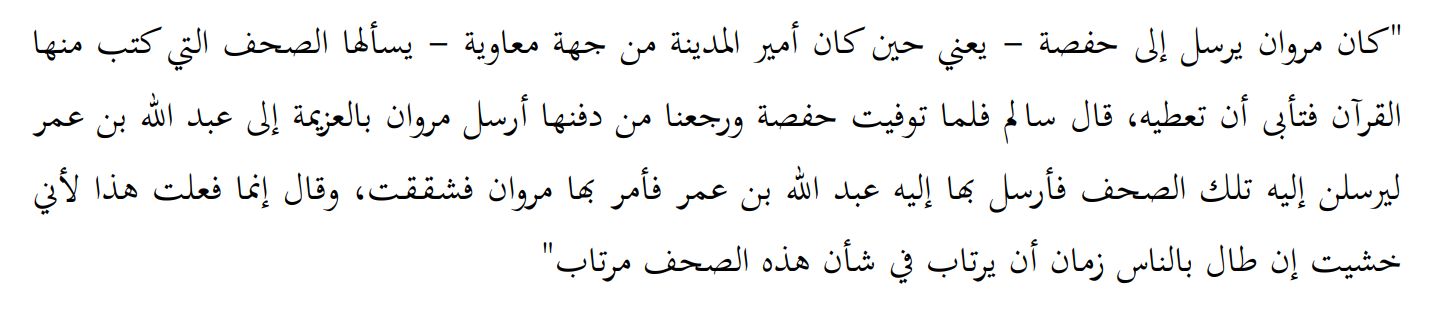
「マルワーンはハフサ(の家)に人を遣わし、ムアーウィヤを通じてマディーナの総督であった時、クルアーンが書き写された綴り(の紙葉)を求めていた。しかし彼女はそれを渡すことを拒んだ。サーリムは言った。ハフサが亡くなり、私たちが彼女の埋葬から帰る途中、マルワーンはアブドゥッラー・イブン・ウマルに、そのムスハフを送るようにという固い決意を伝えた。そこでアブドゥッラー・イブン・ウマルはそれを彼に送った。マルワーンはそれを破棄するよう命じた。彼は言った。『私がこれを行ったのは、もしそれが長く人々の手元に残れば、人々がこれらの紙葉について疑いを抱くようになるのではないかと恐れたからだ』」
‘That Marwan used to send for Hafsa – i.e when he was the amir of Madinah via Mu'awiyya - asking her for the sheets from which the Qur’ān was written. She refused to give him it. Salim said: When Hafsa died, while we were returning from her burial Marwan communicated his firm decision to 'Abd Allah ibn 'Umar that he send him that mushaf. So 'Abd Allah ibn 'Umar sent it to him. Marwan ordered it to be destroyed. He said: I did this because I feared that if it remained with people for a long time then people will have doubts regarding these sheets’.