2.7 アル=カダー・ワ=ル=カダル
2.7 Al-qadā’ Wa‘l-qadar
「アル=カダーウ・ワ=ル=カダル」は、この二語を結びつけて一つの意味を表す名称であり、特定の指示対象を持つ。すなわち、アル=カダーウとアル=カダルを、一方が他方から切り離せない相伴う二つの事柄として結びつけ、それ自体に固有の意味を持たせたものである。サハーバーやタービウーンが用いていない意味をそこに含めることは正しくない。シャリーア上の文献や言語上の文献、そしてサハーバー、タービウーン、およびその後に続くウラマーの言葉を研究すれば、「アル=カダーウ・ワ=ル=カダル」という語が共に用いられる場合、サハーバーやタービウーンのいずれもが特定の術語的[イスティラーヒー]意味で用いたことは明らかであり、クルアーンやハディースにおいても、特定の術語的意味をもって共に現れてはいない。ただし、アル=バッザールがジャービル(رضي الله عنه)のハディースから、ハサンの伝承経路によって預言者ﷺが次のように述べたと伝えたものの中では、言語上の意味において共に現れている。
Al-qadā’ wa‘l-qadar, with this name, that is, by connecting two words together for one meaning, has a specific referent; that is, al-qadā’ linked to al-qadar, by making them two concomitant matters whereby one is not separable from the other, and they have a meaning that is exclusive to them. It is not correct to include in it other than this meaning which has not been used by the Sahabah or the Tabi’een. By studying the shar’i and linguistic texts and studying the sayings of the Sahabah, Tabi’een and those who came after them from the Ulama’, it is apparent that the terms al qadā’ wa‘l-qadar together, have not been used with a specific technical [istilāhī] meaning by any of the Sahabah or Tabi’een, nor have they come together with a specific technical meaning in the Qur’ān or the Hadīth; though they have come together in their linguistic meaning in what al Bazzār reported from the hadīth of Jabir with a hasan chain on the authority of the Prophet (PBUH) that he said:
「私のウンマの多くは、アッラーのカダーとその定め(カダル)により、魂(アンフス)とともに死んでいく」
“Most of my Ummah die after the qadā’ of Allaah and his qadar with the souls [anfūs].”
したがって、この名称を指し示す術語的な意味は、第一世紀が過ぎ、ギリシャ哲学が翻訳された後のムタカッリムーン(神学者)からしか見いだされない。サハーバの時代には存在せず、この二つの語を一つの特定の術語的意味をもつ名称として用いることについての論争や議論もなかった。サハーバの時代を通じて、ムスリムは「アル=カダーウ・ワ=ル=カダル」という語を知らなかったが、「カダー」という語は単独で、「カダル」という語も単独で、前述のジャービルのハディースにおいて二語が一緒に現れたように、ハディースの中に現れていた。しかしそれらはいずれも言語上の意味で用いられており、術語上の意味で現れたものではない。「カダー」という語は、ハサン・アル=カヌートのハディースにも現れている。ハサンは言った。「アッラーの使徒ﷺが、ウィトルの礼拝のカヌートで唱える言葉を私に教えてくださいました。」そして彼はカヌートの祈願文を述べたが、その一節は次のとおりである。
Therefore this terminological meaning which alludes to this name is not found except from the Mutakallimūn, after the first century had passed and after the translation of the Greek philosophy. It did not exist in the time of the Sahabah nor was there any dispute or discussion of those two terms as one name for a specific technical meaning. Throughout the era of the Sahabah the Muslims did not know of ‘al-qadā’ wa‘l-qadar’ though the word qadā’ had come on its own and the word qadar had come on its own in the ahadīth just as the two had come together in the aforementioned hadīth of Jabir, but in all of these cases they had come in the linguistic meaning. They have not come in the technical meaning. The word qadā’ has come in the hadīth of al-qunut. Al-Hasan said, the Messenger of Allah (PBUH) taught me words I say in the qunut of the witr, then he mentioned the du’a of qunut, of which is,
「……そして、あなたが定められたことから私をお守りください。あなたこそ定める方であり、あなたに対して定められることはないのですから」 [Reported by al-Darimi , Narrated by al-Hasan ibn Ali]
“...and save me from what You have decreed, for You are the one Who Decrees and you are not decreed upon,” [Reported by al-Darimi , Narrated by al-Hasan ibn Ali]
その意味は、「あなたが定めたものの悪から私をお守りください。あなたは望むものを定められ、あなたに対して定める者はいないのですから」ということです。ジブリールのハディースには、その一部の伝承において「カダル(定め)」という語が出てきます。彼は言った。
Its meaning is, protect me from the evil of what you have judged, for you judge what you wish and no one judges over you. The word qadar has come in the hadīth of Jibrīl in some of its narrations: He said,
「そして、アル・カダル(天命)を、その善なるものも悪なるものも含めて信じること」 [Reported by Muslim, Narrated by Umar ibn al-Khattab]
“And to believe in al-qadar, the good and the bad thereof”, [Reported by Muslim, Narrated by Umar ibn al-Khattab]
彼の言葉においても
And in his saying
「もし何かの災いがあなたに降りかかったとしても、『もし私がこうしていたなら、このようになっていたはずだ』と言ってはならない。むしろ『アッラーがお定めになり、お望みのことをなさったのだ』と言いなさい」 [Reported by Muslim, Narrated by Abu Hurairah]
“…If anything befalls you do not say, ‘had I done (this), it would have been such-and-such, but rather say, ‘Allah determined [qaddara] and He did what He willed,’”[Reported by Muslim, Narrated by Abu Hurairah]
この二つのハディースにおける「カダル(qadar)」という語の意味は、「定め(タクディール, taqdīr)」と、アッラーの「知識」である。すなわち、あらゆる事物はそれが善であれ悪であれ、それが存在する前にアッラーによって「ラウフ・アル・マフフーズ(Lawh al-Mahfūdh)」に書き記されており、アッラーはそれらが存在する以前からそれを知っている、と信じなければならない。また、アッラーがそれを「ラウフ・アル・マフフーズ」に書き記され、それが存在する以前にそれを知っておられ、お望みになったとおりにそれを行われた、と言わなければならない。「カダー(al-qadā’)」という語は、このハディースで用いられている意味においても、他のどこで用いられている意味においても、ムスリムの間で異論はなかった。その語の表現や意味について議論がなされたこともない。
The meaning of the word qadar in these two ahadīth is the Determination [taqdīr] and Knowledge of Allah , that is, that you should believe that the things have been written by Allah in the Lawh al-Mahfūdh and He knows of them before they come into existence, whether they be good or bad; and say Allah has written this in the Lawh al-Mahfūdh and he knew it before it came into being and he did what he wished. The word al-qadā’ in the meaning which it came in this hadīth or anywhere else it came was not disputed by the Muslims; they did not have discussions with regards to its wording or its import.
ところで、この二つのハディースに言われる「カダル」という語の意味について、ムスリムたちはギリシャ哲学が伝わる以前には、その語義や意味をめぐって対立したり議論したりすることはなかった。しかし、ギリシャ哲学がムスリムの間に入ってくると、クーファの一派が現れて、「カダルは存在しない。すなわち、あらかじめ定める者はおらず、万物は事前の定めなしに起こる」と言った。彼らはカダリーヤと呼ばれ、カダルを否定し、アッラーは事物の根本を創造したのちに放置したのであり、その細部(ジュズイーヤート)についての知識を持たないと主張した。これは、アッラーが大小、根本と枝葉を問わず万物の創造主であり、存在する以前にすべてを定めたこと、すなわちアッラーがそれを「守られた書板(ラウフ・アル=マフフーズ)」に書き記したこと、つまり事物が生じる以前にアッラーがそれを知っていたことを明確に述べる、クルアーンの明文に反するものである。アッラーは次のように仰せられている。
As for the word qadar in the meaning mentioned in those two ahadīth, the Muslims, before the presence of Greek philosophy, did not disagree about it or have discussions with regards to its wording or import. But after the presence of the Greek philosophy amongst the Muslims, a group from Kufa arose and said: there is no qadar, that is, there is no one who (pre)determines and everything occurs without any previous determination; they were called the Qadariyyah and they are the ones who deny the qadar and say that Allah created the fundamentals of things and then left them, so He does not have knowledge of their particulars [juz'iyāt]. This is contrary to what has come in the clear text of the Qur’ān which states that Allah is the Creator of all things, small or big, fundamental or branchial, and that He determined everything before its existence, that is, He wrote it in the Lawh al-Mahfūdh, that is, He knew it before it came to be. He said:
「彼はすべてのものを創造され、そしてすべてのことを知り尽くしておられる方である」 [TMQ-An’ām: 101]
“He created all things and He is the All-Knower of everything” [TMQ-An’ām: 101]
そして
And
「大地にあるもの、海にあるものすべてを、神はご存じである。一枚の葉が落ちても、神はそれをご存じである。大地の暗闇の中にある一粒の種も、新鮮なものも乾いたものも、明白な書に記されていないものはない。」 [TMQ-An’ām: 59]
“And He knows whatever there is in the Earth and in the sea: not a leaf falls, but He knows it. There is not a grain in the darkness of the Earth nor anything fresh or dry, but is written in a Clear Record.” [TMQ-An’ām: 59]
しかし、この意見の相違と議論は、アッラーの「カダル(定め)」のうち、その知識に関するものに限られる。すなわち、カダリーヤは、アッラーは物事の根本(全体的な事柄)は知っているが、その細部については知らないと主張したのに対し、イスラームは、アッラーは物事の根本だけでなく、その細部についても知っていると述べる。したがって、アッラーのカダル、すなわちその知識に関する議論は、アッラーの知識という主題に関するものであり、アル=カダー・ワ=ル・カダルの主題とは異なる。それは、アル=カダー・ワ=ル・カダルの議論とは別個の、異なる議論である。実際に起きたその実態も同じであり、すなわち、アル=カダー・ワ=ル・カダルとは異なる主題なのである。
However, this disagreement and discussion is only with respect to the ‘qadar of Allah’ in terms of His Knowledge. So the Qadariyyah claimed that Allah knows the fundamentals of things but not their partial aspects, whilst Islam states that Allah knows the fundamentals of things as well as their partial aspects. Thus, the discussion with respect to the qadar of Allah , that is, His Knowledge, is about the subject of Allah's Knowledge. It is a subject different to that of al-qadā’ wa‘l-qadar. It is a different discussion, separate from the discussion of al-qadā’ wa‘l-qadar. Its reality that took place is the same, that is, it is a different subject to that of al-qadā’ wa‘l-qadar.
したがって、al-qadā'(カダー)とal-qadar(カダル)という二つの語は、それぞれが独自に、固有の意味を持って用いられてきたことが明らかである。これらの語は、al-qadā' wa'l-qadar(カダーとカダルの教義)の研究とは何の関係も持たない。言い換えれば、立法者(Ash-Shaari')から伝えられた、言語的およびシャリーア上のすべての意味におけるal-qadā'という語も、同じく立法者から伝えられた、言語的およびシャリーア上のすべての意味におけるal-qadarという語も、単独で言及されようと併せて言及されようと、al-qadā' wa'l-qadarの議論においてこれらの語のいずれとも関係がない。それらの意味は、言語的およびシャリーア上の意味として伝えられたものに限定される。
Thus, it is plainly apparent that the words al-qadā’ and al-qadar have each come on their own with each having a specific meaning. They do not have any relation with the study of al-qadā’ wa‘l qadar. In other words, the word al-qadā’ in all its linguistic and shar’i meanings that have come from the Legislator, and the word al-qadar in all its linguistic and shar’i meanings that have come from the Legislator, have no relation to any of these terms, whether mentioned alone or together, in the discussion of al-qadā’ wa‘l-qadar. They are confined with regards to their meaning, to that what they come with from the linguistic and shar'i meanings.
アッラーの知識を示すために下されたアーヤートは、アッラーの知識があらゆるものを包括していることを示すものであり、次のアッラーのお言葉がそれにあたります。
The ayāt which have come in demonstrating the Knowledge of Allah are the ones that indicate the all-encompassing nature of Allah's Knowledge with regards to all things, thus His saying:
「地上にも、あなたがた自身にも、いかなる災いが降りかかろうとも、それは我らがそれを創り出す前から、一冊の書の中に記されている。まことに、それはアッラーにとって容易なことである」 [TMQ-Hadīd: 22]
“No calamity befalls on the Earth or in yourselves but is inscribed in a Book, before We bring it into existence. Indeed, that, upon Allah, is easy” [TMQ-Hadīd: 22]
そして、彼のお言葉、
And His saying,
「言いなさい。『アッラーが我々のために定められたこと以外は、我々の身に何も起こることはない。アッラーこそ我々の守護者である』。そして信者たちは、アッラーに信頼を置くべきである。」 [TMQ Tawba: 51]
“Say: ‘Nothing shall ever happen to us except what Allah has ordained for us. He is our Mawla.’ Then in Allah let the believers put their trust” [TMQ Tawba: 51]
そして、彼のお言葉、
And His saying,
「天にあっても地にあっても、原子の重さほどのもの、またはそれより小さいものや大きいものでさえ、彼の知識から逃れることはない。それはすべて明白な書物に記されている」 [TMQ Saba: 3]
“Escapes not from His Knowledge even the weight of an atom, in the Heavens or in the Earth, or less than that, or greater, but it is in a Clear Book” [TMQ Saba: 3]
そして、彼のお言葉、
And His saying,
それは、夜にあなたがたの魂を取り上げ、昼にあなたがたが行ったすべてのことをご存じの御方である。そして定められた期限が満たされるよう、あなたがたを再び目覚めさせる。それから、あなたがたの帰還は御方のもとにある。そして御方は、あなたがたが行っていたことを告げてくださる。 [TMQ An’ām: 60]
“It is He, Who takes your souls by night, and (Who) has knowledge of all that you have done by day, then He raises (wakes) you up again that a term appointed be fulfilled, then unto Him will be your return. Then He will inform you what you used to do” [TMQ An’ām: 60]
これらの節は預言者ﷺに啓示され、サハーバたちはそれを暗記し理解していたが、彼らがアル=カダーゥ・ワ=ル=カダル(天命と天命の定め)について議論することは思いつかなかった。さらに、これらの節の言葉遣い、理解、そしてその示すところは、それらがアッラーの知識についての説明であり、アル=カダーゥ・ワ=ル=カダルの研究とは関係がないことを示している。同様に、次の節も、
These verses were revealed to the Messenger (PBUH) and they were memorised and understood by the Sahabah, it did not occur to them to discuss al-qadā’ wa‘l-qadar. Furthermore, the wording, understanding and indication of these verses states that they are a clarification about the Knowledge of Allah and have no relation to the study of al-qadā’ wa‘l-qadar. Similarly the ayah,
「そして、彼らに何か良いことが起きると、『これはアッラーからのものだ』と言い、悪いことが降りかかると、『これはあなたのせいだ』と言う。言いなさい。『すべてのことはアッラーからのものである』と。それなのに、この人々はいったいどうしたことか、一つの言葉さえ理解しようとしないとは。」 [TMQ-Nisā’: 78]
“And if some good reaches them, they say, ‘This is from Allah’, but if some evil befalls them, they say, ‘This is from you’. Say: ‘All things are from Allah’; so what is wrong with these people that they fail to understand any word?’ [TMQ-Nisā’: 78]
これは「アル=カダーウ・ワ=ル=カダル(運命と定め)」の議論とは関係がありません。なぜなら、これは善と悪を区別した不信仰者(クッファール)に対する反論だからです。彼らは悪はメッセンジャーから、善はアッラーから来ると主張しました。そこでアッラーは、すべてはアッラーから来ると宣言して彼らを退けられたのです。この議論は人間が行う善や、追い求める悪についてのものではなく、戦いと死についてのものです。その節自体と、その前にある節がこのことを明らかにしています。
It has nothing to do with the discussion of al-qadā’ wa‘l-qadar because it is a refutation of the kuffār who differentiated between bad and good. Thus, they made bad to come from the Messenger and good from Allah . So Allah refuted them by declaring that everything is from Allah . The discussion is not about the good that a human being does and the evil that he pursues; rather the discussion is about fighting and death. The ayah itself and that what precedes it clarifies this:
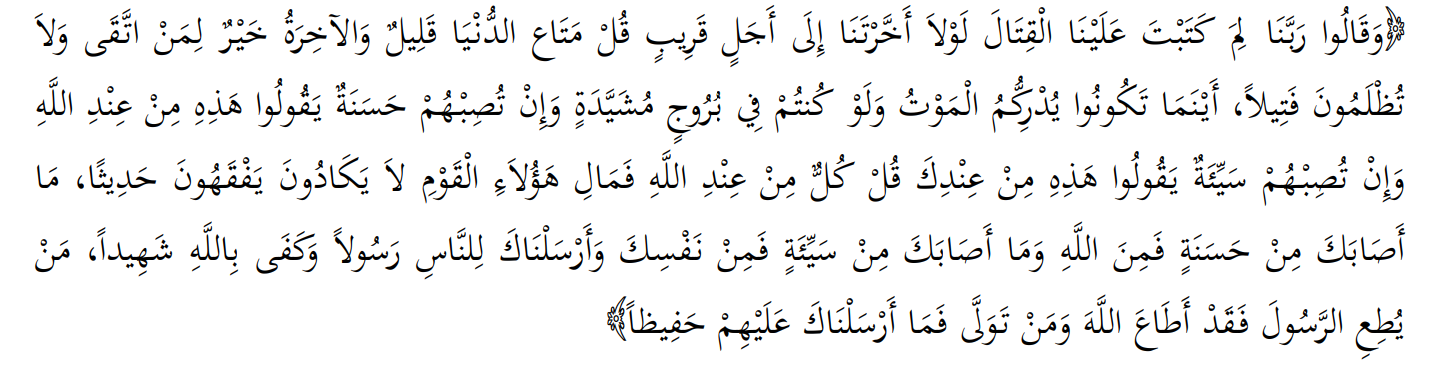
「彼らは言う。『主よ、なぜ我々に戦いを命じられたのですか。もう少しの間、猶予を与えてくださらなかったのですか』と。言え。『現世の享楽はわずかであり、来世は、主を畏れる者にとってはるかに良いものである。あなたがたは、糸一本ほども不当に扱われることはない。たとえ堅固で高い砦の中にいようとも、死はあなたがたに追いつくのだ』と。彼らに何か善いことが起これば『これはアッラーからのものだ』と言い、悪いことが起これば『これはあなたのせいだ』と言う。言え。『すべてはアッラーからのものである』と。この人々はどうしたことか、ほとんど言葉を理解しようとしない。あなたに降りかかる善はアッラーからのものであり、あなたに降りかかる悪はあなた自身からのものである。われはあなた(ムハンマド)を人類への使徒として遣わした。アッラーは証人として十分である。使徒に従う者は、まことにアッラーに従ったのである。しかし背を向ける者には、あなたを彼らの監視者として遣わしたのではない」』 [TMQ-Nisā’: 77-80]
“They say: Our Lord! Why have you ordained for us fighting? Would that you have granted us respite for a short period?’ Say: ‘Short is the enjoyment of this world. The Hereafter is (far) better for him who fears Allah, and you shall not be dealt with unjustly in the least. Wheresoever you may be, death will overtake you even if you are in fortresses built up strong and high! And if some good reaches them, they say, ‘This is from Allah,’ but if some evil befalls them, they say, ’This is from you.’ Say: ‘All things are from Allah’, so what is wrong with these people that they fail to understand any word? Whatever of good reaches you, is from Allah, but whatever of evil befalls you, is from yourself. And We have sent you (O Muhammad) as a Messenger to mankind, and Allah is sufficient as Witness. He who obeys the Messenger, has indeed obeyed Allah, but he who turns away, then we have not sent you as a watcher over them.” [TMQ-Nisā’: 77-80]
つまり、ここでの主語は彼らの身に起こること(何が彼らに降りかかるか)であって、彼らが何をしているかではない。したがって、これはアル=カダー・ワ=ル=カダル(天命と天定)の学問とは関係がない。
So the subject is what befalls them and not what they are doing. Thus it has nothing to do with the study of al-qadā’ wa‘l-qadar.
したがって、上に述べられてきたことはすべて、アル=カダーウ・ワ=ル・カダルの学問とは関係がなく、その意味にも含まれず、先に述べられたこととは何の関係もない。むしろ、アル=カダーウ・ワ=ル=カダルという意味は、ギリシャ哲学から来たものであり、それをムウタズィラ派が伝え、それについて見解を述べた。アフル・スンナと・ジャブリーヤ派は彼らを論駁し、アフル・スンナはまた、ジャブリーヤ派への反論を行った。議論は同じ意味の範囲に限られ、同じ前提に基づいて進められた。このように、この問題はギリシャ哲学から来た意味であり、ムスリムと、ギリシャ哲学で武装していた不信仰者(クファール)との間で行われていた論争の中で表面化したものである。それはアキーダ(信条)に関わる意味を持つものであるから、この意味についてイスラームの見解を示すことが求められている。ムウタズィラ派が見解を示し、ジャブリーヤ派がそれを論駁して別の見解を示した。アフル・スンナはそれら全てを論駁し、見解を示した。そして彼らはそれを、二つの見解の間から生じた第三の見解であると述べ、それを「排泄物と血の間から出てくる、飲んで甘い、純粋な乳」と表現した。
Therefore, all that has been mentioned above has nothing to do with the study of al-qadā’ wa‘l qadar; they do not come under its meaning and have no relation whatsoever with what has been mentioned above. Rather, al-qadā’ wa‘l-qadar as a meaning has come from Greek philosophy which was transmitted by the Mu'tazilah who gave an opinion with regards to it. Ahl al-Sunnah and the Jabriyyah refuted them and Ahl al-Sunnah (also) made a refutation of the Jabriyyah. The discussion was confined to the same meaning and preceded upon the same premise. Thus the issue is a meaning/sense that came from Greek philosophy and it came to the fore in the debate which used to take place between the Muslims and the kuffar who used to be armed with the Greek philosophy. It is a meaning which has a relevance to the ‘aqīdah (creed), thus what is desired is to give Islam's opinion regarding this meaning. The Mu'tazilah gave an opinion and the Jabriyyah refuted them and gave another opinion. Ahl al-Sunnah refuted all of them and gave an opinion, and said about it that it is a third opinion which has come out from the two opinions and they described it as ‘the pure milk, sweet to drink, that comes out from between excrement and blood’.
したがって、ギリシャ哲学に由来する論題が知られるようになったが、これはアキーダ(信条)に関わるものであるから、ムスリムは、この問題についての自らの信仰が何であるかを明確にしていなければならない。ムスリムたちは実際に自らの見解を述べ、三つの学派が生まれた。したがって、アル・カダーゥ・ワ・ル・カダル(天命と天定)の問題を、言語的にもシャリーアにおいても、アル・カダーゥやアル・カダルの意味として伝えられてきたものに帰することは許されない。また、単なる推測、観念、想像から、アル・カダーゥやアル・カダルに何らかの意味を想定し思い描くことも許されない。たとえば、アル・カダーゥは普遍的なものだけに対する普遍的な裁定であり、アル・カダルは個別的な側面とその細部に対する普遍的な裁定である、と言うことや、アル・カダルは物事についての永遠の計画であり、アル・カダーゥはその予定と計画に従った実行と創造である、と言うことも許されない。実際、これは単なる想像と憶測であり、特定の言語的・シャリーア的な表現を、それが当てはまらないものに無理に適用しようとする失敗した試みにすぎず、それらの表現はむしろ一般的な意味を示すものである。そのような証拠もなく、この二つの語をこれらの特定の意味に限定することは、恣意的な行為となるであろう。
Therefore, the subject of discussion, which came from the Greek philosophy, became known, and since it is related to the ‘aqīdah (creed), the Muslim must be clear as to what his belief is regarding this subject. The Muslims did actually state their opinion and three schools of thought arose. Thus it is not allowed to refer the issue of al-qadā’ wa‘l-qadar to what has come of the meaning of al-qadā’ or al-qadar, linguistically and in the Sharī’ah, nor is it allowed to imagine or conceive for al-qadā’ or ‘al-qadar any meaning from mere supposition, conception or imagination, and to say, for example, that al-qadā’ is the universal judgement on only the universals and al qadar is the universal judgement on the partial aspects and its details, or to say that al-qadar is the eternal plan for things and al-qadā’ is the execution and creation according to that predetermination and plan. Indeed, this is not allowed because this is mere imagination, assumption and a failed attempt of applying certain linguistic and shar’i expressions because they do not apply to it, they rather indicate general meanings; . It would then be an arbitrary action to restrict the two words to these specific meanings without evidence.
「すべての魂は、自らが稼いだものによって担保されている」 [TMQ Muddathir: 38]
“Every soul is a pledge for what it earns,” [TMQ Muddathir: 38]