17.3 バイア(忠誠の誓い)
17.3 The Pledge (bay’ah)
バイアは、すべてのムスリムにとって義務であり、男性であれ女性であれ、すべてのムスリムの権利でもあります。バイアが義務であることの根拠は、預言者ﷺが次のように言われた多くのハディースの中にあります。
Bay’ah is an obligation upon all Muslims, and it is a right for every Muslim, man or woman. The evidence for it being an obligation is in many ahadith of the Prophet (saw), in which he said:
「誰であれ、首にバイア(忠誠の誓い)をかけないまま死ぬ者は、ジャーヒリーヤの死に方で死ぬ。」
“Whosoever dies without having a bay’ah upon his neck dies a death of jahiliyyah.”
イスラーム教徒にとっての権利であることについては、バイア(忠誠の誓約)そのものがそれを示している。というのも、バイアはイスラーム教徒がカリフに対して行うものであり、カリフがイスラーム教徒に対して行うものではないからである。預言者ムハンマド ﷺ へのムスリムのバイアは、ハディースにおいて確認されている。アル=ブハーリーは、ウバーダ・ブン・アッ=サーミト(ra)が次のように述べたと伝えている。
As for being a right for Muslims, the bay’ah itself indicates that, because the bay’ah is offered by the Muslims to the Khalifah, and not by the Khalifah to the Muslims. The bay’ah of the Muslims to the Prophet (saw) was confirmed in the ahadith. Al-Bukhari reported that ‘Ubadah bin as-Samit (ra) said:
私たちは預言者ﷺに対して、好むことにも好まないことにも耳を傾け従うこと、命令を下す者たちと争わないこと、どこにいても真実を語ること、そしてアッラーのために行動し発言する際には、誰の非難も恐れないことを誓約(バイア)しました。
“We made a bay’ah to the Prophet (saw) to hear and to obey in whatever pleases and displeases us, and that we would not dispute the order of those in charge, that we would speak the truth wherever we are, and that we would not fear the blame of anyone when acting or speaking for the sake of Allah.”
アル=ブハーリーは、アイユーブから、ハフサから、そしてウンム・アティーヤーから伝えて、彼女はこう言ったと報告している。
Al-Bukhari reported from Ayyub from Hafsa from Umm ‘Atiyyah who said:
「私たちは預言者ﷺに忠誠の誓い(バイア)を立てました。預言者ﷺは私に、{彼らは、アッラーに何ものをも併せ拝むことをしない}(クルアーン60章12節)という節を朗誦されました。また、預言者ﷺは、私たちが死者のために泣き叫び、嘆き悲しむことを禁じられました。私たちの中の一人の女性が手を差し出して言いました。『あの女性は、私の家族の死者のために泣いてくれました。その泣いてくれたことに対して、私はその女性に報いたいのです』。預言者ﷺは何もお答えにならず、彼女は去って、そして戻ってきました。」
“We gave a bay’ah to the Prophet (saw) and he recited to me the verse That they will not associate anything in worship with Allah (TMQ 60.12). And he also prevented us from wailing and lamenting over the dead. A woman from us held her hand out and said, "Such-and-such a woman cried over a dead person belonging to my family and I want to compensate her for that crying" The Prophet did not say anything in reply and she left and returned.”
そして『サヒーフ・アル=ブハーリー』に、アブー・フライラ(ラ)が伝えたところによれば、彼は次のように述べました。「預言者ﷺは言われた。」
And in Al-Bukhari from Abu Hurairah (ra) who said: The Prophet (saw) said:
「復活の日にアッラーが語りかけず、彼らを清めることもなく、彼らには厳しい罰がある三種の人がいる。道中で余った水を持ちながら、旅人にそれを与えない人。ただ現世の利益のためだけにイマームへの忠誠の誓い(バイア)を行い、イマームが望むものを与えれば誓いを果たすが、与えなければ果たさない人。そして、アスル(午後の礼拝)の後に商品を別の人に売り、それに対してこれこれの値を提示されたと、実際にはそうでないのにアッラーにかけて誓い、相手がそれを信じて買う人。」
“(There are) three persons to whom Allah will not talk on the Resurrection Day, nor purify them, and for them is a severe punishment: A person who has an excess of water on the road and prevents the wayfarer from it; a person who gives bay’ah to an Imam for his worldly affairs only, so if the Imam gave him that which he wants he fulfilled (the bay’ah) to him, otherwise he would not; and a person trading a commodity to another after asr (late afternoon) and he swore by Allah that he was offered so and so for it, although he was not, and the person believed him and bought it.”
アル=ブハーリーは、アブドゥッラー・ブン・ウマル(ラ)が次のように語ったと伝えている。
Al-Bukhari narrated from ‘Abdullah bin ‘Umar (ra) who said:
「私たちが預言者ﷺに、聞き従うことを誓約したとき、預言者ﷺは私たちに、『できる限りで』と言われた」
“When we gave a bay’ah to the Prophet (saw) to hear and obey, he would say to us: As much as you are capable of”
「私たちが預言者ﷺに、聞き従うことを誓って忠誠の誓約(バイア)をしたとき、預言者ﷺは私たちに、『あなたがたにできる限りで』と言われたものだった。」
“When we gave a bay’ah to the Prophet (saw) to hear and obey, he would say to us: As much as you are capable of”
私は預言者ﷺに耳を傾け従うことを誓って忠誠を誓い(バイア)、預言者ﷺは私に「できる限りのことをし、すべてのムスリムに誠実な助言を与えなさい」と命じられた。
“I gave bay’ah to the Prophet (saw) to hear and obey and he instructed me: As much as you are able, and to give good advice to every Muslim.”
アル=ブハーリーは、ジュナーダ・ビン・アビー・ウマイヤーから次のように伝えた。彼は言った。
Al-Bukhari narrated from Junada bin Abu Umayyah who said:
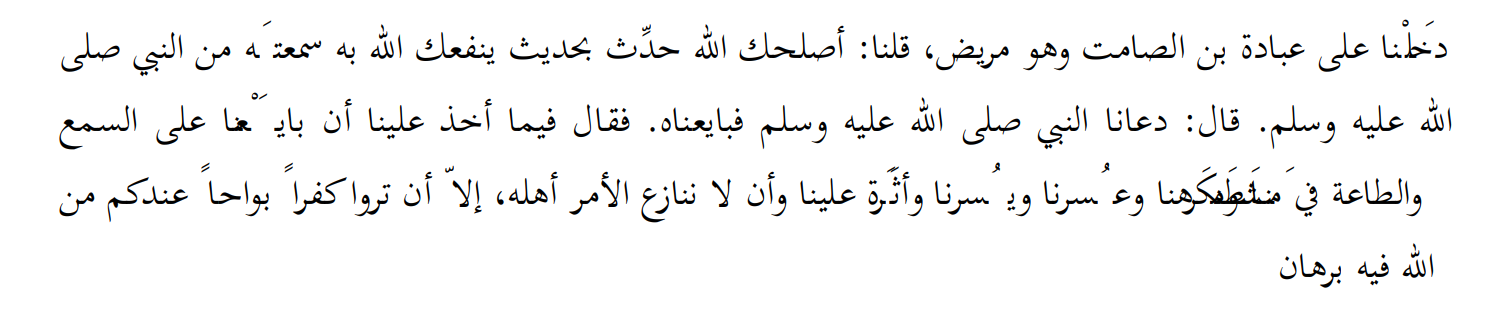
「私たちは病床にあったウバーダ・ビン・アッ=サーミトの家を訪ね、こう言いました。『アッラーがあなたを健康にしてくださいますように。アッラーがあなたに益を与えてくださるように、預言者(ﷺ)から聞いた hadith をお話しください。』彼は言いました。『預言者(ﷺ)は私たちを招かれ、私たちは彼にバイア(忠誠の誓い)を捧げました。彼が私たちから誓約を取られた条件の中には、活動的な時も疲れている時も、楽な時も困難な時も、そして(他者が自分たちより優遇されるのを)目にする時も、命令に聞き従い服従すること、また権限を委ねられた者たちの権威に異議を唱えないこと、が含まれていました。ただし、アッラーからの明白な証拠をもって、あなたがたが明白な不信仰(クフル・バワーフ)を目にした場合は除く、と。』」
“We entered the house of ‘Ubadah bin as-Samit while he was ill and we said: May Allah make you healthy, inform us of a hadith you heard from the Prophet (saw) by which Allah (swt) may benefit you. He said: The Prophet (saw) invited us and we gave him our bay’ah (pledge of Allegiance). And among the conditions on which he took the pledge from us, was that we were to listen and obey (the orders) both at the time when we were active and when we were tired , and in the times of ease and hardship and when we see preference (for others over us), and not to dispute the authority of those who are entrusted with it saying: Unless you see open disbelief (kufr bawah) upon which you have a clear proof from Allah.”
カリフへのバイア(忠誠の誓約)は、ムスリムの手にあり、それはムスリムの権利である。バイアを行うのはムスリムであり、彼らのバイアによって、カリフの任命が契約として成立する。バイアは握手によっても、書面によっても行うことができる。アブドゥッラー・ブン・ディーナールは次のように伝えている。
The bay’ah for the Khalifah is in the hands of the Muslims, and it is their right; it is they who give the bay’ah, and it is their bay’ah which makes the Khilafah contracted for a Khalifah. The bay’ah can be by shaking hand or by writing. ‘Abdullah bin Dinar narrated saying:
「私はイブン・ウマルが、人々がアブドゥルマリク・ビン・マルワーンの周りに集まった際にその場にいたのを見た。彼は書いた。『私はアッラーのしもべであり信徒たちの長であるアブドゥルマリクに、アッラーのスンナおよびその預言者ﷺのスンナに従い、できる限り、聞き従うことに同意する。』」
“I witnessed bin ‘Umar where the people gathered around ‘Abdulmalik bin Marwan. He wrote: I agree to listen and obey to the slave of Allah, ‘Abdulmalik the Amir al-Mu’mineen, according to the Sunnah of Allah and the Sunnah of His Prophet as much as I am able.”
さらに、バイア(忠誠の誓い)は、いかなる手段(ワスィーラ)によっても正しいものです。ただし、バイアは成人した者によって行われなければならず、幼い者が行うことは不適切です。アブー・アキール・ザフラ・ブン・マァベド は、彼の祖父であるアブドゥッラー・ブン・ヒシャームから伝えています。彼は預言者(ﷺ)にお会いした人物です。彼の母ザイナブ(ハミードの娘)が彼を預言者(ﷺ)のもとに連れて行き、こう言いました。「アッラーの預言者よ、この子からバイアを取ってください。」すると預言者(ﷺ)は言われました。
Moreover, the bay’ah is correct by any means (waseelah). However, the bay’ah has to be given by the mature person, so it is improper to be given by the young. Abu Aqeel Zahra bin Ma‘bed reported from his grandfather ‘Abdullah bin Hisham--who witnessed the Prophet (saw)--that his mother Zaynab, the daughter of Hameed, took him to the Prophet (saw) and said: O Prophet of Allah, take a pledge from him. The Prophet (saw) said:
「彼は子供で、その頭を撫でて、彼のために du‘a(ドゥアー)を唱えた。」
“He is a child, wiped his head and made a du‘a for him.”
バイア(誓約)の文言は特定の言葉に限定されない。しかし、それには、カリフによる{アッラーの書}とその預言者(ﷺ)のスンナに従って行動すること、困難な時にも安楽な時にも服従すること、そして誓約する者の側で好むことと好まないことに服従することが含まれていなければならない。誓約する者がカリフにバイアを与えた場合、あるいは他のムスリムのバイアによってカリフとの契約が成立した場合、そのバイアは、バイアを与えた者の首にかかった信託となり、彼がそれを撤回することは許されない。それはカリフ制の契約に対する権利であり、一度与えたならば、それに従わなければならない。彼がそれを撤回することは許されない。 アル=ブハーリーは、ジャービル・ブン・アブドゥッラー(ra)から、ある遊牧民がイスラームへのバイアを預言者(ﷺ)に与えたが、病に襲われたため、預言者(ﷺ)に「私のバイアを取り消させてください」と言ったと伝えている。しかし預言者(ﷺ)はそれを拒み、その男は立ち去った。その後、預言者(ﷺ)は言われた:
As for the words of the bay’ah they are not restricted to specific terms. However they must include acting according to the Book of Allah (swt) and the Sunnah of His Prophet (saw) by the Khalifah, and obedience in hardship and ease and obedience, and whatever pleases and displeases on the part of the person who gives the bay’ah (to the Khalifah). Whenever the one who pledges has given his bay’ah to the Khalifah or the Khilafah is contracted to the Khalifah by the bay’ah of other Muslims, then the bay’ah has become a trust on the neck of the one who gives the bay’ah and he is not allowed to retract it. It is a right for the contract of the Khilafah until he has given it, and once he has given it he must abide by it. He is not allowed to retract from it. Al-Bukhari narrated from Jabir bin ‘Abdullah (ra) that a Bedouin gave the Prophet (saw) his pledge on Islam, and an illness struck him so he said to the Prophet (saw): “Let me withdraw my bay’ah but the Prophet (saw) refused, and the man left. The Prophet (saw) then said:
「マディーナは炉のようなものである。不純物を吐き出し、良いものを選び出して、それを完璧なものにする。」
“Medina is like a furnace, it expels out the impurities and selects the good ones and makes them perfect.”
そしてナーフィウから伝えられている。彼は言った。イブン・ウマル(ラ)が私に語った。彼は預言者(サ)がこう言うのを聞いたという。ﷺ
And it is narrated from Nafi‘a who said: Ibn ‘Umar (ra) said to me that he heard the Prophet (saw) saying:
「誰でもアミール(指導者)への服従から手を引く者は、復活の日にアッラーの御前に立つとき、弁明の余地を何も持たないであろう。」
“Whoever withdraws his hand from obedience (to the Amir) will find no argument (in his defense) when he stands before Allah on the Day of Resurrection.”
カリフのバイアを破棄することは、アッラー(SWT)への服従から手を引くことである。これは、そのバイアが契約としてのバイアである場合、あるいはムスリムが受け入れてバイアを与えたカリフへの服従としてのバイアである場合に当てはまる。しかし、もし彼が当初あるカリフにバイアを与えたものの、ムスリム全体がその人物をカリフとして受け入れなかったためにそれが完結しなかった場合には、そのバイアから手を引く権利を彼は持つ。ハディースに記された禁止は、カリフへのバイアの破棄に焦点を当てたものであり、カリフ制が成立しなかった人物へのバイアには当たらない。
To break the bay’ah of the Khalifah is withdrawing of one’s hand from the obedience of Allah (swt). This is the case if his bay’ah to the Khalifah is a bay’ah of contract or it is a bay’ah of obedience to a Khalifah whom the Muslims accepted and gave their bay’ah to. However, if he gave his bay’ah in the beginning to a Khalifah and it was not completed because the Muslims as a whole did not accept him as Khalifah, then he has the right to withdraw from that bay’ah. The prohibition mentioned in the hadith is focused on the withdrawal of a bay’ah to a Khalifah, not to a man for whom the Khilafah was not accomplished