このハディースは、善い指導者と悪い指導者について明確に伝えており、彼らがディーン(宗教)を確立している限り、剣をもって敵対することを禁じている点でも明確です。なぜなら、サラート(礼拝)を確立することは、ディーンを堅持しそれによって統治していることを示すからです。
This hadith is clear in informing about the good and bad leaders, and clear in prohibiting confronting them with the sword as long as they establish the deen, since establishing the salat (prayer) indicates upholding of the deen and ruling by it.
イスラーム法の諸典拠において、ムスリムがイスラームの法を確立し、その呼びかけを伝えるカリフを任命することが義務であることは、その確実性について疑いのない事柄である。さらに、これはアッラー(SWT)がムスリムに対してイスラームの統治を確立し、ムスリムの名誉を守ることをファルド(義務)とされたことによるものであり、義務である。しかし、この義務は集団的なものであるため、ウンマの一部の者がそれを成し遂げれば、ファルドは果たされ、残りのウンマからは責任が消える。また、ウンマの一部がファルドを成し遂げることができず、それを確立するための行動を取ったとしても、責任はすべてのムスリムに残り、ムスリムがカリフを持たない限り、ファルドはすべてのムスリム一人ひとりに残り続ける。
So the obligation upon Muslims to appoint the Khalifah who establishes the laws of Islam and conveys its call is a matter which has no doubt with regard to its certainty in the sound texts of Shari’ah. Moreover, it is an obligatory duty due to the fact that Allah (swt) made it fard upon Muslims to establish the rule of Islam and to protect the honour of Muslims. However, this duty is a collective one, so if some people of the Ummah accomplished it, the fard is fulfilled and thus responsibility drops from the rest of the Ummah. And if part of the Ummah was unable to achieve the fard, though they carried out the actions which establish it, then the responsibility remains upon all the Muslims, and the fard remains upon every Muslim as long as Muslims are without a Khalifah.
ムスリムのためにカリフを樹立することを怠ることは、最大の罪の一つである。なぜなら、それはイスラームの最も重要な義務の一つを果たさないことであり、その義務の遂行にこそ宗教の実践がかかっており、さらには人生の戦場においてイスラームが存在するかどうかさえもそれにかかっているからである。したがって、ムスリム全体は、すべてのムスリムのためにカリフを樹立することを怠ることによって、大きな罪を犯すのである。そして、もし彼らすべてがカリフなしにとどまることに同意したならば、その罪は人の住むすべての地域(全世界)のすべてのムスリムに及ぶ。
しかしながら、ムスリムの一部がカリフの樹立に向けて努力を始め、他の者が努力しなかった場合、カリフの樹立に努めた者たちの肩からは罪が取り除かれる。ただし、カリフが任命されるまで、その義務は彼らに残り続ける。(これは)義務の遂行に関わることによって、本来の時期にそれを樹立することの遅れに対する罪と、その不樹立に対する罪が取り除かれるからである。それは、カリフの樹立に努める自身の働きと、それを妨げるものへの嫌悪によるものである。
To refrain from establishing a Khalifah for the Muslims is among the greatest sins because it is abstaining from carrying out among the most important obligations of Islam upon which the implementation of the deen depends; nay even the very existence of Islam in the battlefield of life depends upon it as well. So Muslims as a whole commit a great sin by refraining from establishing a Khalifah for all Muslims. And if they all agreed to remain without a Khalifah the sin would befall all Muslims in all inhabited regions (entire world). However, if some of the Muslims embarked on working to establish a Khalifah and the others did not, the sin will drop from the shoulders of those who started to work to establish the Khalifah though the fard remains upon them until the Khalifah is appointed. (This is so) because the involvement in establishing the fard removes the sin for the delay in establishing it in its proper time, and for its non-establishment, due to one’s work to establish it and his hatred of that which prevents him from establishing it.
もし、フィルド(義務)を確立する営みに携わっていなかった者たちは、カリフが去ってから新たなカリフが任命されるまで三日が経過した後も、その罪は彼らに残ります。アッラー(スブハーナhu wa ta'ala)は彼らに一つのフィルドを託されたのに、彼らはそれを果たさず、その完成に必要な営みにも身を投じなかったからです。したがって彼らは罪に値し、現世と来世においてアッラー(スブハーナhu wa ta'ala)の罰を受けるに値します。
カリフを確立すること、あるいはシャリーアに従ってカリフを確立する行為を怠ったことによって罪に値することは、明らかです。ムスリムは、自らに課された義務のいずれかを無視したとき、とりわけ他のすべての義務が実行され、宗教の規範が確立され、イスラームの大義が高く掲げられ、イスラームの地および世界の他の地域においてアッラー(スブハーナhu wa ta'ala)の御言葉が崇高なものとされる、その義務を無視したときに、アッラー(スブハーナhu wa ta'ala)の罰を受けるに値するのです。
As for those who were not engaged in the work to establish the fard, the sin will remain on them after three days have passed from the departure of the Khalifah until the appointment of a new Khalifah, because Allah (swt) has entrusted them with a fard which they did not carry out nor engage themselves in the work which is required for its completion. Therefore, they are deserving of sin and deserve the punishment of Allah (swt) in this life and the hereafter. Their deserving of sin due to their refraining from establishing the Khalifah, or performing the actions which (according to Shari’ah) establish the Khalifah, is explicitly clear in that a Muslim deserves the punishment of Allah (swt) when he ignores any of the duties enjoined upon him, particularly the obligation by which the other obligations are implemented, the rules of the deen are established, the cause of Islam is raised high and the word of Allah (swt) becomes exalted in the Islamic lands and the rest of the world.
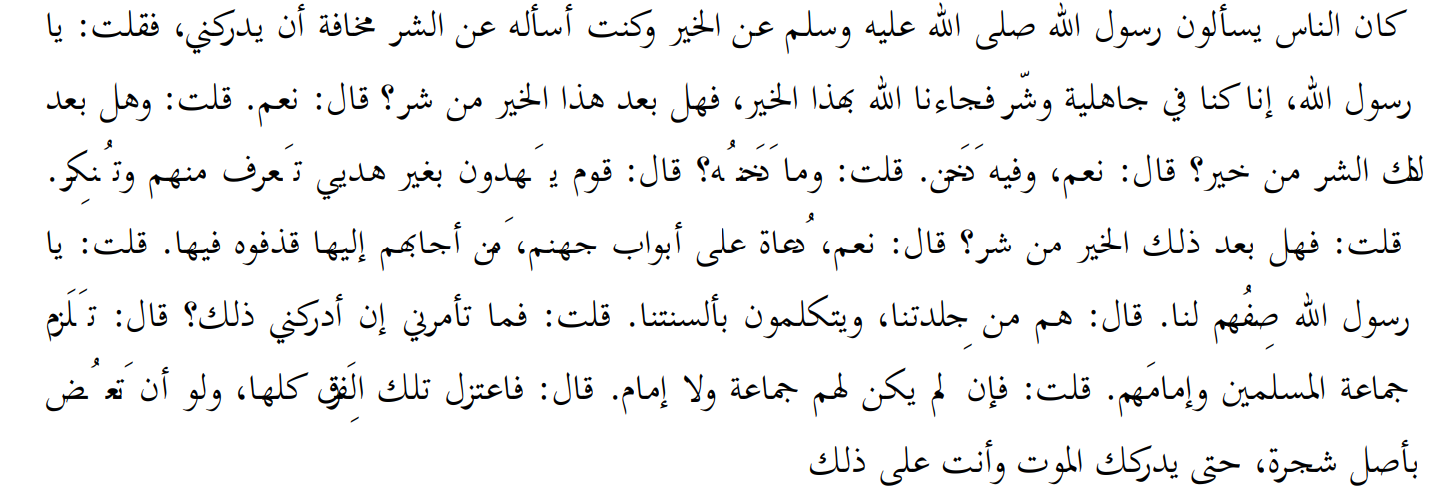
人々からの隔絶や、ただ個人的な礼拝など宗教上の事柄にのみ従事することに自らを限定することについて述べられたいくつかのハディースについては、それらはカリフ制の樹立を控えること、またこの controlled 控えによって生じる罪を取り除くことの根拠としては適していない。これらのハディースを注意深く学ぶ者は、それらが、ムスリムのためにカリフを樹立することを控える許可ではなく、宗教に従うことに関わる事柄に関係していることに気づくであろう。例えば、ブハーリーは、ビスル・ビン・ウバイドゥッラー・アル=ハドラミーについて、彼がアブー・イドリース・アル=フーラーニーが次のように言うのを聞いたと伝えている。彼はフザイファ・ビン・アル=ヤマーンが言うのを聞いたという。
As for what came in some of the ahadith regarding isolation from the people, and restricting oneself to adhering only to matters of personal worship of the matters of the deen, these ahadith are not suitable as evidence to refrain from establishing a Khalifah nor removing the sin due to this abstention. Whoever studies these ahadith carefully will find them related to the matter of adhering to the deen rather than permission to refrain from establishing a Khalifah for Muslims. For example, Al-Bukhari narrated about Bisr bin Ubaydullah al-Hadhrami that he heard Abu Idrees al-Khoolani say that he heard Hudhayfah bin al-Yaman saying: