9. 科学と文化
9. Science And Culture
アラビア語では「彼は知識(ʿilm)を得た(ʿalima)」と言います。これは、彼が知識の真の実在に到達したことを意味します。ある事柄について知識(ʿilm)を得たとは、それを認識するようになった、すなわち、ある事柄について知らされた、あるいはそれに通じたことを意味します。また、同じ言語では「彼は理解力を得た(thaqifa)」とも言い、それは彼が熟達し、そのため教養があり文化的である(thaqif)ことを意味します。「彼は言語を理解した(thaqifa)」とは、それを習得し、素早く理解したことを意味します。これらの語義的な意味が、語の用法の基礎となっています。しかし、これらの語が語義的意味に関連する他の意味を示すために用いられた場合、それは許容されます。例えば、文法において「主語(fāʿil)」という語が採用された場合がそうです。語義的な意味が優勢であったため、古人は「ʿilm」という語を、学問や分野を区別せずあらゆる種類の知識に適用していました。その後、人々は知性的・自然的な学問をすべての人々に共通するものと見なし、一方で伝承的(テクスト的)な学問は、それが伝えられた民族に特有のものと見なすようになりました。その後、「ʿilm(学問・科学)」と「thaqāfa(文化)」はそれぞれ、異なる特定の学問分野に応じて定義されるようになり、語義とは異なる術語的な意味を獲得しました。この術語に従えば、次のような意味になります。学問(ʿilm)とは、観察、実験、教育を通じて獲得される知識であり、物理学、化学、そしてその他の経験的な諸科学がこれにあたります。文化(thaqāfa)とは、伝承、学習、推論によって獲得される知識であり、歴史、言語、法学(fiqh)、哲学、そしてその他の非経験的な諸学問がこれにあたります。 また、経験的ではないものの、科学('ilm)として含まれる学問分野も存在する。たとえば算術、工学、工業である。これらは文化(thaqafa)に属するものの、特定の一民族に限られず万人に共通するものであるため、科学の一部とみなされる。同様に、工業に似た手仕事に関わる文化の要素、たとえば商業や海運も、科学の一部であり普遍的なものとみなされる。一方、絵画、彫刻、音楽といった芸術は文化の一部である。これらは特定の見方に従っており、それは特定の文化である。文化(thaqafa)と科学('ilm)の違い
In Arabic language it is said: the man has obtained (‘alima) knowledge (‘ilm). This means that he attained the true reality of knowledge (‘ilm). He gained knowledge of a thing means he became cognisant of it, which means that he became informed of a matter or acquainted with it. Also in the language it is said: He has gained comprehension (thaqifa), which means that he has become proficient, thus he is educated and cultured (thaqif). He has understood (thaqifa) a language (means) he has mastered and understood it swiftly. These linguistic meanings are the basis of the use of words, However if these words were used to indicate other meanings that relate to the linguistic meaning then that is permitted, like in the case of the adoption of the word fa’il (subject) in grammar for example. The linguistic meaning (of the words) was prevailing and this is why the ancients used to apply the word ‘ilm on all forms of knowledge without differentiating between the sciences and disciplines. Then people began to consider intellectual and natural disciplines as being general to all people whilst other traditional (textual) disciplines were considered specific to the nation from which it was transferred. Subsequently, each of science (‘ilm) and culture (thaqafa) began to be defined according to different specific disciplines, acquiring terminological meanings which were different to their linguistic meanings. According to this terminology they have the following meaning: Science (‘ilm) is the knowledge which is acquired through observation, experimentation and education like physics, chemistry and the rest of the empirical sciences and culture (thaqafa) is the knowledge which is acquired by way of transmission, learning and deduction as in (the study of) history, languages, jurisprudence (fiqh), philosophy and the rest of the non-empirical disciplines. And there are other non-empirical disciplines which are included as sciences (‘ilm) even though they come within culture such as arithmetic, engineering and industry; even though they come under culture (thaqafa) they are regarded as part of science because they are universal to all people and not specific to any one nation. In a similar way anything from the culture related to crafts which resemble industry such as trade and shipping; they are considered to be part of science and they are universal. As for the arts such as; painting, sculpture and music they are part of culture. They follow a particular viewpoint; which is a specific culture. The difference between culture (thaqafa) and science (‘ilm)
科学は、すべての国々に共通するものであり、いかなる一国に特有のものでもなく、他国を排除するものでもない。これに対して文化(ثقافة、サカーファ)は、特定的であることもある。すなわちそれを生み出した国民に帰属する場合がある。あるいは、文学や英雄たちの伝記、人生に関する哲学など、その国民の特有で固有の性格の一部である場合もある。また、商業や海運などのように普遍的である場合もある。したがって、科学はそれが普遍的であり、いかなる特定の国にも特有でないがゆえに、あらゆる国から普遍的に取り入れられる。これに対して文化については、国民はまず自らの文化から始めるべきであり、それを学び、よく理解し、その文化が心の中で明確な焦点を結ぶまで努めた後に、他の文化を学ぶことができる。ムスリムは、人が自ら獲得した学問と、他者から受け取った学問とを区別していた。イブン・ハルドゥーンは著書『ムカッダマ』で次のように述べている。
is that science is universal to all nations and not specific to any nation to the exclusion of another nation. As for culture (thaqafa) it might be specific, being ascribed to the nation from which it resulted or it may be part of the nation’s specific and particular characteristics such as literature and biographies of heroes, and their philosophy concerning life or they may be universal such as trade, shipping etc. Therefore, science is adopted universally from all nations because it is universal and not specific to any particular nation. As for culture (thaqafa) the nation should begin with its own culture, when she has studied it and is cognisant of it until it becomes focused in their minds then they can study other cultures. The Muslims used to differentiate between the sciences which a person used to attain by himself and the sciences he used to receive from others. Ibn Khaldun says in his book al-Muqaddima:
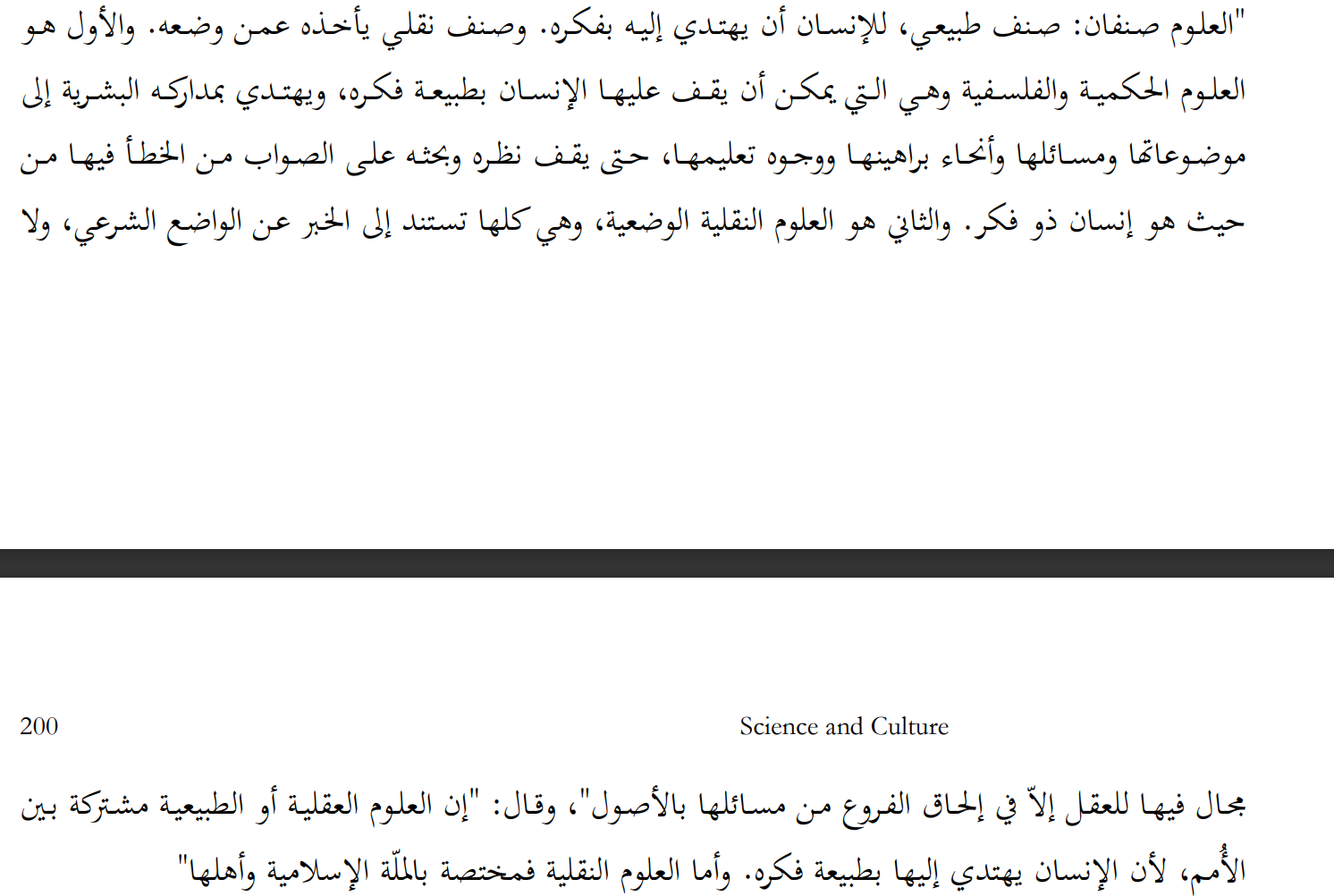
学問には二つの種類がある。一つは自然的な種類であり、人が自らの思考によって到達するものである。もう一つは伝承的な種類であり、人がそれを著した者から受け取るものである。前者は哲学的・格言的な諸学問であり、人はそれを思考によって探求し、人間の能力を通じてその対象や問題、そのすべての決定的な論証と教えの諸側面へと導かれる。こうして人は、思考の能力を備えた人間としての識別と研究において、誤ったものから正しい見解を見いだすのである。後者は伝承的・文書的な諸学問である。これらは、シャリーア由来の伝えに依拠している。この点において理性が働く余地は、枝葉の問題を根本原理(ウスール)に関連づける以外にはない。
“The sciences are of two types: A natural type which is for man to arrive at through his thinking and a textual type which he takes from the one who authored it. The first are the philosophical and aphoristic sciences which he can seek by his thought and be guided through the human faculties to its subjects and issues and all its decisive proofs and aspects of its teachings. So as in his discernment and study he attains the correct (opinion) from the incorrect, in his capacity as a human being possessing the faculty of thought. The second are the textual and written sciences. They depend on the report coming from a shar’i source. The mind has no scope in this regard except to relate the branch issues to the usul (foundation)”.
彼はまた次のようにも述べている。「合理的あるいは自然の学問は、人間が思考を通じて自然にそこに到達するため、すべての民族に共通である。他方、伝承の学問は、イスラーム教とその信奉者に固有のものである。」イブン・ハルドゥーンが伝承の学問をイスラーム共同体(ミッラ)によって特定したのは、単なる一例にすぎなかったと思われる。というのも、イスラーム共同体以外の民族にも、その立法や言語など、それぞれに固有の伝承の学問が存在するからである。イブン・ハルドゥーンの言明は、彼が学問と文化を区別していたことを示すものではない。それが示しているのは、彼が伝承の学問と合理的な学問を区別していたということにすぎない。したがって、彼の論評は、ムスリムが学問と文化を区別していたことの証拠ではなく、むしろムスリムが学問の分野同士を区別していたことを証明するものである。彼らはそれらを二つの部門に分けた。ただし、その区分は学問の習得の仕方によるものではなく、一般的な獲得の仕方によるものであった。すなわち、知性を通じて獲得されるものを合理的な学問、テクストから獲得されるものを伝承の学問と呼んだのである。しかし今日の人々は、学問の分野を、それらを受容する仕方によって区別している。すなわち、経験的方法によって獲得されるものすべてに「学問」(ilm)という語を適用し、経験的方法以外の手段によって獲得されるものには「文化」(thaqafa)という語を適用するのである。
He also said “The rational or natural sciences are common to all nations since man arrives at them naturally through his thought. As for the textual sciences they are specific to the Muslim religion and its adherents.” It appears that what Ibn Khaldun meant by specifying the textual sciences with the Islamic millah was only an example because nations other than the Islamic nation as well have textual sciences specific to them such as their legislation and language. Ibn Khaldun’s statement does not indicate that he distinguished between science and culture. It only indicates that he distinguished between textual and rational sciences. His comments are not an evidence to say that the Muslims used to differentiate between science and culture rather they are an evidence to prove that the Muslims used only to differentiate between disciplines. Thus, they divided them into two sections. However their division was in terms of their general acquisition and not in terms of the manner of acquisition. So they designated them as rational sciences i.e, acquired via the mind. And textual sciences acquired from the text. However, people today differentiate between disciplines in terms of the manner in which they were received. Thus, they apply the term ‘science’ (‘ilm) on anything that is acquired through the empirical method and they apply the term ‘culture’ (thaqafa) on anything acquired by means other than the empirical method