26. 信者による不信仰者との交友
26. The Believer's Befriending The Disbelievers
アッラーはこう仰せられた:
Allah (swt) said:
「信者たちは、信者を差し置いて不信者を友としてはならない。そのようなことをする者は、いかなる意味でもアッラーとは無関係である。ただし、彼らから何らかの恐れるべきものを恐れる場合は別である。アッラーは、ご自身について汝らに警告される。そして帰着はアッラーのもとにある」[TMQ 3:28]。
“Let not the believers take the disbelievers as friends instead of believers, and whoever does that is not of Allah in anything except if you fear from them something to be feared. And Allah warns you against Himself and to Allah is the return” [TMQ 3:28].
ヤアクーブとサフルは、これを(タクィーヤ)と読みます。これはハサンとムジャーヒドの読み方です。残りの人々は(トゥカート)と読みます。『アル=カームース・アル=ムヒート』には次のようにあります。「(at-tawqiyya)は(al-kalau)であり、守ることである。私は何かを(taqa)する、私はそれを(taqa)した、そしてそれを(taqi)する、(taqa)、彼はそれを(taqi)した、(tiqa)は(kisa)のようなものであり、私はそれを恐れた」。この節の本文はその主題を明示しています。また、「タクィーヤ」という語の言語的な意味は、この節においてこの語が何を意味するかを、その意味の面で明示しています。なぜなら、この語にはシャリーア上の意味が確立されていないからです。したがって、言語的な意味によって解釈することが明示されています。この根拠に基づいてのみ、この節は、その一般性と細部において理解されるのです。また、啓示の背景に関して伝えられたハディースについては、それが真正であるとされるならば、節に含まれる細部へと導くものではありますが、節の主題や、言語とシャリーアに照らした文の意味を変えるものではありません。節の主題は、その文の中で明らかです。すなわち、信者が不信仰者と親交を結ぶこと、つまり彼らを友として扱うことです。本文は次のとおりです。
Ya’qub and Sahl recite it as (taqiyyah) which is the recitation of Al-Hasan and Mujahid, while the rest (recite it) as (tuqat). It is said in Al-Qamus Al-Muheet: ‘(At-tawqiyya) is (al-kalau) and protection. I do (taqa) something and I did (taqa) it and do (taqi) it (taqa) and he (taqi) it (tiqa) like (kisa) is I feared it.’ This text in the ayah specifies its subject and this linguistic meaning of the word (taqiyyah) specifies what this word means in this ayah in meaning since no Shari’ah meaning was established for it. So it specifies interpreting it with its linguistic meaning. Upon this basis alone is the ayah understood in its generality and details. As for what came in the ahadith of the circumstances of its revelation, if authenticated, guides to the details of what came in the ayah but would not change its subject neither the meaning of its sentences according to the language and Shar’a. The subject of the ayah is clear in its sentence which is believers befriending the disbelievers i.e. treating them as friends. The text is:
「信者たちは、信者ではなく不信者を友としてはならない」{タフシール・クルアーン 3:28}
“Let not the believers take the disbelievers as friends instead of believers” [TMQ 3:28].
もし節やハディースが特定の主題について下されたものであれば、それはその主題に限定されるのであって、それ以外のものを含むことはありません。問題となっているのは、信者が不信仰者と友情を結ぶことであり、それを明確に禁じる節が下されています。しかもこの主題について述べる節はこれ一つだけではなく、アッラーの次の言葉のように、数多くの節が下されています。
If the ayah or ahadith came about a specific subject, then it is specific to this subject and does not include anything else. The issue is the issue of believers befriending disbelievers for which came the ayah decisively prohibiting it. Nor is this the only ayah upon this subject; there have come numerous ayahs like Allah’s statement:
「偽信者たちに、彼らには痛ましい懲罰があると知らせなさい。信者たちを差し置いて不信仰者を味方(アウリヤー)とする者たちに」[TMQ 4:138-139]
“Give tidings to the hypocrites that for them is a painful punishment. Those who take the disbelievers as (awliya) instead of believers” [TMQ 4:138-139].
そしてアッラーのお言葉:
And Allah’s statement:
「信仰する者たちよ、信者ではない者を信者の代わりに{أَوْلِيَاء}(アウリヤー)として取ってはならない」 [TMQ 4:144]
“O you who believe, do not take the disbelievers as (awliya) instead of disbelievers” [TMQ 4:144]
そして彼(SWT)の言葉:
And His (swt) statement:
「アッラーと最後の審判の日を信じる人々が、アッラーとその使徒に背く者を愛するのを見出すことはないであろう」 [TMQ 58:22]
“You will not find a people who believe in Allah and the Day of Judgement loving those who oppose Allah and His Messenger” [TMQ 58:22]
そして彼(SWT)の言葉
And His (swt) statement
「ユダヤ教徒とキリスト教徒を(アウリヤー)として取ってはならない」 [TMQ 5:51]
“Do not take the Jews and Christians as (awliya)” [TMQ 5:51]
そして、彼の言葉:
And His statement:
「私の敵とあなたの敵を、(アウリヤー)として取ってはならない」 [TMQ 60:1]
“Do not take my enemy and your enemy as (awliya)” [TMQ 60:1]
主題は信者が不信仰者と親しくすることについてであり、節の残りの部分はその主題を詳しく述べています。アッラー(SWT)は信者が不信仰者を友とすることを禁じ、その禁止を、そうする者はアッラーからの離脱を受けるという断固たる文言と結びつけられました。そして、この断固たる禁止から一つの状況が除外されています。それは、信者が不信仰者から害を受けることを恐れる場合であり、その害を防ぐために不信仰者と親しくすることが許されるという状況です。これは、ムスリムが不信仰者の支配下にあり、その事柄において敗北している場合に当たります。すなわち、不信仰者への恐れがあるときに限り、親しくすることが許されるのです。その恐れが消えれば、親しくすることは禁じられます。したがって、この状況は親しくしつつ別の何かを隠すことを示しているのではなく、ムスリムが事柄において敗北し不信仰者を恐れる状況を、親しくすることを禁じる一般原則から除外することが問題なのです。 節の意味は、信者が不信仰者を自分たちの友とし、彼らの助力を求めて頼り、親しみを持ち、互いの間に愛情を抱くことに対する断固たる禁止です。したがって、節は信者が不信仰者と親しくすることを禁じ、その後、一つの状況を除外しています。それは、不信仰者の支配下にあって彼らから恐れがある状況です。その場合には、彼らの悪や害を防ぐために愛情を示し、親しくすることが許されます。つまり、不信仰者の支配下にあって恐れがある状況においては、彼らを友とすることが許されるのです。それ以外では、いかなる場合も決して許されません。これは不信仰者と信者との関係に限ったものであり、この節はメッカの多神教徒と親交のあった信者たちの事柄について下されたものです。 それは、マディーナの人々がマッカの多神教徒と友情を結ぶことを禁じ、また信者全員を禁じたが、その中でマッカにいて自分たちの事態において敗れた信者たちは除外した。つまり、近くにいる不信仰者からの害を恐れる状況があるために除外されたのである。これがこの節の主題であり、その意味である。そして、ここから導き出されるシャリーアの規定は、信者が不信仰者と、あらゆる種類の友情、すなわち支持、親交、援助などにおいて関わることの禁止である。「アウリヤー」という語は節の中で一般的な形で現れており、そのすべての意味を含んでいるからである。また、不信仰者が優勢で、ムスリムが自分たちの事態において敗れているとき、すなわち彼らの暴力や害を恐れる状況では、関係を結ぶことが許される。これは、マッカにおける多神教徒の中のムスリムの状況とまったく同じである。この節には、ここから導かれる規定以外の意味も、他の規定も存在しない。 一部の人々が「タキーヤ」とは、ムスリムが害を受けることを恐れる相手、あるいは自分の実情や心中を知られることを恐れる相手に対して、内心に隠していることと反対のことを示すことであり、その相手が不信仰者であれ信者であれそうだと述べていることについては、これは全くの誤りである。この節はそのようなことを一切示していない。なぜなら、「あなたがたが彼らを恐れる場合は別として(トゥカート)」、すなわち彼らから何か恐れるべきものを恐れる場合は別として、という意味であり、「アッタクャイトゥ」が何かを恐れたという意味であるのと同様に、「トゥカート」と「タキーヤ」は同じ意味だからである。これは、信者が不信仰者ではなく信者を友とすることの禁止から除外されたものであり、したがって除外された事柄に限定される。
The subject is the subject of believers befriending disbelievers and the rest of the ayah is detailing the subject. This is because Allah (swt) prohibited the believers from taking the disbelievers as friends, and linked this prohibition with a definite decisiveness that the one who does that and takes the disbelievers as friends then Allah is absolved from him. The he excluded from this decisive prohibition one situation which is the believer fearing harm from the disbeliever, wherein it is allowed for him to befriend the disbelievers to prevent this harm. This is if the Muslim were under the disbelievers’ authority defeated in his affair i.e. the fear of the disbeliever permits his befriending. If the fear disappears then the befriending is forbidden. Accordingly the situation is not displaying befriending and hiding something else, but the issue is excluding the situation of the believer’s fear of the disbeliever when the Muslim is defeated in his affair from the generality of forbidding his befriending him. The meaning of the ayah is the decisive prohibition for the believers from taking the disbelievers as friends for them, and that they seek their assistance and depend upon them, and that they befriend them and there be love between them. So it forbade the believers from befriending disbelievers instead of believers then excluded one situation from this, which is in the situation where there exists fear from them when they are under their authority. Then it is allowed to display love for them and to befriend them to prevent their evil and harm. That is, it is allowed to take them as i.e. friends in the situation where there exists fear from them when they are under their rule. Apart from that, it is absolutely not allowed. This is for the disbelievers only in relation with the believers as the ayah was revealed in the affair of the believers who had relations friendship with the polytheists in Makkah. It prohibited those in Madinah from befriending the polytheists in Makkah and it prohibited all believers but excluded from that the believers who were in Makkah who were defeated in their affair. So it excluded them due to the existence of fear of the harm of the disbelievers near to them. This is the subject of the ayah and this is its meaning, and this is the Shari’ah rule deduced from it which is the forbidding of the believers befriending the disbelievers in all types of befriending, for support, friendship, assistance etc as the word (awliya) came general in the ayah covering all its meanings, and the permission of befriending them in the situation of fearing them i.e. fearing their violence and harm when the disbelievers are victorious over Muslims and the Muslims are defeated in their affair exactly like the situation of the Muslims in Makkah with the polytheists. There does not exist any other meaning in the ayah nor any rule other than this rule deducted from it. As for what some say that “taqiyyah” is that a Muslim displays opposite to what is hidden before any person from whom he fears harm or fears his knowing his reality and what is in his soul whether that person is a disbeliever or believer, this statement is pure error. The ayah does not indicate anything of this since the meaning of: “Except if you fear from them (tuqat)” i.e. except if you fear from them something to be frightened of as the meaning of “atqaytu” something “taqiyyah” is I feared it, and (tuqat) and (taqiyyah) are of one meaning. This is excluded from the prohibition of believers befriending disbelievers instead of believers so it is specific to what is excluded of it.
「アッラーと終末の日を信じる民が、アッラーとその使徒に敵対する者を愛しているのを、あなたは見出すことはないでしょう」 [TMQ 58:22]
‘You will not find a people who believe in Allah and the Last Day loving those who oppose Allah and His Messenger’ [TMQ 58:22]
そして彼(SWT)の言葉:
And His (swt) statement:
「ユダヤ教徒とキリスト教徒を友としてはならない」 [TMQ 5:51]
‘Do not take the Jews and Christians as friends’ [TMQ 5:51]
そして彼(SWT)の言葉:
And His (swt) statement:
「私の敵とあなたがたの敵を友としてはならない。」 [TMQ 60:1]
‘Do not take my enemy and your enemy as friends.’ [TMQ 60:1]
そして彼(SWT)の言葉:
And His (swt) statement:
「私の敵とあなたがたの敵を友としてはならない。」 [TMQ 60:1]
‘Do not take my enemy and your enemy as friends.’ [TMQ 60:1]
彼(SWT)の言葉:
His (swt) statement:
「信者の代わりに」 [TMQ 28:53]
‘Instead of believers’ [TMQ 28:53]
それは、信者どうしの間に友情が義務づけられていることを意味し、また不信仰者と友誼を結ぶこと、そして信者に対して彼らを助けることを禁じるものである。また、不信仰者に親切と友愛をもって接することを禁じている、とも言われている。イブン・アッバースからの伝承によれば、「友(アウリヤー)」は「友(ワリィ)」の複数形であり、「ワリィ」とは、その行いに満足している者に対して、援助と支援をもって命令する者のことである。そしてそれは二通りの意味で用いられる。第一に、支援を与える指定された支援者、第二に、支援を受ける者である。したがって、アッラーの(スブハーナҲー・ワ・タアーラー)の御言葉は次のとおりである。
Means that friendship is obliged with believers, and this is a prohibition from befriending disbelievers and assisting them against believers. And it is said (that it is) a prohibition of treating the disbelievers with kindness and friendliness. It is narrated from ibn Abbas: "friends" (awliya) is the plural of "friend (waliyy) who is the one who commands the one pleased with his action with assistance and support, and it occurs in two ways. Firstly, the designated supporter with support and the other who is the supported. So His (swt) statement:
「アッラーは信仰する者たちの味方である」[TMQ 2:257
‘Allah is the friend of those who believe’ [TMQ 2:257
それは、彼らの助け手や支持者という意味であり、神の御加護によって、という意味である。信者は神の友である、すなわち神の御加護によって助けられた者である、と言われている。「そのようなことをする者は」とは、信者ではなく不信仰者を友とする者を指す。「その者は、いかなる意味でも神に属さない」、すなわち神(SWT)の友には属さず、神(SWT)はその者と関わりを持たない、とも言われ、また、いかなる意味でも神の友(wilayah)には属さない、とも言われている。そして、(神は)例外を設けて次のように仰せられた。
Means their helpers and supporters by His support, and it is said that the believer is the friend of Allah i.e. one assisted by His support. His statement: ‘whoever does that’ means whoever takes disbelievers as friends instead of believers ‘then he is not of Allah in anything’ i.e. he is not from the friends of Allah (swt) and Allah (swt) is absolved of him, and it is said he is not from the friendship (wilayah) of Allah in anything. Then He excluded and said:
「ただし、彼らから恐れるべき何かを懸念する場合は別である」
‘except if you fear from them something to be feared’
ただし、不信仰者が優勢となり信徒が劣勢となって、信徒が自分に危害が及ぶことを恐れ、彼らへの同調を示さなかったり、彼らとの交友を装わなかったりすれば害を受けるという場合は別である。そのような時には、彼らからの防衛と自らの保護のために、信じてもいないのに、舌で彼らへの愛情を示し、彼らに従うふりをすることが許される。この節には、自分自身に対する恐れがあるときに、信仰において避難的偽装(タキーヤ)が許されることが示されている。わがシーア派の学者たちは、必要な時には、あらゆる事柄においてタキーヤが許されると述べ、親切や和解の多くの形態においては、しばしばそれが義務となるとしている。ただし、信徒を殺害する行為や、信仰を損なうこと(イスティフサード)であると知られている、あるいは最も蓋然性が高いと考えられる行為においては、許されない。 アル=ムフィードは、時によっては義務となり、ファルドとなること、時によっては許され、推奨されることがあると述べた。また、義務ではなく許される場合もあり、時にはそれを行わないよりも望ましい場合もある。さらに、それを行わないほうがよい場合もあるが、その行為者は赦されており、それについて非難されることはないとした。 シャイフ・アブー・ジャアファル・アッ=トゥースィーは、伝承の表面的な意味は、生命への恐れがある間は義務であることを示しており、また、そのうえで真実を明確に語ることを許す免除が伝えられていると述べた。ハサンは伝えている。
means except that if the disbelievers are victorious and the believers defeated so the believer fears them if he does not show his agreement with them or make good his companionship with them. At that time, it is allowed for him to show his affection for them with his tongue and compliance to them as a precaution (taqiyyah) from them and protection for himself without believing that. In this ayah there is an indication that taqiyyah is permitted in the deen when there is fear over oneself and our companions say it is permitted in all matter at times of necessity and often it becomes obligatory for the variety of kindness and reconciliation, but it is not permitted from the actions in killing a believer or what is known or he considers most probable that it is spoiling (istifsad) in the deen. Al-Mufid said that it is obligatory at times and becomes fard, and it is permitted at times and becomes recommended. And it is permitted at time without obligation and it becomes at times better than leaving it; and it could at times be better to leave it even though its performer is excused and forgiven over it by leaving the blame over it. Sheikh Abu Ja’far At-Tusi said that the apparent meaning of the narrations indicate that it is obligatory during fear of one’s life, and it has been narrated that a dispensation in allowing speaking clearly the truth thereupon. Al-Hasan narrated
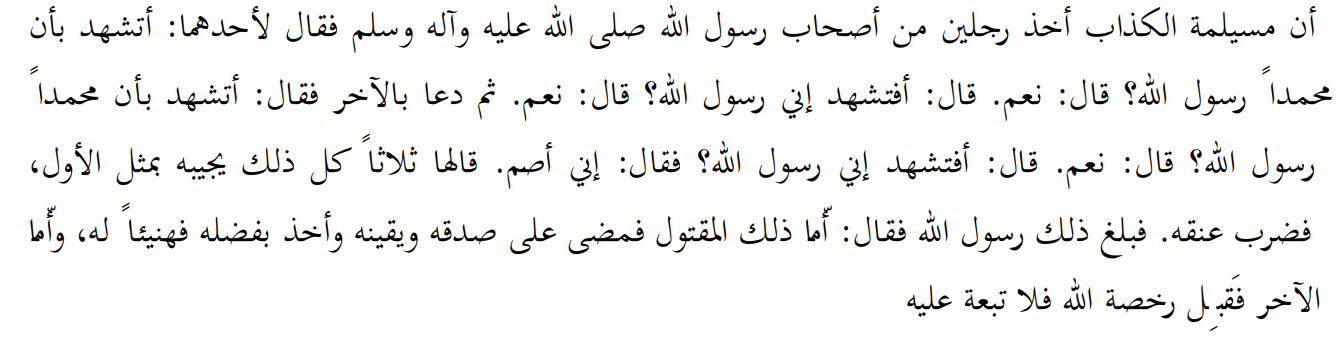
「あの嘘つきのムサイラマは、アッラーの使徒の教友の二人の男を連れ出し、そのうちの一人に言った。『お前は、ムハンマドがアッラーの使徒であることを証言するか。』彼は言った。『はい。』彼は言った。『では、私がアッラーの使徒であることを証言するか。』彼は言った。『はい。』それから彼はもう一人を呼び、言った。『お前は、ムハンマドがアッラーの使徒であることを証言するか。』彼は言った。『はい。』それから彼は言った。『では、私がアッラーの使徒であることを証言するか。』彼は言った。『私は耳が聞こえない。』彼は三度それを言い、毎回最初の時と同じように答えた。そこで彼は首を打ち落とされた。このことがアッラーの使徒ﷺに伝えられると、使徒ﷺは言った。『殺された者については、彼は自らの真理と確信を貫き、その徳を得た。だから彼にとって良いことがあるように。もう一人については、彼はアッラーの許しを受け入れた。だから彼に責任はない。』」
‘That Musaylimah the liar took two men of the Sahabah of the Messenger of Allah (saw) and said to one of them: Do you bear witness that Muhammad is a Messenger of Allah? He said: Yes. He said: Then do you bear witness that I am a Messenger of Allah? He said: Yes. Then he called for the other and said: Do you bear witness that Muhammad is a Messenger of Allah? He said: Yes. Then he said: Then do you bear witness that I am a Messenger of Allah? He said: I am deaf (to that). He said it thrice each time answering him like the first so he struck off his neck. This was conveyed to the Messenger of Allah who said: As for the one killed, he executed his truth and conviction, and he took his virtue so may it be good for him. As for the other, he accepted the concession of Allah so there is no liability on him.’
したがって、タキーヤは許可(ルフサ)であり、真実を明確に語ることは美徳である」(アット=タバルスィーの発言はここで終わる)。
Accordingly taqiyyah is a dispensation and speaking clearly the truth is a virtue” (At-Tabarsi’s speech ends).
したがって、二人の釈義者、アット・タバリーとアット・タバルシーの言葉から示されるように、両者は異なる学派に属しながらも、この節の意味を説明する点で一致している。すなわち、信者が不信仰者と親交を結ぶことは禁じられており、信者が不信仰者の害を恐れる状況はこの禁止から除外される、ということである。アット・タバリーの言葉を見よ。「ただし、あなたがたが彼らから恐れるべき何か(tuqat)を恐れる場合は別である」(すなわち)「ただし、あなたがたが彼らの権力下にあり、自分の命について彼らを恐れ、そのため舌では彼らに友情を示す場合は別である」。そしてアット・タバルシーの言葉を見よ。「それから、彼は除外して言われた。『ただし、あなたがたが彼らから恐れるべき何かを恐れる場合は別である』。その意味は、不信仰者が勝利し、信者が敗北して、信者が、もし彼らに同意を示さず、彼らとの友情を良好に保たなければ恐れを抱く場合は別である、ということである。その時には、自身の魂を守るための用心として、舌によって彼らへの愛を示し、彼らに従うことが許される」。二人の釈義者は、主題が信者による不信仰者との親交の禁止からの除外であり、それに限定されるという点で一致している。ただし、アット・タバルシーは主題の外にあることに従い、この節を、人の命に関わる間は信仰(ディーン)においてタキーヤが許されることの証拠とした。しかし、この節の主題は信者による不信仰者との親交の禁止であり、不信仰者が ムスリムを打ち負かす状況で恐れを抱く場合にその親交を許す、というものであるから、この節にはそのような内容は含まれていない。これは信仰上のタキーヤではなく、また命への恐れに限定されるものでもない。除外は一般的であり、「ただし、あなたがたが彼らから恐れるべき何かを恐れる場合は別である」(すなわち)「ただし、あなたがたが彼らから、恐れるべきものを恐れる場合は別である」。ザマフシャリーは『アル・カッシャーフ』においてこう述べた。
Accordingly it is shown from the words of the two mufasireen, At-Tabari and At-Tabarsi, who are of two different schools of thought, their agreement upon explaining the meaning of the ayah as it came in that it is a prohibition for believers befriending disbelievers and excluding the situation of believers fearing the harm of the disbelievers from this prohibition. Look at the words of At Tabari: “except if you fear from them something to be feared (tuqat)’ (i.e.) except if you are in their authority and you fear them over your lives so you show them friendship with your tongues.” And look at the words of At-Tabarisi: “Then He excluded and said: ‘except if you fear from them something to be feared’ and the meaning is except if the disbelievers are victorious and believers defeated so the believer fears them if he does not show his agreement with them and does not make good his friendship with them. At that time it is allowed for him to show his love for them by his tongue and compliance to them as a precaution and in protection of his soul.” The two mufasireen agree that the subject is excluding the prohibition of believers befriending disbelievers and that it is limited to that. Except that At-Tabarisi followed upon that which is outside the subject and made the ayah an evidence that taqiyyah is permitted in the deen during for one’s life which is not present in the ayah since its subject is the prohibition of believers befriending disbelievers and excluding the situation of fear of the disbelievers when they defeat the Muslims in allowing their friendship in this situation. It is not taqiyyah in the deen nor is it specified to fear over life because the exclusion is general “except if you fear from them something to be feared” (i.e.) except if you fear from them what is to be feared from. Az-Zamakhshari said in Al Kashaf
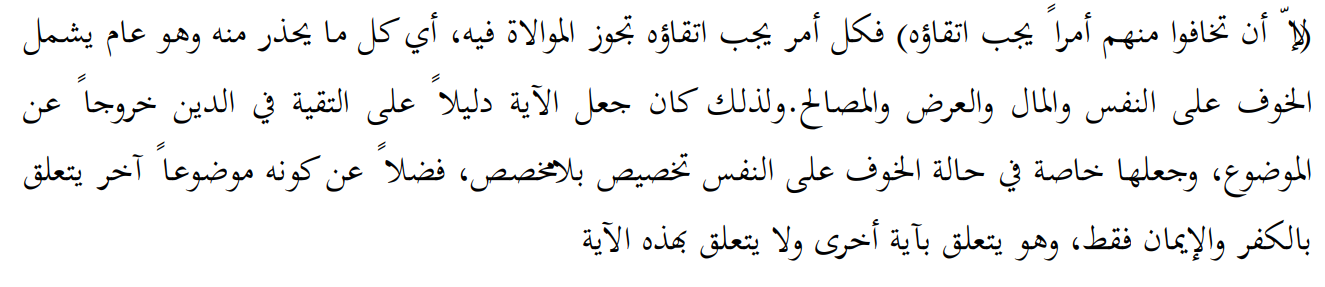
「ただし、彼らから何らかの、守られる必要がある事柄への恐れがある場合は除く」――したがって、守られなければならないあらゆる事柄は、それを友とすることを許す。すなわち、命、財産、名誉、利益に関する恐れを含め、彼らに対して恐れるすべてのものがこれに当たる。それゆえ、この節をもって、信仰の本分とは無関係な事柄における(タキーヤ)の証拠とすることになるが、これを命への恐れという状況に限定することは、限定する根拠なき限定にほかならない。さらに、これは別の主題、すなわち不信仰と信仰のみに関わる主題であり、それは別の節に関連するもので、この節とは関係がない。
“Except if you fear from them a matter which requires protection from” so any matter which must be protected from permits befriending it i.e. all that you fear them which is general covering fear over life, wealth, honour and interests. Accordingly making the ayah an evidence for (taqiyyah) in the deen outside the subject, and making it specific in the situation of fear over life is specification without a specifying (evidence). This is besides it being another subject relating to kufr and iman only which is related to another ayah and it is not related to this ayah.
アッ=タバルスィーの「我々の仲間は、必要に迫られた場合にはあらゆる事柄において(それを)許容されると言った」という発言について、彼がアル=ムフィードから引用している、(それが)義務であるか義務でないか、という最後の部分までの内容は、いかなる証拠にも基づかない抽象的な言説である。その節は、アッ=タバルスィー自身の注釈書によってさえ、いかなる形でもそのことを示してはいない。また彼は、クルアーンからもスンナからも、サハーバ(教友)の合意からも、他のいかなる証拠も示していない。したがって、それは退けられ、考慮に値する地位から外れる。 また、恐れの状況で不信仰者と親交を結ぶことが許されるならば、力を持つ不正な支配者や違反者への服従はなおさら優先される、と言われているわけでもない。そのように言われてもいないのは、より優先されるべきものが発言の趣旨であり、それがここには含まれておらず、またそれと関連づける余地もないからである。それはアッラーの次の言葉のようなものではない。
As for the statement of At-Tabarisi: “Our companions said (it is) permitted in all matters during necessity” then what he quotes from Al-Mufid of its being obligatory or not obligatory to the last of what he mentioned is abstract speech of any evidence. The ayah does not indicate this in any way even according to At-Tabarisi’s own tafsir, nor did he come with any other evidence neither from the Book or Sunnah or Ijma’a of the Sahabah, hence it is rejected and falls from the rank of consideration. Nor is it said that if befriending disbelievers in the situation of fear of them is allowed then compliance with the unjust or transgressor ruler with power is of greater precedent. This is not said because that which is of greater precedent is the sense of the speech and this is not from it nor is their any extention of any connection with it. It is not like Allah’s statement:
「彼らの中には、一ディーナールを預けても返してくれない者がいる」 [TMQ 3:75]
“Among them is one whom if you entrust him with a Dinar would not return it to you” [TMQ 3:75]
アッラーのお言葉「」のようなものでもありません。 Note: The fragment is incomplete in the original. Please provide the full verse or statement for an accurate translation.
Nor is it like Allah’s statement:
「そして啓典の民の中には、一キンターラの財産を預けても、それを返してくれる者がいる」[コーラン 3:75]
“And of the People of the Book is one whom if you entrusted with a qintar will return it to you” [TMQ 3:75].
これは、その違反者が不信仰者の部類やその階級に属さないからであり、またこの節で禁じられている友好とは、信者の代わりに(不信仰者を)友とすることだからです。権力を持つ不正で違反を犯す支配者は信者の一人であり、その者から生じる不正や、その者を覆う違反は、その者から信仰(イーマーン)の性質を否定するものではありません。したがって、この事柄は大きな不信仰(クフル・アクバル)の研究には入らず、それゆえ大きな不信仰はそこに当てはまらず、証拠として用いられることもありません。
This is because the transgressor is not from the category of the disbeliever or from their class, and because the friendship prohibited in this ayah is befriending instead of the believers. The unjust and transgressor ruler with power is among the believers injustice occurring from him or the transgression covering him does not negate the description of iman from him. Hence this subject does not enter in the research of greater precedent, so accordingly the greater precedent does not come into it such that it is used as a witness.
さらに、権力を持つ不正で逸脱した支配者と親しくすることは、安全な状況でも恐れの状況でも等しく許される。なぜなら彼は信者であり、信者と親しくすることは明らかに許されるからである。「信者たちを差し置いて」という彼(スブハーナhu wa ta'ala)の言葉における「信者たち」という語は、すべての信者を含む一般的な語である。不正な支配者や逸脱した支配者、あるいは逸脱者や邪悪な者(フッジャール)と親しくすることを禁じる文言は存在しない。むしろ、禁じる文言は不信仰者と親しくすることに限定されている。それに加えて、不正な支配者への服従は、罪とジihadを除いた事柄においては義務であり、その旗のもとでジihadを行うことも義務である。また、逸脱した者がイマームである場合でも、その背後で礼拝を行うことが許されている。これらは、彼らとの友好を許すことを示す最も重要な根拠である。禁じられているのは、支配者の不正や逸脱した者の逸脱に満足することである。したがって、権力を持つ不正で逸脱した支配者、あるいは反対者に対して、意見などにおいて内心に隠していることと反対のことを示す信者の場合、タキーヤは退けられる。そうすることは、偽善であり、あらゆる偽善は禁じられているので、ハラーム(禁止)である。
Moreover the befriending of the unjust and transgressor ruler with power is allowed in the situation of security and the situation of fear equally because he is a believer and befriending believers is definitely allowed because the word “believers” in His statement: “instead of believers” is general covering all believers. There did not come any text prohibiting befriending the unjust or transgressor ruler or befriending transgressors and the wicked (fujjar); rather the texts are specific in prohibiting the befriending of disbelievers. More than that, the obedience to the unjust ruler is obliged in other than sin and jihad is obliged under his banner and it is allowed to pray behind the Imam in prayer if he is a transgressor which are of the greatest indication regarding permitting their friendship. What is prohibited is the pleasure with the injustice of the ruler and the transgression of the transgressor. Accordingly taqiyyah is rejected when it is a believer showing opposite to what he hides in front of powerful unjust or transgressor ruler or opponent in the opinion or similar, and doing it is haram as it is hypocrisy and all hypocrisy is forbidden.
上記のすべてに加えて、不正な統治者に対してその不正を問いただすことは義務であり、統治者への恐れ、金銭、利益、あるいは危害への恐れを理由にそれを放置することは許されない。また、そこにおいてタキーヤも許されない。統治者がイスラームによる統治の後に明白な不信仰(クフル・バワー)を示した場合、彼に対して戦いを宣言することは義務であり、それを行うことを控えることは禁じられている。また、統治者や、その他の逸脱者や不正を行う者の前で善を命じ悪を禁じることは、アッラー(SWT)がムスリムに課した義務である。これはタキーヤの見解を否定し、それと完全に矛盾する。なぜなら、アッラー(SWT)は不正な統治者や逸脱者に対して沈黙を守ることを明確に禁じておられるのに対し、タキーヤは時と場合によって沈黙を義務づけ、別の時には推奨し、また別の時には許容するからである。これは善を命じ悪を禁じる御言葉と矛盾し、不正または逸脱した指導者や統治者を拒絶することを示す真正なハディースとも矛盾し、彼らの行為を問いただす義務について述べる真正なハディースにも反する。さらに、アッラー(SWT)のために、訴える者の不満を考慮せずに真実を明らかにする義務とも対立する。したがって、不正で逸脱した統治者、あるいは力で他者を抑圧する簒奪者(ムタサッリト)、邪悪な者(ファッジャール)のうちの者、あるいは見解においてあなたに反対する者へのタキーヤについては、それに反し、それを行うことの義務を勧める御言葉と真正なハディースの文言が存在する。これは、タキーヤが禁じられていること、そしてそれがムスリムに許されない偽善であることを強調している。
「ただし、強制された者であっても、その心が信仰に安らいでいる場合は別である」(コーラン16章106節)
“Except the one who is compelled and his heart is content upon iman” [TMQ 16:106].
一部の注釈者は、このアーヤ「ただし、彼らから何か恐れるべきものを恐れるなら別である」と関連づけ、そこから、信仰を隠しながら不信仰を示すこと、いわゆるタキーヤを、友好関係の範疇に入れて許容されるものとし、さらにそこから、友好関係が許されるのは命を恐れる状況に限られ、それ以外の状況では許されないと導き出している。これは純粋な誤りである。なぜなら、アーヤ「強制された者は別であり、その心は信仰に安らいでいる」は、まったく異なる状況と異なる主題を持つからである。その主題は、確実で確定的な殺害の恐れが存在し、それが推測ではない状況での、イスラームからの背教である。一方、アーヤ「ただし、彼らから何か恐れるべきものを恐れるなら別である」の主題は、不信仰者との友好をあらゆる形態において禁じることであり、そこに恐れるものが存在する場合、すなわち命、財産、利益、その他いかなる害に対する恐れであれ、その友好が許される例外を定めることである。この二つは状況と主題において区別されており、一方が他方に入り込むことも、他方と結びつけられることもない。 イスラーム教徒が、自らの事柄について不信仰者に打ち負かされ、その支配下にあるとき、服従を示すためにイスラームから背教することは許されない。むしろ、彼らとの友好が許される場合とは逆に、宗教の規定を実行できないのであれば、移住することが彼に義務となる。ただし、イスラーム教徒の命に確定的な死が迫っており、不信仰を強制された場合には、不信仰を示し信仰を隠すことが許される。それ以外の場合には、アーヤの文言により許されない。
Some mufasireen link it with the ayah: “except if you fear from them something to be feared” and deduce from it the entering of showing kufr and hiding iman in the category of friendship and making it to enter what they call (taqiyyah), with some deducing from it that friendship is allowed in the situation of fearing for one’s life only but not in other (situations). This is pure error because the ayah: “except the one who is compelled and his heart is content upon iman” has a different situation and a different subject as its subject is apostasy from Islam in the situation where there exists fear of definite, confirmed killing not probable and the subject of the ayah: “except if you fear from them something to be feared” is prohibiting befriending disbelievers in all its types and excluding the permissibility of this befriending in the situation of there existing what is feared from whether it was fear over life, wealth, interest or any harm. It distinguishes between the two situations and two subjects such that one does not enter into the other nor are they linked with it due to the difference in situation and subject. When the Muslim is under the authority of disbelievers defeated over his matter before them, it is not permitted for him to apostatise from Islam as a show of compliance to them; rather it is obligatory upon him to emigrate if he is unable to perform the rules of his deen contrary to befriending them which is allowed. However if the Muslims fear over his life a confirmed death and he is forced upon kufr then it is permitted for him to show kufr and hide iman, and other than that it is not permitted because of the text of the ayah:
「信仰した後にアッラーを拒む者は、強制された者を除き――その心が信仰に安んじている者を除き――(その者には怒りがあり、大きな刑罰がある)。」[TMQ 16:106]
“Whoever disbelieves in Allah after his iman except the one who is compelled and his heart is content upon iman.” [TMQ 16:106].
ここでの主題は、信仰の後の不信仰、すなわち棄教(イスラームからの背教)であり、その状況は死を恐れる状況である。これは、フカハーが「ムルジャーの強制(ikrah mulji’)」と呼ぶものであり、シャリーアが、強制された者からその規定を取り除くとすべての状況で認めている唯一の強制である。シャリーアが除外している強制は、逃げ場のない強制、すなわち確実な死を恐れる状況である。このことは、死を恐れて棄教した者たちについて下されたアーヤによって裏付けられる。 このアーヤは、アンマール・ブン・ヤースィルについて下されたと伝えられている。アル=ターバリーは次のように述べている。「ムハンマド・ブン・サアドが私に伝え、こう言った。私の叔父が私に伝え、こう言った。私の父が、その父から、イブン・アッバースより伝えたところによれば、アッラーの御言葉『信仰した後にアッラーを拒む者は――ただし強制され、心が信仰に安らいでいる者は別である』{…アーヤの終わりまで}。これは、多神教徒たちがアンマール・ブン・ヤースィルを打ち、罰した後に彼を放置したことによる。そこで彼はアッラーの使徒ﷺのもとに戻り、クライシュから受けたことと、自分が言ったことを報告した。そこでアッラーは、彼の弁明に言及して啓示された。『アッラーを信仰した後に拒む者は』から『大きな懲罰』まで。」 バシュルが私たちに伝え、こう言った。ヤズィードが私たちに伝え、こう言った。サイードがカターダから私たちに伝えた。『信仰した後にアッラーを拒む者は――ただし強制され、心が信仰に安らいでいる者は別である』について、彼はこう述べた。「私たちに伝えられたところによれば、これはバヌー・アル=ムギーラがアンマール・ブン・ヤースィルを捕らえ、マイムーンの井戸に押し込んで、『アッラーを拒め』と言ったことについて下された。彼は彼らに従ってそう言ったが、その心は強制されていた。そこでアッラーは啓示された。『ただし強制され、心が信仰に安らいでいる者は別である』と。」 そしてアト=タバリーは言った。イブン・アブドゥル=アラーが私たちに伝え、こう言った。ムハンマド・ブン・サウルが私たちに、ムアンマルから、アブドゥルカリーム・アル=ジュズィーから、アブー・ウバイド・ブン・ムハンマド・ブン・アンマール・ブン・ヤーサルから伝え、彼はこう言った。
So the subject is the subject of kufr after iman i.e. the subject of apostasy from Islam, and the situation is the situation of fearing death. This is what the fuqaha term as alikrah almulji (compulsion of refuge) which is the only compulsion considered by the Shar’a in all situations in which the rule is lifted from the one compelled. The compulsion which the Shar’a excluded is the compulsion by refuge i.e. the situation of fearing definite death. This is strengthened in the ayah that was revealed about Muslims who apostatised fearing death. It was narrated that this ayah was revealed about Ammar bin Yasir. At-Tabari said: “Muhammad bin S’aad related to me and said: My paternal uncle related to me and said: My father related to me from his father from ibn Abbas that His statement: ‘Whoever disbelieves in Allah after his belief except the one who is compelled and his heart is content upon iman’ to the end of the ayah. This was because the polytheists struck Ammar bin Yasir and punished him then left him. So he returned to the Messenger of Allah (saw) and informed him about what he met with from Quraysh and what he said. So Allah (swt) revealed his mention of his excuse: ‘Whoever disbelieves in Allah after his iman’ until His statement ‘great punishment.’ Bashr related to us and said: Yazid related to us and said: Saeed related to us from Qatadah: ‘Whoever disbelieves in Allah after his belief except the one who is compelled and his heart is content upon iman’ and said: It was mentioned to us that it was revealed about Ammar bin Yasir whom Banu Al-Mughira captured and covered him in the well of Maymun and said: Disbelieve in Allah, so he followed them in that and his heart was compelled. So Allah (swt) revealed His statement: ‘except the one who is compelled and his heart is content upon iman.’ And At-Tabari said: Ibn Abd al-‘Ala related to us and said: Muhammad bin Thawr related to us from Mu’ammar from Abdulkareem Al-Juzri from Abu Ubayd bin Muhammad bin Ammar bin Yasir who said:
多神教徒たちはアンマール・ビン・ヤースィルを捕らえ、彼らの望むことの一部を口にするまで拷問した。彼はそのことを預言者ﷺに伝えた。預言者ﷺは言われた。「お前の心はどのような状態だったか。」彼は言った。「信仰に確かに守られていました。」預言者ﷺは言われた。「もし彼らがまた繰り返すなら、お前も繰り返しなさい。」
The polytheists took Ammar bin Yasir and punished him until he said to them in some of what they wished. He mentioned that to the Prophet (saw) and the Prophet (saw) said: How did you find your heart? He said: Secured upon iman. The Prophet (saw) said: If they repeat, then you repeat.”
これらのハディースは、この啓示の機会となった出来事がアンマールの件であり、その主題は信仰からの離反(背教)であることを示している。そこに特有の状況は、殺害への確かな恐れであり、それだけで十分にそのことを裏付ける。それは次の節とは関係がない。「ただし、彼らから恐るべきものを恐れる場合は別である」。「強制された者で、その心が信仰に安んじている者は別である」という節はメッカで啓示され、信仰を主題としている。一方、「ただし、彼らから恐るべきものを恐れる場合は別である」という節はマディーナで啓示され、信者が不信仰者と親密になることの禁止から、恐るべきものを恐れる状況を除外することを主題としている。したがって、この節はその主題には適用されない。
These ahadith indicate that the circumstance of revelation of the ayah is the incident of Ammar and its subject is apostasy from Islam. The situation specific to it is the definite fear of killing which alone is sufficient to strengthen that it has no relationship with the ayah: “except if you fear from them something to be feared.” The ayah: “except the one who is compelled and his heart is content upon iman” was revealed in Makkah on the subject of iman, and the ayah: “except if you fear from them something to be feared” is Madinan revealed on the subject of excluding the situation of fearing what is to be feared from the prohibition of believers befriending disbelievers. Accordingly this ayah is not applicable on that subject.
残る規定についてです。確実に殺されると脅された者について、kufr(不信仰)を示して iman(信仰)を隠し、死を免れる方が徳が高いのか、それとも死に至ろうとも iman を堅持する方が良いのか。答えは、死に至ろうとも iman を堅持する方が良い、というものです。なぜなら、kufr を示すことの許容は譲歩(ruksah)であり、困難を取り除くものであるのに対し、iman を守ることは(‘azeemah)、すなわち原則であるからです。ゆえに、その方が良いのです。それは次のように伝えられています。
There remains the rule regarding the one threatened with confirmed killing: Is it more virtuous to show kufr and hide iman so as to be safe from death or is it better to persevere upon his iman even if it leads to death? The answer is that persevering to iman even if it leads to death is better because the permissibility of showing kufr is a dispensation and lifts difficulty, and preserving the iman is (‘azeemah) which is the principle therefore it is better. It is narrated

ムサイリマが二人の男を捕らえ、一人に言った。「ムハンマドについて、お前はどう言うか。」彼は答えた。「アッラーの使徒です。」ムサイリマは言った。「では、私についてはどう言うか。」彼は言った。「あなたも(同じく)です。」そこでムサイリマは彼を解放した。もう一人に言った。「ムハンマドについて、お前はどう言うか。」彼は答えた。「アッラーの使徒です。」ムサイリマは言った。「では、私についてはどう言うか。」彼は言った。「私は聾です。」ムサイリマはこれを三度繰り返し、彼も同じ答えを繰り返したので、ムサイリマは彼を殺した。このことがアッラーの使徒ﷺに伝わると、ﷺは言われた。「最初の者は、アッラーの許しを受け入れた。二番目の者は、真理を明らかにした。ゆえにその者は祝福される。」
“That Musaylimah took two men and said to one of them: What do you say about Muhammad? He said: A Messenger of Allah. He said: Then what do you say of me? You as well. So he left him free. He said to the other: What do you say of Muhammad? He said: A Messenger of Allah. He said: Then what do you say of me? He said: I am dumb. He repeated it thrice and he repeated his answer, so he killed him. That reached the Messenger of Allah (saw) so he said: As for the first, he took the dispensation of Allah. As for the second, he exposed the truth so blessed be he.”
これは、忍耐して信仰を堅持した者を、アッラーの許可(ルフサ)を取って、殺される確実な恐れから表面的に不信仰を示した者よりも優先することを明確に示しています。
This is explicit in preferring the one who was patient and stuck to iman over the one who took the dispensation of Allah (swt) and showed kufr fearing for his life from a confirmed killing.
これは、クフル(不信仰)を求められた者についてのことです。それより軽いことを求められた場合、たとえばイスラームの布教(ダアワ)をやめること、あるいは罪を犯すことなどのようなものについては、このアーヤから許可が導き出されるわけではありません。したがって、アッラーが、ムスリムがクフルを示すことを許されたのであれば、クフルより軽いものはなおさら許される、とは言われません。これは、不従順(マアスィヤ)がクフルの種類に含まれず、そのため優先による(より軽いことの許可という)検討の対象にはならないからです。同様に、クフルと罪をアナロジー(キヤース)で結びつけることもありません。アナロジーが成り立つための理由が存在しないからです。 しかし、確実な殺害を前にして自分の命を恐れ、罪を犯すことやクフルより軽いことを求められた者については、自分の命を守るためにそうすることが許され、その者に罪はありません。これは預言者ﷺの次の言葉によるものです。
This is regarding the one from whom kufr is demanded. As for the one from whom is sought less than that like leaving the Islamic da’wah or performing a sin or something similar; permissibility is not taken from this ayah. Accordingly it is not said that if Allah permitted the Muslim to show kufr, then what is lesser than kufr is of greater precedent. This is not said because disobedience is not from the species of kufr, so it does not enter the research by greater precedent. Similarly an analogy between kufr and sin is not performed since there does not exist a reason until analogy occurs. However as for the one who fears for his life over confirmed killing and it is sought from him sin or doing less than kufr, it is permitted for him to do so to save his life and there is no sin upon him. This is due to his (saw) statement:
「私のウンマから、過ち、忘却、そして強制されたことについては(その責任が)取り除かれた」
“Lifted from my Ummah is the mistake, forgetfulness and what is compelled upon it”
つまり、罪と咎が取り除かれ、規定も取り除かれる、すなわちそれを行うことの許容性が認められる。ただし、それは確実で確定的な殺害の状況においてのみである。これがファキーフ(法学者)たちが「アル=イクラー・アル=ムルジ(逃げ場となる強制)」と呼んだものであり、シャリーア(イスラーム法)がすべての状況において考慮する唯一の強制である。この強制の下にある者からは、離婚、婚姻、商取引、その他の行為や契約においても(規定が)取り除かれる。彼の言葉「そして、それに強いられたもの」とは、アル=イクラー・アル=ムルジ(逃げ場となる強制)のことである。
I.e. the blame and sin is lifted, and the rule is lifted, which means the permissibility of doing it. However (this is) only in one situation which is the situation of definite, confirmed killing which is what the fuqaha called alikrah almulji (compulsion by refuge) which is the only compulsion considered by the Shar’a in all conditions in which there is lifted from the one compelled like divorce, marriage, trade and other actions and contracts. His statement “and what is forced upon it” which is alikrah almulji (compulsion by refuge).