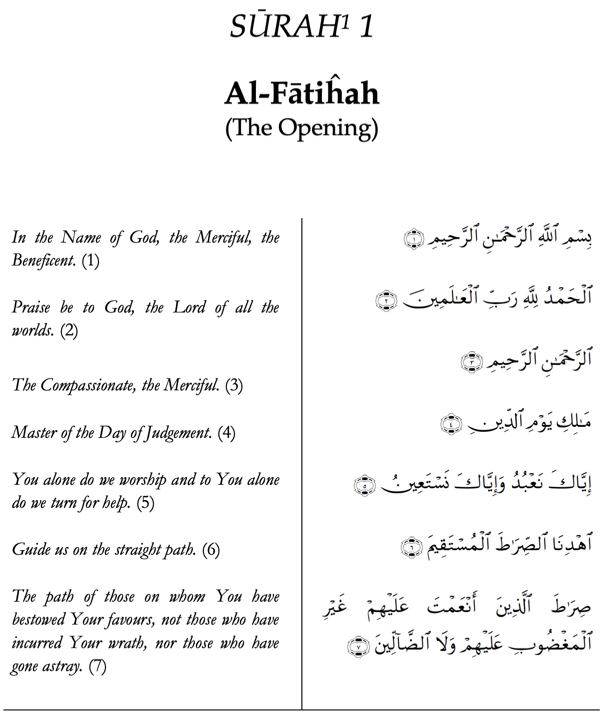
Todo muçulmano recita esta curta sūrah de sete versículos pelo menos dezessete vezes por dia. Um ḥadīth autêntico do Profeta Muḥammad ﷺ diz: “A oração de quem não recita a Fātiḥah é inválida.” Esta curta sūrah contém grande parte das ideias básicas centrais do Islã, suas crenças e conceitos. Ela delineia muitas de suas percepções e atitudes essenciais. Tudo isso deixa claro por que ela é escolhida para a recitação frequente e por que é essencial para a validade da oração.
Every Muslim recites this short sūrah of seven verses at least seventeen times a day. An authentic ĥadīth of the Prophet Muĥammad (peace be upon him), says: “A prayer by one who does not read the Fātiĥah is invalid.” This short sūrah contains a great deal of the central basic ideas of Islam, its beliefs and concepts. It outlines many of its essential perceptions and attitudes. All this makes it clear why it is chosen for frequent recitation and why it is essential for the validity of prayer.
A surata começa com a frase:
The sūrah opens with the phrase:
Em nome de Deus, o Clemente, o Misericordioso. (Versículo 1)
In the name of God, the Compassionate, the Merciful. (Verse 1)
A maioria dos eruditos reconhece que este é um versículo da própria sūrah, por direito próprio, completando os seus versículos em sete. Há, porém, divergência de opinião quanto a saber se isto se aplica também a todas as outras sūrahs do Alcorão em que as mesmas palavras aparecem como frase inicial. Alguns eruditos sustentam que é à Fātiĥah que se refere a seguinte declaração do Alcorão: “Já te concedemos sete versículos repetidos e este sublime Alcorão.” (15: 87)
This is recognized by the majority of scholars as a verse of the sūrah, in its own right, completing its verses into seven. There is, however, a difference of opinion over whether this is so with respect to all other sūrahs of the Qur’ān in which the same words appear as the opening phrase. Some scholars maintain that it is to the Fātiĥah that the following Qur’ānic statement refers: “We have given you seven oft- repeated verses and this sublime Qur’ān.” (15: 87)
Os primeiros versículos do Alcorão revelados ao Profeta Muhammad ﷺ, que começam com: "Lê em nome do teu Senhor..." (96:1), estabelecem a etiqueta islâmica de invocar o nome de Deus no início de toda ação. Isto também está em consonância com o princípio islâmico fundamental de que Deus é "o Primeiro e o Último, o Manifesto e o Oculto." (57:3) Ele é, de fato, o ser real, a origem e a razão de ser de tudo o que existe. Em Seu nome, portanto, todo movimento e toda ação são realizados, e em Seu nome tudo começa.
The very first verses of the Qur’ān revealed to Prophet Muĥammad, which begin with: “Read in the name of your Lord...” (96: 1) establish the Islamic etiquette of invoking the name of God at the beginning of every action. This is also in line with the fundamental Islamic principle that God is “the first and the last, the outward and the inward.” (57: 3) He is indeed the real being, the origin and the raison d’être of all that exists. In His name, therefore, every movement and action is made, and in His name everything begins.
Os atributos divinos do Misericordioso, al-Raĥmān, e do Compassivo, al-Raĥīm, abrangem todos os aspectos e significados da misericórdia, e só podem ser usados em conjunto em referência a Deus Todo-Poderoso. Seria apropriado usar o atributo de al-Raĥīm em referência a um ser humano, mas a fé islâmica exige que o uso de al-Raĥmān seja exclusivo de Deus. Quanto ao debate sobre qual dos dois adjetivos denota o sentido mais amplo de misericórdia e compaixão, ele não nos diz respeito aqui. Podemos concluir, no entanto, que, quando combinados, eles abrangem todos os aspectos e dimensões da misericórdia.
The divine attributes of the Compassionate, al-Raĥmān, and the Merciful, al-Raĥīm, encompass all aspects and meaning of mercy, and can only be used together with respect to God Almighty. It would be appropriate to use the attribute of al-Raĥīm in reference to a human being, but the Islamic faith requires that use of al-Raĥmān is exclusive to God. As for the debate over which of the two adjectives denotes the wider meaning of mercy and compassion, it does not concern us here. We can conclude, however, that when combined, they encompass all aspects and dimensions of mercy.
Assim como a invocação do nome de Deus no início de toda ação constitui o primeiro princípio fundamental da fé muçulmana, a restrição do uso de al-Raḥmān e al-Raḥīm somente a Deus constitui o segundo princípio e define a relação entre Deus e o homem. Tendo invocado o nome de Deus e reconhecido Sua misericórdia infinita, o indivíduo é conduzido a louvar a Deus e a reconhecer Sua soberania absoluta sobre todos os seres:
As the invocation of God’s name at the beginning of every action constitutes the first fundamental principle of the Muslim faith, the restriction of the use of al-Raĥmān and al-Raĥīm to God alone constitutes the second principle and defines the relationship between God and man. Having invoked God’s name and acknowledged His infinite mercy, one is directed to praise God and recognize His absolute sovereignty over all beings:
Louvado seja Deus, Senhor dos mundos. (Versículo 2)
Praise be to God, the Lord of all the worlds. (Verse 2)
O louvor a Deus é o primeiro sentimento que se desperta no coração do crente ao se mencionar Deus. Pois a própria existência do homem é um aspecto da graça infinita de Deus, o que suscita gratidão e reverência para com Deus. As manifestações da munificência e da generosidade de Deus para com o homem e as demais criaturas são abundantes em toda parte e podem ser percebidas a cada momento. Louvar a Deus no início e no fim de toda ação é outro princípio fundamental da fé islâmica. O Alcorão diz: {Ele é Deus; não há divindade senão Ele. A Ele pertence o louvor no início e no fim...} (28: 70)
Praise of God is the first feeling aroused in a believer’s heart at the mention of God. For man’s own existence is an aspect of God’s infinite grace, which engenders gratitude and reverence towards God. The manifestations of God’s munificence and generosity to man and other creatures abound everywhere and can be seen at every moment. To praise God at the beginning and at the end of every action is another fundamental principle of the Islamic faith. The Qur’ān says: “He is God; there is no deity but He. To Him belongs praise in the first and in the last...” (28: 70)
Contudo, a graça de Deus é tal que, quando um crente diz "louvado seja Deus", isso lhe é registrado como uma boa ação que supera tudo. 'Umar ibn al-Khaţţāb, companheiro do Profeta ﷺ, relata que o Profeta ﷺ contou como um homem certa vez disse: "Senhor, Eu Te louvo como convém à majestade do Teu rosto e à grandeza do Teu poder." Os dois anjos que acompanhavam aquele homem não conseguiram avaliar a expressão e recorreram a Deus Todo-Poderoso, que lhes ordenou: "Registrai-a em seu registro tal como ele a disse, e Eu o recompensarei como ele merece quando retornar a Mim." A última parte deste versículo, "Senhor dos mundos", expressa a crença na divindade absoluta e universal, que está no próprio cerne do conceito islâmico de Deus. Deus é o único, absoluto e último proprietário, com plena autoridade independente para agir em todo o cosmos. Ele é o supremo senhor geral, que criou o mundo e continua a velar por ele, a cuidar dele e a garantir sua estabilidade e bem-estar. Essa relação viva e dinâmica entre o Criador e a criação é a fonte perpétua de vida para toda a criação. Deus não criou o mundo e o abandonou à própria sorte. Ele continua a ser uma autoridade viva e ativa sobre Sua criação, concedendo-lhe o que necessita para uma vida contínua e significativa. Isso se aplica a toda a criação de Deus.
Nevertheless, God’s grace is such that when a believer says, ‘praise be to God,’ it is recorded for him as a good deed outweighing everything. `Umar ibn al-Khaţţāb, the Prophet’s Companion, relates that the Prophet (peace be upon him) told how a man once said, “Lord, I praise You as befits the majesty of Your face and the greatness of Your power.” The two angels accompanying that man could not evaluate the remark and referred to God Almighty, who commanded them: “Register it in his record as he said it, and I shall reward him as he deserves when he returns to Me.” The last part of this verse, “Lord of all the worlds”, expresses the belief in absolute universal Godhead which is at the very core of the Islamic concept of God. God is the sole, absolute and ultimate owner with full independent authority to act in the whole cosmos. He is the overall supreme master who has created the world and continues to watch over it, take care of it, and ensure its stability and well-being. This living and dynamic relationship between the Creator and the created is the perpetual fountain of life for all creation. God has not created the world and abandoned it to its own devices. He continues to be an active living authority over His creation, giving it what it needs for its continued and meaningful life. This applies to all God’s creation.
Reconhecer o Senhorio absoluto de Deus faz toda a diferença entre clareza e confusão no que diz respeito à unicidade absoluta de Deus. As pessoas frequentemente combinavam o reconhecimento de Deus como o único criador com a crença de que múltiplas divindades tinham autoridade sobre suas vidas. Pode parecer absurdo que as pessoas sustentem tal crença, mas isso era verdade no passado e continua sendo verdade hoje. O Alcorão fala daqueles que alegam que "só os adoram [deuses menores] para que nos aproximem de Deus". (39: 3) Também menciona que alguns grupos judeus e cristãos que "tomaram os seus rabinos e sacerdotes como deuses além de Deus". (9: 31) O politeísmo, ou a adoração de várias divindades ou semideuses além do chamado "Grande Deus", era generalizado quando o Islã surgiu no século VII, na Arábia.
Acknowledging God’s absolute Lordship makes all the difference between clarity and confusion with regard to God’s absolute oneness. People often combined their acknowledgement of God as the sole creator with belief in multiple deities having authority in their life. It may seem absurd that people should ever hold such a belief, but this was true in the past and is still true today. The Qur’ān speaks of those who claim that they “only worship them [minor gods] so that they may bring us nearer to God.“ (39: 3) It also mentions that some Jewish and Christian groups who “have taken their rabbis and priests as gods alongside God.” (9: 31) Polytheism, or the worship of several deities or demigods besides the perceived ‘Grand Deity’, was widespread when Islam emerged in the 7th century in Arabia.
A afirmação da soberania absoluta e da autoridade ativa do Deus Único.
The affirmation of the absolute sovereignty and active authority of the One God.
sobre toda a criação era necessário para garantir a racionalidade e a tranquilidade de espírito do homem, e para livrá-lo da cruel confusão do politeísmo. O homem deve ter a certeza de que um Deus vigilante e zeloso está à frente deste mundo e jamais o abandonará ou desamparará.
over all creation was necessary to ensure man’s rationality and peace of mind, and to relieve him from the cruel bewilderment of polytheism. Man must be reassured that a vigilant and caring God is in charge of this world and will never abandon or forsake it.
Com o advento do Islã, o mundo estava cheio de crenças e filosofias errôneas, e de religiões falsas baseadas na superstição, na lenda e na mitologia. Muito pouco disso era verdadeiro ou sequer racional. No que se referia ao conceito de Deus e à Sua relação com o homem e com o mundo, havia muita confusão lamentável. Isso, por sua vez, levou à confusão na compreensão que o homem tinha do mundo e de sua própria posição e papel dentro dele.
At the advent of Islam, the world was full of erroneous beliefs and philosophies, and of false religions based on superstition, legend and mythology. Very little of it was true or even rational. As far as the concept of God and His relationship with man and the world was concerned, there was plenty of miserable confusion. This in turn led to confusion in man’s understanding of the world and of his own position and role within it.
A necessidade de um sistema de crenças racional, claro e coerente só se torna evidente quando estudamos aqueles períodos sombrios da história humana em que não existia tal sistema. Percebemos então o peso enorme que esses grandes mitos e crenças falsas exercem sobre o homem. Haverá mais sobre isso quando chegarmos a estudar casos específicos no Alcorão.
The need for a rational, clear and consistent system of beliefs only becomes apparent when we study those dark periods of human history when there was no such system. We then realize how heavily such great myth and false beliefs weigh on man. There will be more on this when we come to study specific instances in the Qur’ān.
É à luz dessa necessidade que o Islã tomou especial cuidado em corrigir as crenças do homem e definir com grande clareza o conceito e a natureza de Deus e de Seus atributos, bem como a relação entre o Criador e a criação.
It is in the light of such need that Islam has taken great care to correct man’s beliefs and define very clearly the concept and nature of God and His attributes, and the relationship between Creator and creation.
Isso está incorporado no conceito islâmico da unicidade de Deus, a essência e o princípio mais fundamental do Islã. Muito cuidado foi dedicado a estabelecer e elucidar a afirmação de que Deus é o Senhor e Mestre único, absoluto e transcendente de tudo o que existe. O outro aspecto desse conceito ao qual o Islã deu maior atenção é a definição dos atributos de Deus, que tem sido a causa de muita confusão, obscurecimento e pensamento religioso e filosófico embaraçado ao longo dos séculos.
This is embodied in the Islamic concept of God’s oneness, the essence and most fundamental principle of Islam. Much care has been devoted to establishing and elucidating the affirmation that God is the One, absolute and transcendent Lord and Master of all that exists. The other aspect of this concept to which Islam has given its greatest attention is the definition of God’s attributes, which has been the cause of much confusion, obfuscation and muddled religious and philosophical thinking through the ages.
A intensidade, a ênfase e o detalhamento com que o Islã tratou o conceito da unicidade de Deus, e de todos os assuntos a ele relacionados, só podem ser devidamente apreciados contra o pano de fundo da grande massa de crenças equivocadas e teologias confusas que se haviam acumulado ao longo da história. Sob essa perspectiva, o Islã pode facilmente ser visto como um ato profundo e oportuno da misericórdia divina concedida à humanidade — misericórdia que é dada com beleza, simplicidade, clareza, harmonia e plena conformidade com a natureza humana.
The intensity, emphasis and detail with which Islam has dealt with the concept of God’s oneness, and all subjects related to it, can only be appreciated against the background of the great mass of erroneous beliefs and confused theologies that had accumulated in the course of history. From this perspective, Islam can readily be seen as a profound and timely act of divine mercy bestowed on humanity — mercy that is given with beauty, simplicity, clarity, harmony and full accordance with human nature.
O Misericordioso, o Clemente. (Versículo 3)
The Compassionate, the Merciful. (Verse 3)
Estes são dois atributos que abrangem todos os significados e aspectos da misericórdia e da compaixão, e que personificam a misericórdia como uma propriedade de Deus Todo-Poderoso. Estes dois atributos definem a ligação entre o Senhor, como Criador, e a Sua criação. É uma ligação baseada inteiramente no amor, na paz, na segurança e no cuidado, e que inspira no ser humano um sentimento espontâneo de gratidão e louvor a Deus.
These are two attributes that encompass all meanings and aspects of mercy and compassion, and epitomize mercy as a property of God Almighty. These two attributes define the link between the Lord as Creator and His creation. It is a link based entirely on love, peace, reassurance and care, and which inspires within man a spontaneous feeling of gratitude and praise towards God.
Ao contrário da mitologia grega ou do Antigo Testamento (Gênesis, 4: 11-12), o Islã não retrata Deus como um inimigo que persegue o homem com vingança implacável, nem como alguém que trama e conspira contra Sua criação com rancor e vingatividade.
Unlike Greek mythology or the Old Testament (Genesis, 4: 1112), Islam does not depict God as an enemy who pursues man with relentless vengeance, or plots and schemes against His creation with spite and vindictiveness.
Senhor do Dia do Juízo. (Verso 4)
Master of the Day of Judgement. (Verse 4)
Este versículo enuncia um princípio fundamental do Islã com a mais profunda influência sobre a vida humana: a crença na vida futura. O Alcorão comenta o fato curioso de que as pessoas muitas vezes creram em Deus como Criador, mas deixaram de crer em um Dia do Julgamento, em uma vida por vir, quando se dão recompensas e castigos para restabelecer o equilíbrio da justiça. É a respeito destas que o Alcorão diz: "Se lhes perguntares: 'Quem criou os céus e a terra?', certamente responderão: 'Deus'" (31:25). Em outro lugar, o Alcorão diz dessas pessoas: "Eles acham estranho que um admoestador tenha vindo até eles do meio de si mesmos. Assim, os descrentes dizem: 'Isto é algo estranho! [Seremos ressuscitados] depois de mortos e reduzidos a pó? Tal retorno parece realmente inverossímil!'" (50:2-3)
This verse states a fundamental Islamic principle that has a most profound influence on human life: belief in the hereafter. The Qur’ān comments on the curious fact that people have often believed in God as Creator but have failed to believe in a Day of Judgement, in a life to come, when reward and punishment are meted out to restore the balance of justice. It is in reference to these that the Qur’ān says: “If you ask them, ‘Who is it that created the heavens and the earth?’ they will surely answer, ‘God’” (31: 25) Elsewhere the Qur’ān says of such people: “They deem it strange that a warner should have come to them from their own midst. Thus, the unbelievers say, A strange thing is this! [Are we to be resurrected] after we have died and become mere dust? Such a return seems far-fetched indeed!’“ (50: 2-3)
A crença no Além é essencial, pois envolve a alma e a mente humanas e concentra a atenção do homem numa existência futura. Isso, por sua vez, ajuda a conter a obsessão do homem pela vida presente e a transcender os seus desejos terrenos imediatos. Ele já não está ansioso por colher todas as suas recompensas aqui e agora; pode vencer o seu egoísmo e desenvolver sentimentos e interesses altruístas. O homem é capaz de atravessar a vida como um ser motivado, tolerante, confiante e otimista.
Belief in the hereafter is essential because it engages the human soul and mind and concentrates man’s attention on a future existence. This in turn helps to rein in man’s obsession with the present life, and to transcend his immediate earthly desires. He is no longer anxious to reap all his rewards here and now; he can conquer his selfishness and develop altruistic feelings and interests. Man is able to go through life as a motivated, tolerant, confident and optimistic being.
Esta crença islâmica central distingue claramente entre aspirar a alcançar a liberdade moral e intelectual de que o homem precisa e merece, e a capitulação diante dos desejos e prazeres mundanos e egoístas. Ela marca a diferença entre uma humanidade equilibrada e consciente, e uma humanidade egocêntrica e voltada para si mesma.
This central Islamic belief distinguishes clearly between aspiring to gain the moral and intellectual freedom that man needs and deserves, and capitulation to worldly and selfish desires and pleasures. It marks the difference between a well-balanced and conscientious humanity and an egotistic, self-seeking one.
A vida humana nunca poderá ser equilibrada e justa enquanto as pessoas não acreditarem que o que ganham nesta vida passageira não é tudo nem o fim de tudo. O homem precisa do estímulo de uma crença firme de que outra vida o aguarda, uma vida que vale a pena o esforço, os sacrifícios e as lutas que ele possa ter de enfrentar nesta vida curta. Essa crença traz uma diferença fundamental nos sentimentos, nas atitudes e no comportamento daqueles que a sustentam.
Human life can never be balanced and equitable until people believe that what they earn in this transient life is not the be-all and the end- all. Man needs to have the incentive of a confident belief that another life awaits him, which is worth the struggle and the sacrifices and the effort he may have to make here in this short one. This belief brings a fundamental difference in the feelings, attitudes and behaviour of those who uphold it.
Somente a Ti adoramos e somente a Ti pedimos ajuda. (Versículo 5)
You alone do we worship and to You alone do we turn for help. (Verse 5)
Este versículo expressa outro princípio fundamental, que decorre logicamente dos anteriores. Trata-se também de um princípio decisivo e crucial, que traça uma linha divisória entre a liberdade que o homem alcança ao submeter-se a Deus e o abuso e a degradação implícitos na servidão do homem ao homem.
This verse expresses another fundamental principle that follows logically from the preceding ones. It is also a decisive and crucial principle that draws a line between the freedom man gains in submitting to God and the abuse and debasement implicit in man’s servitude to man.
Quando o homem se submete a Deus e busca ajuda e orientação somente d'Ele, alcança a libertação total da tirania de todos os poderes religiosos, intelectuais, morais e políticos.
Once man has submitted himself to God and sought help and guidance from Him alone, he has achieved total liberation from the tyranny of all religious, intellectual, moral and political powers.
Para o crente no Islã, o poder humano divide-se em duas categorias: um poder bem-guiado, que reconhece a Deus e cumpre as Suas orientações, e um poder arrogante e rebelde, que não admite a soberania e a autoridade de Deus. O muçulmano é obrigado a apoiar e a endossar o primeiro, por mais fraco ou desfavorecido que seja, e a rejeitar e a opor-se ao segundo, independentemente da sua força ou do seu domínio. O Alcorão diz: "Quantas vezes um pequeno grupo, pela graça de Deus, venceu um grupo grande." (2: 249) Tal vitória do exército aparentemente mais fraco só pode ser alcançada quando ele confia em Deus, a fonte de todo o poder.
To the believer in Islam, human power falls into two categories: a rightly-guided power that recognizes God and abides by His directions, and an arrogant, rebellious one that does not admit to God’s sovereignty and authority. A Muslim is required to support and endorse the former, no matter how weak or disadvantaged it may be, and to reject and oppose the latter, regardless of its strength or dominance. The Qur’ān says: “Many a small band, by the grace of God, has vanquished a large one.” (2: 249) Such victory of the apparently weaker host could only be achieved when it relies on God, the source of all power.
Em relação às forças naturais, a atitude de um muçulmano é de curiosidade e amizade, e não de medo ou hostilidade. Os poderes do homem e os poderes da natureza são percebidos como subprodutos do próprio poder de Deus, e sujeitos à Sua vontade. São, portanto, perfeitamente complementares e interdependentes.
Towards natural forces, a Muslim’s attitude is one of curiosity and friendliness rather than fear or hostility. The powers of man and the powers of nature are perceived as by-products of God’s own power, and subject to His will. They are, therefore, perfectly complementary and interdependent.
O Islã ensina que Deus criou o mundo físico e todas as suas forças para o uso e o benefício do próprio homem. O homem é especificamente instruído e orientado a estudar o mundo ao seu redor, descobrir o seu potencial e utilizar todo o seu meio ambiente para o seu próprio bem e para o bem de seus semelhantes. Qualquer dano que o homem sofre às mãos da natureza é resultado apenas de sua ignorância ou de sua falta de compreensão sobre ela e sobre as leis que a regem. Quanto mais o homem aprende sobre a natureza, mais pacífica e harmoniosa se torna a sua relação com a natureza e com o meio ambiente.
Islam teaches that God has created the physical world and all its forces for man’s own use and benefit. Man is specifically taught and directed to study the world around him, discover its potential and utilize all his environment for his own good and the good of his fellow humans. Any harm that man suffers at the hands of nature is a result only of his ignorance or lack of understanding of it and of the laws governing it. The more man learns about nature, the more peaceful and harmonious his relationship with nature and the environment.
Daí, a noção de "conquistar a natureza" pode facilmente ser vista como cínica e negativa. Ela é estranha às perspectivas islâmicas e revela uma ignorância despudorada do espírito com que o mundo foi criado e da sabedoria divina que o fundamenta.
Hence the notion of “conquering nature” can readily be seen as cynical and negative. It is alien to Islamic perceptions and betrays a shameless ignorance of the spirit in which the world has been created and the divine wisdom that underlies it.
Sempre consciente da mão de Deus e do Seu papel na formação e no funcionamento do mundo, o muçulmano tem uma visão positiva, amigável e construtiva da relação do homem com a natureza. Dito de forma simples, esta visão reconhece Deus como a origem e o Criador de todas essas forças, com base no mesmo conjunto de axiomas e leis. Elas foram criadas para funcionar em conjunto, com um propósito comum, em harmonia, compatibilidade e apoio mútuo. As forças da natureza estão essencialmente sujeitas ao homem, que está mental e fisicamente equipado para discernir essas forças, desvendar os seus segredos, compreender as leis que as regem e, posteriormente, aproveitá-las para melhorar a qualidade de vida na terra. O Alcorão afirma: "Ele pôs à vossa disposição tudo o que há nos céus e na terra." (45: 13)
Being always aware of God’s hand and role in shaping and running the world, Muslims have a positive, friendly and constructive outlook on man’s relationship with nature. Simply stated, it acknowledges God as the origin and Creator of all these forces, on the basis of the same set of axioms and laws. They are designed to function together, for a common purpose, in harmony, compatibility and mutual support. The forces of nature are essentially subservient to man, who is mentally and physically equipped to discern them, unravel their secrets, comprehend the laws governing them and, subsequently, to harness them to improve the quality of life on earth. The Qur’ān asserts: “He has all that is on the earth subservient to you.” (45: 13)
Tal perspectiva elimina todos os vestígios de medo ou isolamento e permite, em vez disso, um profundo sentimento de pertença, no qual o homem é visto não apenas como parte integrante do desenho geral do mundo, mas também como alguém essencialmente eficaz e influente. Assim, o seu mundo torna-se um mundo amigável. Isto é melhor expresso pelo Profeta ﷺ quando, certa vez, se defrontou com o Monte Uĥud, cenário de uma amarga derrota para os muçulmanos, e disse: “Como amamos esta montanha, e como ela nos ama!” Isto exprime, em poucas palavras, a afinidade que o Profeta ﷺ sentia para com a natureza, mesmo nas suas formas mais agrestes.
Such an outlook eliminates all traces of fear or isolation and allows, instead, a profound sense of belonging in which man is seen not only as an integral part of the overall design of the world, but also an essentially effective and influential one. Thus, his world becomes a friendly one. This is best expressed by the Prophet when he once faced Mount Uĥud, the scene of a bitter defeat for Muslims, and said, “How we love this mountain, and how it loves us!” This expresses in a nutshell the affinity the Prophet felt towards nature even in its most rugged forms.
Tendo estabelecido esses princípios fundamentais, a sūrah aponta para certos meios práticos de responder a eles, sendo o principal deles a oração:
Having established these fundamental principles, the sūrah points the way to certain practical means of responding to them, foremost among which is prayer:
Guia-nos à senda reta, a senda daqueles que agraciaste, não daqueles que incorreram em Tua ira, nem dos que se desviaram. (Versículos 6-7)
Guide us on the straight path; the path of those on whom You have bestowed Your favours, not those who have incurred Your wrath, nor those who have gone astray. (Verses 6-7)
Com estas palavras, o crente suplica para ser guiado no Caminho Reto e para ser auxiliado nele, o que não pode ser alcançado sem a orientação, o cuidado e a misericórdia de Deus. Reconhecer isso é, em si mesmo, um reconhecimento da soberania de Deus e de Seu domínio sobre todas as coisas e todos os acontecimentos.
With these words a believer pleads to be shown the Right Way and to be helped along it, which cannot be achieved without God’s guidance, care and mercy. To acknowledge that is in itself a recognition of God’s sovereignty and dominance over all things and events.
A orientação para o caminho certo de vida garante a felicidade do homem neste mundo e na vida futura. Isso acontece, na verdade, ao orientar a natureza humana e os instintos, desejos e inspirações do homem em direção ao reconhecimento e à compreensão da vontade divina, trazendo assim a atividade humana em sintonia com a ordem natural e o mundo físico.
Guidance to the right way of life guarantees man’s happiness in this world and in the hereafter. It comes about, in effect, by guiding human nature and man’s instincts, desires and inspirations towards the recognition and comprehension of the divine will, so bringing human activity into rhythm with the natural order and the physical world.
A sūrah revela que a natureza do "caminho reto" é o caminho daqueles a quem Deus agraciou, não o caminho dos que atraíram Sua ira por se desviarem da Verdade, nem o dos desatentos que não têm conhecimento da verdade. É o caminho da felicidade e da salvação.
The sūrah reveals the nature of the “straight path” as being one taken by those whom God has favoured, not the way of those who have earned His displeasure by their deviation from the Truth, nor that of the heedless who have no knowledge of the truth. It is the path of happiness and salvation.
Esta é, portanto, al-Fātiĥah, a sūrah escolhida para a recitação diária frequente, sem a qual as orações islâmicas são inválidas. Apesar de sua brevidade, ela contém alguns dos princípios mais fundamentais da fé islâmica e certas percepções que deles decorrem.
This, then, is al-Fātiĥah, the sūrah selected for frequent daily recitation, without which Islamic prayers are invalid. Despite its brevity, it contains some of the most fundamental principles of the Islamic faith and certain insights that arise from them.
O Profeta Muhammad ﷺ foi confiavelmente relatado como tendo citado Deus dizendo que os frutos da oração são divididos igualmente entre Mim e Meu servo, e Meu servo receberá o que pedir. Quando o adorador recita [na Oração]: "Louvado seja Deus, Senhor dos mundos", Deus dirá: "Meu servo Me louvou." Quando ele recita: "O Clemente, o Misericordioso", Deus dirá: "Meu servo Me agradeceu." Quando ele recita: "Soberano do Dia do Julgamento", Deus dirá: "Meu servo Me exaltou." Quando ele diz: "Só a Ti adoramos, e só a Ti pedimos ajuda", Deus dirá: "Isto é entre Mim e Meu servo, e Meu servo receberá o que pedir." E, quando ele diz: "Guia-nos à senda reta, a senda daqueles a quem agraciaste, não daqueles que incorreram em Tua ira, nem dos que se desviaram", Deus dirá: "Isto é para Meu servo, e ele terá o seu pedido atendido."
Este ḥadīth explora alguns dos significados de al-Fātiḥah. O leitor talvez ache útil para compreender por que Deus escolheu esta sūrah para ser recitada pelos muçulmanos pelo menos dezessete vezes por dia, quando se põem de pé para as suas orações obrigatórias, distribuídas ao longo da noite e do dia, e ainda com mais frequência, sempre que oferecem orações voluntárias.
The Prophet Muĥammad is reliably reported to have quoted God as saying that the fruits of prayer are shared equally between Me and My servant, and My servant will be granted what he asks for. As the worshipper recites [in Prayer]: “Praise be to God, the Lord of all the worlds,” God will say: ‘My servant has praised Me.’ As he recites: “The Compassionate, the Merciful,” God will say: ‘My servant has thanked Me.’ As he recites: “Master of the Day of Judgement,” God will say: “My servant has glorified Me.” As he says: “You alone do we worship, and to You alone do we turn for help,” God will say: ‘This is between Me and My servant, and My servant will receive what he asks for.’ And, as he says: “Guide us on the straight path, the path of those on whom You have bestowed Your favours, not those who have incurred Your wrath, nor those who have gone astray,” God will say: ‘This is for My servant, and he will be granted his wish.’“ This ĥadīth explores some of the meanings of al-Fātiĥah. The reader will perhaps find it helpful in understanding why God has chosen this sūrah for recitation by Muslims at least seventeen times a day, as they stand up for their obligatory prayers, spread over the night and day, and even more frequently, whenever they offer voluntary prayers.