アル=ファーティハ(開扉)
Al-Fatihah (The Opening)
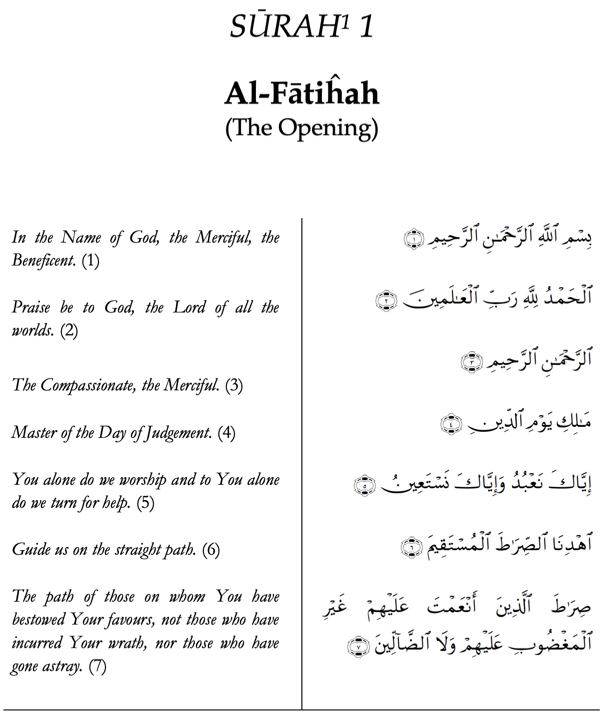
慈悲深く、慈愛あまねき神の御名において。(1)
In the Name of God, the Merciful, the Beneficent. (1)
全世界の主である神に讃えあれ。(2)
Praise be to God, the Lord of all the worlds. (2)
慈悲深く、慈愛あまねき御方の御名において。(3) 審判の日の主権者。(4)
The Compassionate, the Merciful. (3) Master of the Day of Judgement. (4)
あなたのみを私たちは崇拝し、あなたのみに私たちは助けを求めます。(5)
You alone do we worship and to You alone do we turn for help. (5)
わたしたちを真っ直ぐな道へ導いてください。(6)
Guide us on the straight path. (6)
あなたが恩恵をお与えになった者たちの道、怒りを受けた者たちの道でも、迷い去った者たちの道でもない。(7)
The path of those on whom You have bestowed Your favours, not those who have incurred Your wrath, nor those who have gone astray. (7)
概要
Overview
スーラとは、クルアーンの単位の名称である。最も近い英語は「chapter(章)」であるが、アラビア語で「スーラ」はクルアーンの単位にのみ用いられるため、英語でもそのまま「sūrah」として残されている。クルアーンには、長さの異なる114のスーラがある。
1 Sūrah is the name of a unit of the Qur’ān. The nearest English word is ‘chapter’, but since sūrah’ is used in Arabic to denote only units of the Qur’ān, it has been retained in English. The Qur’ān has 114 sūrahs of varying length.
このスーラは七節からなる短い章で、すべてのムスリムが一日に少なくとも十七回は唱えています。預言者ムハンマド(ﷺ)の真正なハディースには、「アル=ファーティハを読まない者の礼拝は無効である」とあります。この短い章には、イスラームの中心的な基本概念、信仰、そして教義の多くが含まれています。また、イスラームの本質的な認識や態度の多くを示しています。これらのことから、なぜこの章が頻繁な朗誦のために選ばれ、礼拝の有効性にとって不可欠なのかが明らかになります。
Every Muslim recites this short sūrah of seven verses at least seventeen times a day. An authentic ĥadīth of the Prophet Muĥammad (peace be upon him), says: “A prayer by one who does not read the Fātiĥah is invalid.” This short sūrah contains a great deal of the central basic ideas of Islam, its beliefs and concepts. It outlines many of its essential perceptions and attitudes. All this makes it clear why it is chosen for frequent recitation and why it is essential for the validity of prayer.
その章は次の句で始まります。
The sūrah opens with the phrase:
慈悲深く、慈愛あまねき神の御名において。(第1節)
In the name of God, the Compassionate, the Merciful. (Verse 1)
これは、学者の大多数が、この章(スーラ)の独立した一節であり、その節数を七つに完成させるものだと認めている。しかし、コーランの他のすべての章のうち、同じ語句で始まる章についても同じかどうかについては意見の相違がある。「我は汝に七つの繰り返し唱えられる節と、この偉大なコーランを与えた」(15:87)というコーランの言葉が指しているのは、ファーティハであると主張する学者もいる。
This is recognized by the majority of scholars as a verse of the sūrah, in its own right, completing its verses into seven. There is, however, a difference of opinion over whether this is so with respect to all other sūrahs of the Qur’ān in which the same words appear as the opening phrase. Some scholars maintain that it is to the Fātiĥah that the following Qur’ānic statement refers: “We have given you seven oft- repeated verses and this sublime Qur’ān.” (15: 87)
イスラームの聖典『クルアーン』のうち、預言者ムハンマドﷺに最初に啓示された節は、「読め、あなたの主の御名において……」(96:1)で始まり、あらゆる行為を始めるに当たって神の御名を唱えるというイスラームの作法を確立しています。これはまた、神は「最初の者であり、最後の者であり、顕れた者であり、隠れた者である」(57:3)という、イスラームの根本原理にも合致しています。実に神こそが真の存在であり、万物の源であり、存在する全てのものの存在理由なのです。したがって、あらゆる動きと行為は神の御名においてなされ、全てのものは神の御名において始まるのです。
The very first verses of the Qur’ān revealed to Prophet Muĥammad, which begin with: “Read in the name of your Lord...” (96: 1) establish the Islamic etiquette of invoking the name of God at the beginning of every action. This is also in line with the fundamental Islamic principle that God is “the first and the last, the outward and the inward.” (57: 3) He is indeed the real being, the origin and the raison d’être of all that exists. In His name, therefore, every movement and action is made, and in His name everything begins.